The Druid Deep Dive, Episode 18: The Great Debasement: when the Crown taxed the coin itself (1544-1551)
Henry VIII took 83 percent of the silver out of the penny and booked about £1.27 million. In 1551 his son's council halved the shilling by decree. Episode 18 traces who paid, twice, and reads the Fed's balance sheet and the debasement trade against it.
The Druid Deep Dive, episode 18. Ancient wisdom for modern DeFi. Historical period: England, 1542 to 1561.
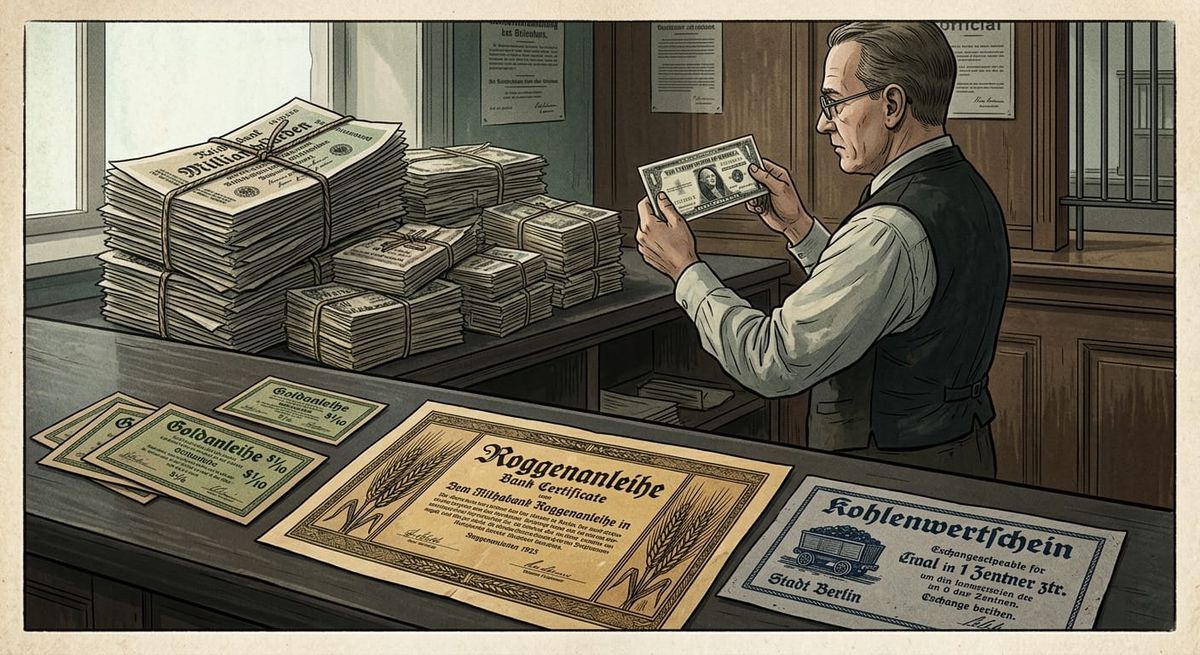
Between 1542 and 1551 the English Crown took most of the silver out of its coins and kept calling them by the same names. The fine silver in a penny fell from 0.639 grams to 0.108 grams, a cut of 83 percent [1]. The operation ran for nine years, the first two of them without anyone outside the Mint being told [2], and it netted the Treasury about £1.27 million [2][3], roughly a quarter of what the Crown took in over those years [4]. Then, in the summer of 1551, the same Crown announced that the shilling it had issued at twelve pence was now worth nine, and a few weeks later six [5]. Whoever held the coin that day took the loss. The two hyperinflation episodes of this series, Brazil and Weimar, were about units of account that died. This one is about a unit that was quietly shaved, and about who paid for the shaving, both when it happened and when it was reversed.
The previous episode, Episode 17, Railroad bond mania: the track was real, the traffic was not (1868-1879), covered a bond market that collapsed after its track was laid.
 Sagix
A debasement that started in secret
Henry VIII entered the 1540s at war with France and Scotland and short of money, and the Mint was the instrument he reached for. Munro classes the policy as an aggressive fiscal debasement, undertaken to pay for the wars rather than to defend the coinage against foreign competition, which had been the medieval excuse [1]. Christopher Challis, whose reconstruction of the Tudor mint accounts remains the foundation of the subject, dates the first steps to 1542 and notes that the first two years were experimental and concealed, with open debasement beginning in 1544 [2]. The mint indenture of 16 May 1542 authorised a new coin, the testoon or shilling, at 9 ounces 5 pennyweight of silver in the pound against the sterling standard of 11 ounces 2 pennyweight [1].
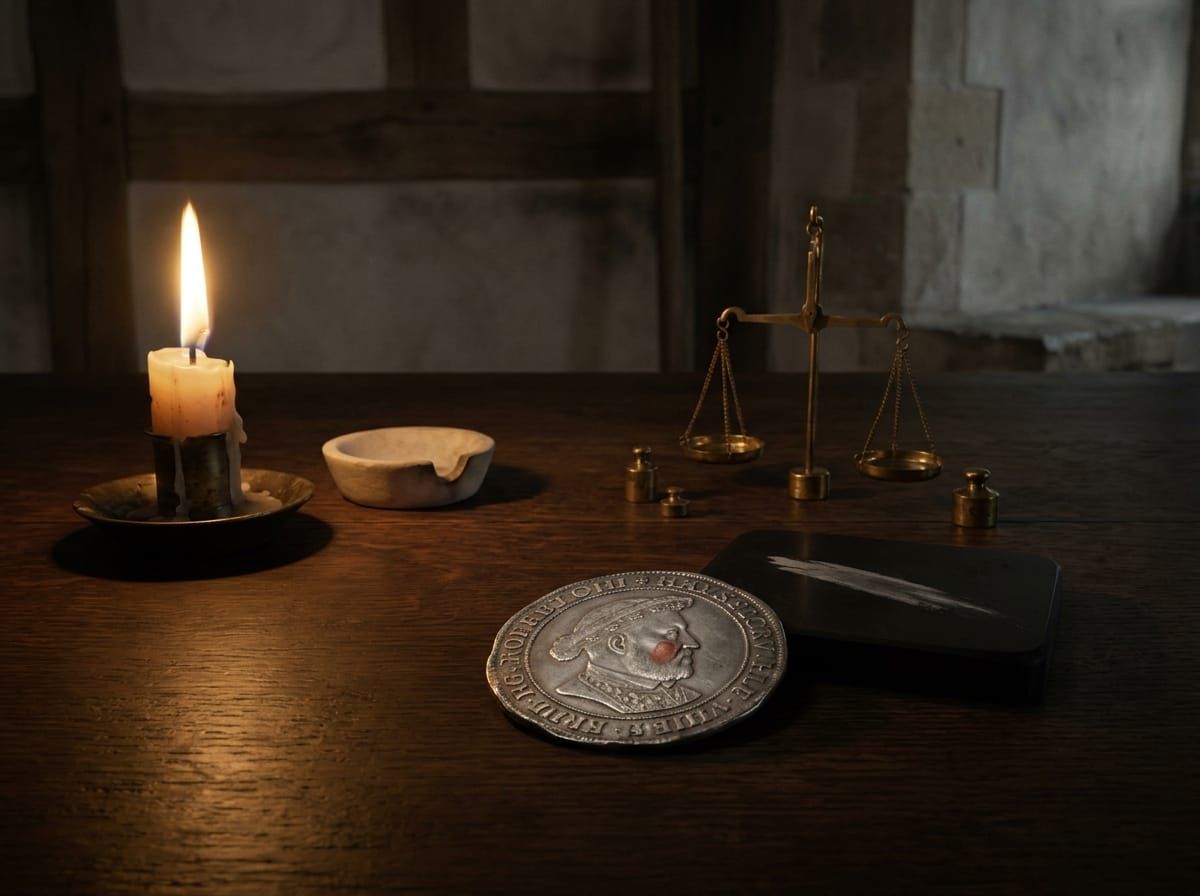
The method was mechanical. Sterling is 925 parts silver in a thousand. The testoons came out at 9 ounces fine, then 6, then 4 [2]. Under the boy king Edward VI the shilling was struck at 8 ounces in January 1549, 6 ounces in April 1549, and 3 ounces by early 1551, a quarter silver and three quarters alloy, while the base groats and pennies ran at a nominal 4 ounces [6]. The worst silver issue, the 3-ounce coin of 1551, was rated at 72 shillings to the pound weight [2]. Gold was debased too, but less, because dealers assayed gold and the fraud could not be hidden for long; silver was harder to test and the war's appetite for ready coin kept the base issues flowing [2]. By the end, the pound sterling contained 73 percent of its pre-debasement gold and no more than 17 percent of its silver [2]. On the testoons the silver wash wore off the king's nose first, and the red copper beneath earned Henry the name Old Coppernose [7].
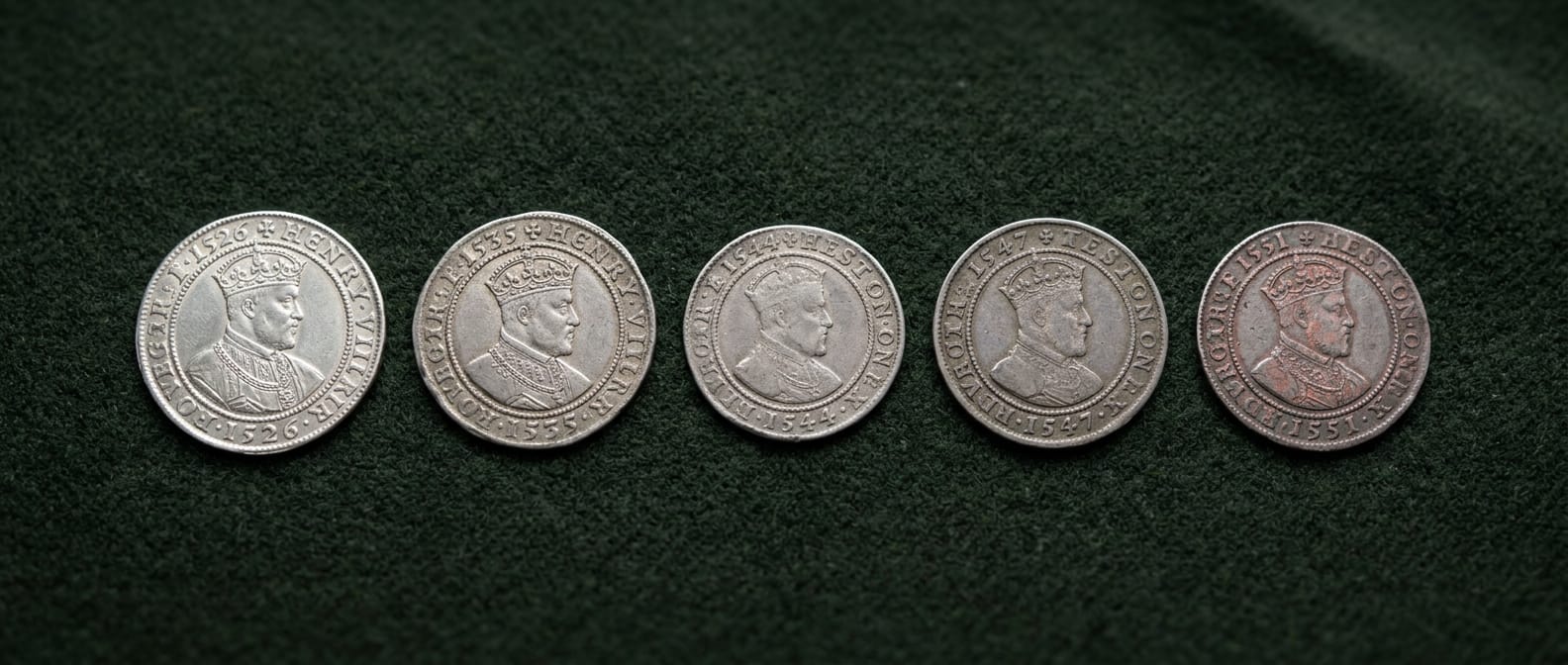
The scale was unlike anything the English mints had done. Between 1544 and 1551 they struck £4,038,667 of coin, £2.72 million of it silver, an annual average roughly fourteen times the level of 1485 to 1526 [2]. The Tower mint was joined by seven new mints created for the purpose [2]. Challis puts the net profit to the Crown at about £1.27 million [2][3]. Rolnick, Velde and Weber, writing for the Federal Reserve Bank of Minneapolis, estimate that the Crown raised about a quarter of its revenues through the mint during these years [4]. It was a tax, levied on everyone who held silver coin, enacted by indenture rather than by statute.
The mint that paid you to be taxed
The strange part is that the silver came willingly. A debasement needs bullion, and the Crown got it by raising its bid: the mint price of silver reached £6 per pound in 1551, 152 percent above its pre-debasement level [2]. A merchant who brought a pound of silver to the Mint walked out with far more coin by face value than he would have a decade earlier, and he could spend it at face value before the market worked out what it was made of. When the supply of new silver slowed, the Crown demonetised the testoons of 1542 to 1544 in 1548 so that the old base coin would come back to be recoined at the new, lower standard [2][3].
Rolnick, Velde and Weber call the result the debasement puzzle. If coins traded by their metal content, a debasement would give no extra reason to bring silver to the mint, yet across medieval France and Tudor England debasements drew in unusual volumes of bullion and unusual seigniorage, and minting activity rose by a factor of 2.8 during the Great Debasement [4]. They reject three explanations in turn: that coin passed simply by tale, at face value, because much coin demonstrably passed by weight; that prices lagged, because in their reading prices adjusted within weeks; and that debtors wanted cheap money, because debtors could have contracted around the sovereign without using the mint [4]. Munro disagrees on the first point. Counting is cheaper than weighing, he argues, so coin circulated by tale and carried a premium over bullion, and he finds the Minneapolis authors' price evidence for England thin [1]. The disagreement is not academic. If coin passed by tale, then whoever controlled the tale could tax every holder by changing what it was worth, which is what happened in 1551.
Contemporaries knew something was wrong before they knew what. On 8 March 1549, preaching the first of his Lenten sermons before Edward VI, Hugh Latimer held up the only shilling in his purse. "We have now a pretty little shilling indeed," he told the court, and added that the fineness of the silver was something he could not see [8].
What prices did, and did not do
The legend says the debasement caused the Tudor price revolution. The data say it caused a sharp inflation that was never proportional to the metal removed. The Bank of England's long price series puts the English consumer price index at 0.20 in 1541 and 0.35 in 1551, on a 2015 base of 100, a rise of roughly 75 percent across the debasement years, against the 83 percent cut in the penny's silver [9]. Munro runs the same comparison on the Phelps Brown and Hopkins index: from 1541 to 1556 the index rose 123 percent, where a response proportional to the debasement would have implied about 492 percent [1][10]. Over the whole century prices rose about sixfold and wages about half that [2], and most of that rise came after the coin was restored.
The sharpest contemporary analysis changed its own mind. The Discourse of the Commonweal, a dialogue among a Doctor, a Knight, a Merchant, a Husbandman and a Capper, was written in late summer 1549 and is now attributed to Sir Thomas Smith. The Doctor traces the dearth to the debasement practised by the government since 1544. When Smith revised his papers in 1576, after the recoinage had removed the base coin and prices had kept rising, he added a section blaming the flood of New World bullion for increasing the money in circulation and lowering its value, which Mary Dewar counts as the first English statement of a quantity theory of money [11]. The same author gave two explanations fifteen years apart, and both were partly right.
The trade story has also been revised. Gould's 1970 study argued that the debased pound fell at Antwerp, made English cloth cheap abroad, and produced an export boom that broke when the coin was cried down in 1551 [12]. A paper published in the Economic History Review in January 2026 tests that claim against the purchase prices in Gresham's daybook and the Johnson letters and finds that the price of English wool and cloth rose at about the same rate as sterling depreciated, so the two effects largely cancelled and foreign demand did the work [13]. What is not in dispute is the direction of the good coin: full-weight sterling and gold were hoarded or exported while the base coin circulated, the mechanism episode 4 examined under Gresham's name.
 Sagix
 Sagix
1551: the Crown cries down its own coin
By 1551 the base coin was doing to prices what the council could no longer ignore, and the council's remedy was to make the holders pay a second time. A proclamation of 30 April 1551 announced that from 31 August the shilling would pass at ninepence and the groat at threepence [5]. On 11 May a second proclamation paired the "amendment of his highnes coyne" with an attack on engrossers of farms and victuals and the raisers of prices, as though the one had caused the other [14]. In June a further proclamation shortened the day limited in the first [15]. A writ dated Westminster, 7 July 1551, and countersigned by seven privy councillors including John Dudley, Earl of Warwick, went to the sheriffs under seal, with orders not to break the seal before a stated day and not to disclose its tenor on pain of "uttermost perill"; the councillors expected unrest and gave the counties time to prepare for it [16]. Then, about a month after the ninepence rate took effect, a further proclamation took the shilling to sixpence and the smaller coins down in proportion [6][17]. In Challis's summary, the 1551 devaluation halved the face value of the silver coinage [2]. The loss fell on whoever was holding it.

Fine coin followed. A commission of 1 October 1551 authorised crowns, half-crowns, shillings and sixpences at 11 ounces 1 pennyweight, a pennyweight short of sterling, while pence and halfpence stayed at the old base standard [6]. The mints then went quiet: £316,701 was struck between 1551 and 1560, after £4 million in the seven years before [2]. Challis is careful to separate the two acts. The debasement was a fraud for fiscal purposes, carried out through the metal; the crying-down was a devaluation by decree, and the second was the price of the first [2].
1560: the restoration had a price too
Elizabeth made the coin a first priority. On the eve of Michaelmas 1560, before noon, a proclamation announced the terms. The best testoons, marked with a portcullis, would pass at fourpence halfpenny; the second sort, marked with a greyhound, at twopence farthing; the third and worst sort, unmarked, would no longer pass at any value; the groat was made current at twopence and the twopenny piece at a penny [17]. The marks were struck in public with stamping irons sent to the mayors of towns [18]. A shilling issued at twelve pence had been cried down to six and now, at its lowest, traded at two and a quarter [18]. The queen visited the Mint in the Tower on 10 July 1561, and the recoinage was later counted among the achievements of her reign [19]. The 1560 standard set a pound of silver coin at 60 shillings face value, containing 55 shillings 6 pence of pure silver, with a manufacturing charge of 1 shilling 6 pence [2].
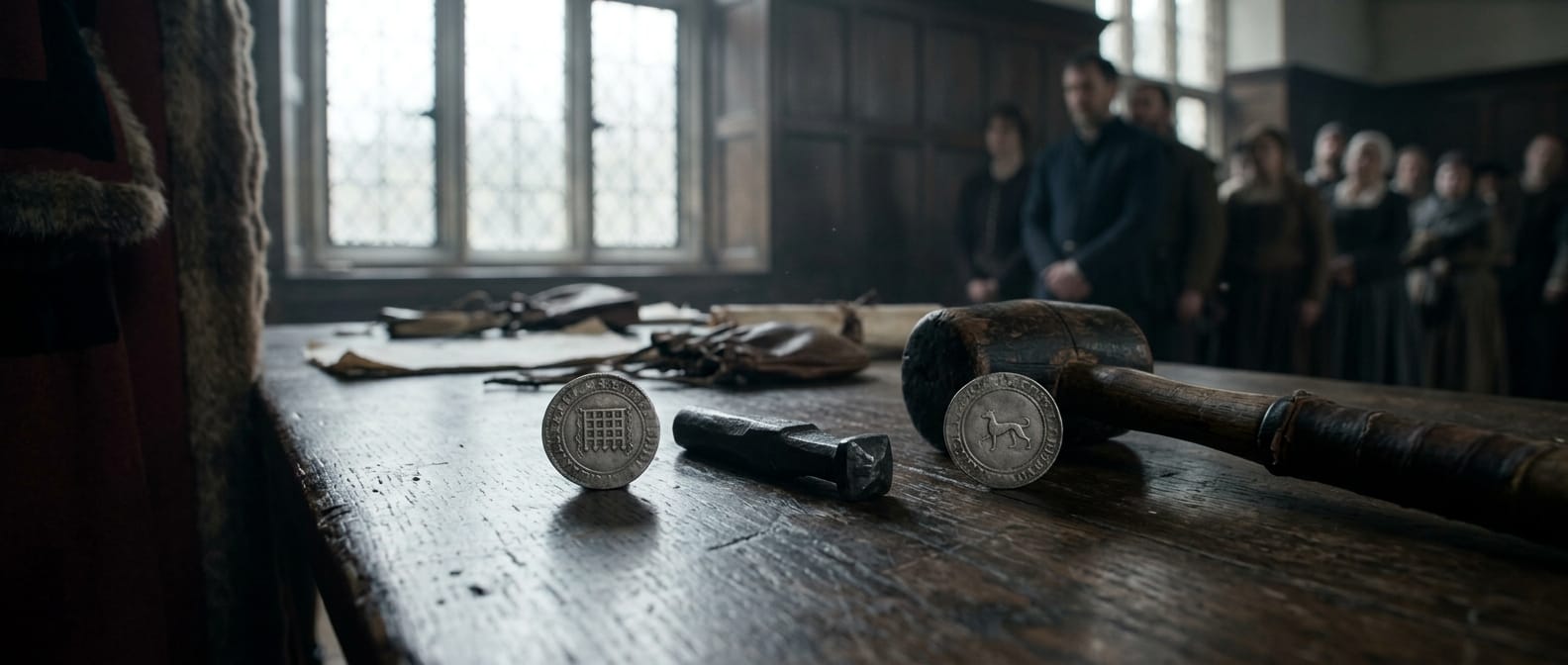
Read the two decrees together. In 1551 the Crown set the rate at which its base coin would pass; in 1560 the Crown set the rate at which it would take that coin back. Both were prices fixed by the issuer, after the fact, for a unit the public had accepted at face value. Restoration was a relief. It was not a refund.
The modern mirror: a balance sheet instead of a mint
The structure survives the technology. An issuer changes the quantity behind the unit, the face value is unchanged, the gain accrues to the issuer, and the holders learn the terms afterwards. The modern instrument is the central bank balance sheet rather than the mint price of silver.
On 23 March 2020 the Federal Reserve said it would buy Treasury and agency mortgage securities "in the amounts needed to support smooth market functioning" [20]. The Fed's total assets rose from $4.16 trillion on 26 February 2020 to $8.97 trillion on 13 April 2022 [21]. M2 growth peaked at 26.9 percent year over year in February 2021 [22]. The consumer price index rose 13.8 percent between February 2020 and June 2022, and the twelve-month rate at the June 2022 peak was about 9 percent [23]. The attribution is as contested as it was in 1549. Bernanke and Blanchard attribute most of the surge to shocks to prices given wages, energy, food and sectoral shortages, with labour-market tightness a minority share, and their decomposition does not use money aggregates at all [24]. Neely, at the St. Louis Fed, reads the eighteen months from the M2 peak to the inflation peak as consistent with a lagged monetary effect, while conceding the Ukraine shock and that monetarists cannot agree which aggregate matters [22]. The Doctor of 1549 and the reviser of 1576 would each find a side to join.
Where the balance sheet stands now is public, weekly. Total assets were $6.75 trillion on 4 November 2026 [21], and the minutes of the Federal Open Market Committee meeting of 15 and 16 September 2026 record a quarter-point increase in the target range to 3.75 to 4 percent, total PCE inflation estimated at 3.8 percent over the twelve months to August, and a pause in the reserve management purchases of Treasury bills that had resumed modest balance sheet growth [25]. On 28 October 2026 the Committee held the range, with two members preferring another quarter-point increase [26]. None of this is hidden. The 1542 indenture was.
Around that balance sheet sits a narrative, and the narrative has a name on the sell side. JPMorgan's strategists, in a note reported on 28 May 2026, called bitcoin the main manifestation of the "debasement trade" since the start of the Iran conflict and reported money leaving both bitcoin and gold exchange-traded funds as inflation fears cooled [27]. The pamphlet test applies: JPMorgan trades, finances and custodies both assets, and a bank note declaring a trade in or out of favour is a market call, not a measurement. The measurement comes from the New York Fed. Benigno and Rosa, in an intraday event study of ten categories of macroeconomic news, find that bitcoin is largely unresponsive to macro announcements, including inflation releases and monetary policy surprises, while gold, the euro-dollar rate and the S&P 500 respond to most of them [28]. A fixed supply is a property of an asset. It is not an observed response to the thing the asset is said to hedge.
The anchor document is Executive Order 14233 of 6 March 2025, published in the Federal Register on 11 March at 90 FR 11789. Its background section states that bitcoin's protocol caps supply at 21 million coins, that this scarcity has earned it the label "digital gold", and that a nation establishing a reserve early gains a strategic advantage; section 3 creates a Strategic Bitcoin Reserve from forfeited coin, bars its sale, and directs the Treasury and Commerce secretaries to develop budget-neutral strategies to acquire more [29]. The state that runs the issuer of the reserve currency has, by its own instrument, established a reserve in the fixed-supply asset. The sequence from 1551 to 1560 is there for the reader to lay alongside it: the sovereign that debased the coin became, in the end, the buyer of the fine one.
Portfolio lessons
The first lesson is about what a unit of account is. To hold the unit is to hold the issuer's fiscal need. In 1551 the loss fell by decree on whoever held base coin on the day; holders of gold coin kept 73 percent of their metal [2], and holders of land, goods or foreign coin were outside the decree altogether. The concentration risk is in the unit, not only in the asset, and the answer is the one this series keeps returning to: diversification across asset classes, geographies and time horizons, with no single issuer able to reprice the whole portfolio in an afternoon. The South Sea episode made the same point about the state as counterparty; here the state is the counterparty to every transaction in its coin.
The second is to read the mint price, not the proclamation. The Crown's bid for silver had risen 152 percent before any decree admitted what the policy was [2], and the indenture of 1542 was the whole plan, two years before the public issue. The modern equivalents are published: the H.4.1 release every Thursday, the FOMC minutes three weeks after each meeting, the Treasury's issuance mix. The narrative, debasement trade or otherwise, is a story told about those documents by people who sell exposure to it. The documents are checkable and the story is not.
The third is that a hedge is a measured response, not a property. The Tudor hedge that worked was the metal that could be assayed. The modern asset most often sold as the hedge shows no measurable response to the macro news it is supposed to hedge, in the only intraday study a central bank has published [28], and the same sell-side desks that named the trade reported its unwinding within months [27]. Hold a fixed-supply asset for what it is, a bet on adoption with a drawdown profile that has repeatedly exceeded a third, and size it so that a drawdown of that order is survivable. Catastrophic risk management is the framework; a halving by decree in a single summer is the historical calibration.
 Sagix

The fourth is that restorations are also decrees. The 1560 proclamation fixed its own rates, voided the unmarked coin outright, and was followed by a decade in which the mints struck less in nine years than they had in one [2]. Survival over optimization and zero leverage follow directly. A borrower in base coin in April 1551 owed the same shillings in August, and each shilling was worth half as much to the lender and had to be found all the same. The terms of a loan are written in a unit, and in 1551 the unit changed twice between spring and autumn.
The fifth is about time. Prices rose 75 percent across the debasement years, then kept rising for a decade after the metal was restored, and the worst years in the Bank of England series, 1556 and 1557, came five years after the last base issue [9]. The debasement's inflation did not arrive on the debasement's schedule, and the restoration's did not stop on the restoration's. A portfolio built to survive a monetary episode has to be built for the aftermath, which in this case lasted longer than the episode.
Educational purpose only: This content is provided exclusively for educational and historical research purposes. It should not be construed as investment advice, financial planning guidance, policy recommendations, or official economic analysis. Any contemporary parallels or policy discussions are presented as academic analysis, not recommendations for action. Historical patterns provide context for learning but do not predict future financial system outcomes or investment performance.
AI-assisted research disclosure: This historical analysis was researched and written with substantial assistance from artificial intelligence technology (Claude, Anthropic). While extensive efforts were made to verify all statistical claims, citations, and institutional analysis against authoritative sources, readers should independently verify any information before relying on it for academic, professional, investment, or policy purposes.
Accuracy and liability limitations: While extensive effort has been made to ensure historical accuracy through authoritative sources, the authors make no warranties about completeness, accuracy, or currency of information. Historical interpretation involves scholarly judgment and academic debate. Economic data may contain revisions, measurement inconsistencies, or reporting variations across time periods and institutional sources. The authors and publisher assume no responsibility for errors, omissions, or consequences arising from the use of this information, including any errors resulting from AI assistance. Users assume full responsibility for decisions or actions taken based on this content.
Investment risk warning: Historical financial analysis does not constitute investment advice or recommendations. Past performance, whether historical or hypothetical, does not guarantee future results. All investments carry risk of loss. Readers should conduct their own research and consult qualified financial advisors before making investment decisions.
No professional relationship: This content does not create any professional, advisory, fiduciary, or client relationship between the reader and The Genesis Address Publishing LLC, its authors, or affiliated entities. Readers seeking financial, investment, legal, regulatory, or policy guidance should consult qualified professionals licensed in their jurisdiction.
Methodological note: This analysis synthesizes findings from central bank research departments, National Bureau of Economic Research publications, peer-reviewed academic journals, and authoritative government historical records. The numbered citation system allows readers to verify specific claims against original sources rather than relying on secondary interpretations.
References to modern financial systems, cryptocurrency protocols, or DeFi mechanisms are made for educational comparison purposes only. These comparisons do not constitute endorsements, recommendations, or predictions about the performance or suitability of any current financial products or services.
Analysis of international monetary systems and policies is presented for historical educational purposes. Different jurisdictions have varying regulatory frameworks, and this content should not be interpreted as applicable to any specific jurisdiction's current legal or regulatory environment.
Publication information: Last updated: November 10, 2026 | Series: The Druid Deep Dive | Publisher: The Genesis Address Publishing LLC
Sources and references
[1] Munro, John H. "The Coinages and Monetary Policies of Henry VIII (r. 1509-1547): Contrasts between Defensive and Aggressive Debasements." University of Toronto, Department of Economics, Working Paper 417 (November 2010). https://www.economics.utoronto.ca/public/workingPapers/tecipa-417.pdf
[2] Challis, C. E. Currency and the Economy in Tudor and Early Stuart England. New Appreciations in History 4. London: Historical Association, 1989. https://www.history.org.uk/files/download/13497/1391622757/Currency_and_the_Economy_in_Tudor_and_Early_Stuart_England.pdf
[3] Glassman, Debra, and Angela Redish. "Currency Depreciation in Early Modern England and France." Paper presented at the Conference on Monetary and Financial History, Federal Reserve Bank of Minneapolis, October 1985. Citing Challis, C. E. The Tudor Coinage. Manchester: Manchester University Press, 1978, p. 255. https://www.minneapolisfed.org/economic-research/conferences/~/media/files/research/events/1985_10-24/Redish_CurrencyDepreciation.pdf
[4] Rolnick, Arthur J., François R. Velde, and Warren E. Weber. "The Debasement Puzzle: An Essay on Medieval Monetary History." Federal Reserve Bank of Minneapolis Quarterly Review 21, no. 4 (Fall 1997): 8-20. Reprinted from Journal of Economic History 56, no. 4 (December 1996): 789-808. https://www.minneapolisfed.org/research/qr/qr2142.pdf
[5] England and Wales, Sovereign (Edward VI). "A proclamation set furthe by the Kynges Maiesty ... for the valuacion of the shillinges and grotes to a meaner and lower value and rate." London, 30 April 1551. STC 7836. Oxford Text Archive A21527, EEBO-TCP. Rates and effective date as recorded in the Oxford Text Archive catalogue note to STC 7837. http://hdl.handle.net/20.500.12024/A21527
[6] Morrieson, H. W. "The Silver Coins of Edward VI." British Numismatic Journal 12 (1916): 137-166. https://www.britnumsoc.org/publications/Digital BNJ/pdfs/1916_BNJ_12_7.pdf
[7] The Royal Mint. "Henry VIII: behind the design." Lifestyle, British monarchs, House of Tudor. https://lifestyle.royalmint.com/british-monarchs/house-of-tudor/henry-viii-behind-the-design
[8] Latimer, Hugh. "The First Sermon Preached Before King Edward, March 8, 1549." In Sermons by Hugh Latimer. Christian Classics Ethereal Library. https://ccel.org/ccel/latimer/sermons.vii.i.html
[9] Bank of England. "A Millennium of Macroeconomic Data for the UK," consumer price index series, retrieved as Federal Reserve Bank of St. Louis FRED series CPIUKA (annual, 2015 = 100). https://fred.stlouisfed.org/series/CPIUKA
[10] Phelps Brown, E. H., and Sheila V. Hopkins. "Seven Centuries of the Prices of Consumables, Compared with Builders' Wage-rates." Economica 23, no. 92 (November 1956): 296-314. As computed in Munro [1], p. 13. https://www.jstor.org/stable/2551456
[11] Gonville and Caius College Library, University of Cambridge. "Commons and commonwealth." Featured books, on A Compendious or Briefe Examination of Certayne Ordinary Complaints (London: Thomas Marsh, 1581), the printed text of A Discourse of the Commonweal of this Realm of England, with Mary Dewar's attribution and dating. https://cai.cam.ac.uk/library/featured-books/commons-and-commonweal
[12] Gould, J. D. The Great Debasement: Currency and the Economy in Mid-Tudor England. Oxford: Clarendon Press, 1970. Reviewed by R. B. Outhwaite, The Historical Journal 14, no. 2 (June 1971): 440-441. https://doi.org/10.1017/S0018246X00009717
[13] Li, L.-F. "The Great Debasement and English Overseas Trade: Gresham and Johnson in Context." The Economic History Review, published online 29 January 2026. https://doi.org/10.1111/ehr.70099
[14] England and Wales, Sovereign (Edward VI). "A proclamation ... declaring his graces determinacion, concerning the amendement of his highnes coyne, and also to admonish such of his subiectes, as be engrossers of fermes, victualles and other thinges." London, 11 May 1551. STC 7837. Oxford Text Archive B12633, EEBO-TCP. http://hdl.handle.net/20.500.12024/B12633
[15] England and Wales, Sovereign (Edward VI). "A proclamacion ... for the shortening of a day limited in another proclamation, concerning the abacing of the value of shilinges and grotes." Greenwich, June 1551. STC 7840. Oxford Text Archive A21531, EEBO-TCP. http://hdl.handle.net/20.500.12024/A21531
[16] Bonhams. "Edward VI: Document bearing the King's stamped signature, Westminster, 7 July [1551]." Lot 52, Fine Books, Manuscripts and Historical Documents, Knightsbridge, 15 September 2021. https://www.bonhams.com/auction/26774/lot/52/
[17] Holinshed, Raphael, et al. The Chronicles of England, Scotland and Ireland (1587 edition), on the proclamation of Michaelmas Eve 1560 and the earlier fall of the teston to sixpence. The Holinshed Project, University of Oxford. https://english.nsms.ox.ac.uk/Holinshed/texts_old_2009-09-17/1587/1587_8813.html
[18] University of Cambridge. "Naughty money: clippers and coiners in 16th-century England." Research features, 12 April 2014, on the doctoral research of Jennifer Bishop. https://www.cam.ac.uk/research/features/naughty-money-clippers-and-coiners-in-16th-century-england
[19] Royal Mint Museum. "Elizabethan recoinage medal." Collection, medals. https://www.royalmintmuseum.org.uk/collection/medals/elizabethan-recoinage-medal/
[20] Board of Governors of the Federal Reserve System. "Federal Reserve announces extensive new measures to support the economy." Press release, 23 March 2020. https://www.federalreserve.gov/newsevents/pressreleases/monetary20200323b.htm
[21] Board of Governors of the Federal Reserve System. "Assets: Total Assets: Total Assets (Less Eliminations from Consolidation): Wednesday Level." H.4.1 Factors Affecting Reserve Balances, retrieved as FRED series WALCL, observations of 26 February 2020, 13 April 2022 and 4 November 2026. https://fred.stlouisfed.org/series/WALCL
[22] Neely, Christopher J. "The Rise and Fall of M2." Federal Reserve Bank of St. Louis, On the Economy, 23 May 2023. https://www.stlouisfed.org/on-the-economy/2023/may/the-rise-and-fall-of-m2
[23] U.S. Bureau of Labor Statistics. "Consumer Price Index for All Urban Consumers: All Items in U.S. City Average," seasonally adjusted, retrieved as FRED series CPIAUCSL, observations of February 2020 (259.250), June 2021 (270.654) and June 2022 (294.957). https://fred.stlouisfed.org/series/CPIAUCSL
[24] Bernanke, Ben S., and Olivier J. Blanchard. "What Caused the U.S. Pandemic-Era Inflation?" NBER Working Paper 31417 (June 2023). https://www.nber.org/papers/w31417
[25] Federal Open Market Committee. "Minutes of the Federal Open Market Committee, September 15-16, 2026." Board of Governors of the Federal Reserve System. https://www.federalreserve.gov/monetarypolicy/fomcminutes20260916.htm
[26] Board of Governors of the Federal Reserve System. "Federal Reserve issues FOMC statement." Press release, 28 October 2026. https://www.federalreserve.gov/newsevents/pressreleases/monetary20261028a.htm
[27] Braun, Helene, and Will Canny. "'Debasement Trade' Falls Out of Favor as Inflation Fears Cool, JPMorgan Says." CoinDesk, 28 May 2026. https://www.coindesk.com/markets/2026/05/28/investors-are-throwing-in-the-towel-on-the-debasement-trade-as-inflation-fears-start-to-cool-jpmorgan-says
[28] Benigno, Gianluca, and Carlo Rosa. "Is There a Bitcoin-Macro Disconnect?" Federal Reserve Bank of New York, Liberty Street Economics, 8 February 2023, summarising Staff Report 1052. https://libertystreeteconomics.newyorkfed.org/2023/02/is-there-a-bitcoin-macro-disconnect/
[29] Executive Office of the President. "Executive Order 14233: Establishment of the Strategic Bitcoin Reserve and United States Digital Asset Stockpile." 6 March 2025. Federal Register 90, no. 46 (11 March 2025): 11789-11791. https://www.govinfo.gov/content/pkg/FR-2025-03-11/html/2025-03992.htm
Publisher: The Genesis Address Publishing LLC