The Druid Deep Dive, Episode 17: Railroad bond mania: the track was real, the traffic was not (1868-1879)
Between 1868 and 1873 American railroads laid 31,000 miles of track on borrowed money, and 36 percent of the corporate bond market then defaulted. Episode 17 traces who built, who paid and who kept the rails, and reads a Texas bankruptcy docket and this week's AI bond selloff against it.

Between 1868 and 1873 American railroads laid 31,000 miles of track on borrowed money, aBetween 1868 and 1873 American railroads laid 31,000 miles of track on borrowed money, and over the next three years 36 percent of the corporate bond market defaulted. Episode 17 traces who built, who paid and who ended up with the rails, and reads a 2022 Texas bankruptcy docket against it.
nd over the next three years 36 percent of the corporate bond market defaulted. Episode 17 traces who built, who paid and who ended up with the rails, and reads a 2022 Texas bankruptcy docket against it.
The Druid Deep Dive, episode 17. Ancient wisdom for modern DeFi. Historical period: United States, 1868 to 1879.
Episode 16 was about a banking system that held. This one is about a bond market that did not. Between 1868 and 1873 the United States laid more railroad than it had traffic for, paid for it with bonds sold at a discount to households and to Europe, and then watched the roads default in a wave no later crisis has matched. The track stayed. The bondholders did not keep it. The modern document is a first day declaration filed in Houston in December 2022 by a bitcoin miner that had built 814 megawatts of data centers on borrowed money, handed them to its noteholders, and then leased the same buildings to an AI cloud. Episode 7 covered the Argentine version of railway paper. This one is about what a bond on infrastructure is a claim on.
 Sagix

Track laid ahead of the traffic
The numbers first. American railroads added 2,979 miles of line in 1868, 4,615 in 1869, 6,078 in 1870, 7,379 in 1871, 5,870 in 1872 and 4,097 in 1873, a little over 31,000 miles in six years [1]. The whole network in 1860 had been about 30,000 miles [2]. Sprague, writing for the National Monetary Commission in 1910, gave the diagnosis in a paragraph: bonds sold at a heavy discount had built roads in advance of any considerable population, their traffic proved insufficient to meet fixed charges, construction had waited on the slow sale of bonds or on bankers' advances, and after the crisis it stopped and left a large mileage connecting nothing in particular [3].
The money was borrowed, much of it abroad. Around 1870 railroad securities were 69.6 percent of the stocks and 92.6 percent of the bonds listed on American exchanges [4]. Corporate bond issuers in the Commercial and Financial Chronicle rose from 158 in 1866 to 421 in 1872 [2]. Europeans holding cash from the French indemnity to Germany bought American railroad bonds in volume, and the Federal Reserve's history records that new projects had outpaced demand and returns were already declining when the Vienna exchange crashed in May 1873 and again in September and the Europeans began to sell [5, 4].
The legend says mania. Mixon's study of equity, option and bond prices in the run-up finds the three markets priced risk consistently, that option markets grew more worried about large declines before the crash, and that the worry concentrated on the more leveraged roads [6]. They were lending into a structure in which the next mile waited on the next bond sale, and they could see it [3].
The distribution machine
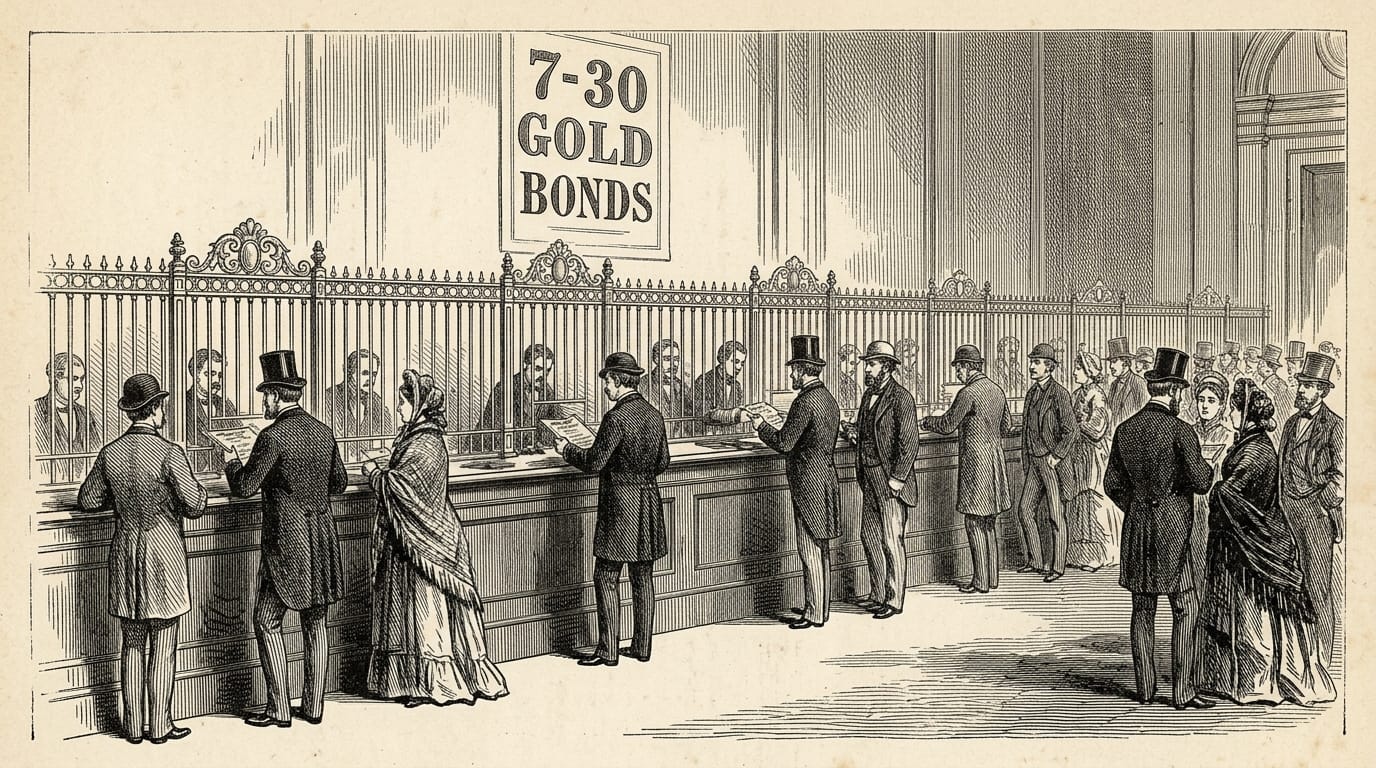
The Northern Pacific was chartered on July 2, 1864, with alternate sections of public land for twenty sections a mile on each side of the line through the territories and ten through the states, 25,600 acres for every mile built in a territory and 12,800 in a state [7]. Nobody would finance the line until Jay Cooke, who had sold the Union's war bonds to ordinary households, took it on. On January 1, 1870, Cooke's house contracted to sell 100 million dollars of Northern Pacific bonds at 7.3 percent and to have 5 million dollars in hand within thirty days [8]; the reported terms gave the house a 12 percent commission and about three fifths of the company's stock [8]. The bonds sold slowly, the company let construction contracts ahead of the sales, and the house covered the gap, more than five million dollars by the same account [8]. A house that distributes a bond and advances against it is a creditor of the road, with depositors of its own.
The second machine ran on the Union Pacific with a Congressman at the controls. The House select committee on the Crédit Mobilier reported in February 1873 that the men who controlled the Union Pacific had contracted with themselves to build the road, at a price high enough to require the issue of bonds to the full extent, and then divided the bonds under the name of profits. The August 1867 contract gave Oakes Ames 667 miles at 42,000 to 96,000 dollars a mile, 47 million dollars, with the profits to flow to the construction company's shareholders [9]. Ames, a member of the House, let colleagues have that stock at par in December 1867, when its holders thought it worth at least double; the January 1868 dividend was 80 percent in Union Pacific bonds and the June dividend 60 percent in cash [9]. His letter to a partner gave the method in seven words: "we want more friends in this Congress" [9]. The committee recommended expulsion; the House censured him instead [10]. The myth outran the ledger here too: Fogel's 1960 reconstruction put the construction company's whole profit at 13 to 15.5 million dollars [10]. Readers of episode 10 will know the shape: sponsor, contractor, price-setter and the legislature's friend in one set of hands.
Ten days with the exchange shut
The failures came in the order of their exposure to railroad paper. On September 13, 1873, Kenyon, Cox and Company fell on 1.5 million dollars of Canada Southern endorsements. On Thursday the 18th, Jay Cooke and Company closed, the Chronicle naming the Philadelphia house's advances to the Northern Pacific and a drain by its depositors; Fisk and Hatch followed on the Friday [3, 5]. On Saturday, September 20, the New York Stock Exchange closed for the first time in its history and stayed shut for ten days [3, 5].
What the banks did next is Sprague's subject. On the day the exchange closed, the New York Clearing House authorized 10 million dollars of loan certificates at 7 percent, exhausted by the Wednesday, then a second 10 million on September 24, when the banks also stamped certified checks "payable through the clearing house", a partial suspension of cash; the certificates peaked at 22,410,000 dollars on October 3, 8.35 percent of the banks' loans [3]. The banks' legal tender reserve fell from 34 million dollars on September 20 to 5.8 million on October 14 [3]. Gold left the Bank of England for New York from September 25, 15 million dollars by the end of October, and by mid-November the banks were back above their legal reserve [3]. The clearing-house machinery of episode 9 worked, without a central bank.
The railroads did not recover with the banks. Giesecke, Longstaff, Schaefer and Strebulaev, who reconstructed every corporate bond listed in the Chronicle from 1866 onward, find a default rate of 14.3 percent of the market's par value in 1873, 16.3 percent in 1874 and 35.90 percent over 1873 to 1875, against 12.88 percent for the worst three years of the 1930s [2]. By a contemporary count relayed in a 2024 working paper, about 25.4 percent of outstanding railroad bonds were in default by 1875, roughly 17.1 percent of those held at home and 64.9 percent of those held abroad [4]; the foreign figure rests on the Bankers' Magazine of May 1876 and is approximate. Construction, 7,379 miles in 1871, fell to 1,711 in 1875 [1]. The NBER dates the contraction from October 1873 to March 1879, 65 months, the longest in its chronology [11].
How many banks failed is disputed. Sprague, counting the national system, found few failures and hardly any with loss to creditors; the Federal Reserve's historians, counting private bankers and brokers as well, put the figure above one hundred [3, 5]. The loss sat in the bonds and the houses that carried them, not in the chartered banks.
 Sagix

What the bondholders got
The Northern Pacific went into receivership under its own president, George W. Cass, with about 600 miles built, and the receivership closed in 1875 on terms that made the first mortgage bonds receivable at par in exchange for land from the grant [7]. The bonds were worth a fraction of face; the land was unsold prairie that settlers could take free from the government next door; the company swapped the one for the other [12, 13]. The National Park Service's documentation records that the first bonanza farm, promoted by the land commissioner James B. Power with Cass and the director Benjamin Cheney west of Fargo, by 1885 had 32,000 acres under cultivation yielding 600,000 bushels of wheat [12, 13]. The farms were advertising for the land grant, and they worked: a Dakota Datebook history drawing on Drache reports that from 1875 to 1878 roughly 70 percent of the railroad's land sales went to its own security holders, and more than a million acres to about forty people [14]. New money came in under Frederick Billings, Villard drove the last spike in 1883, and the road failed again in 1893 [7].
The infrastructure survived every one of its capital structures. The paper did not survive the first. The people who ended up with the land, the track and the eventual returns bought the claim after it had been written down; the households who bought the seven-thirties at issue supplied the write-down. Equity receivership, the court-supervised reorganization railroads improvised because no bankruptcy statute fit them, kept the road running while the securities were restructured, and Swain's 1898 survey of 150 receiverships found insiders appointed as receivers in 138 of them [2]. A judge in the 1884 Wabash case named the alternative: without it the bondholders held "a streak of iron-rust on the prairie" [2].

The modern parallel: a first day declaration in Houston
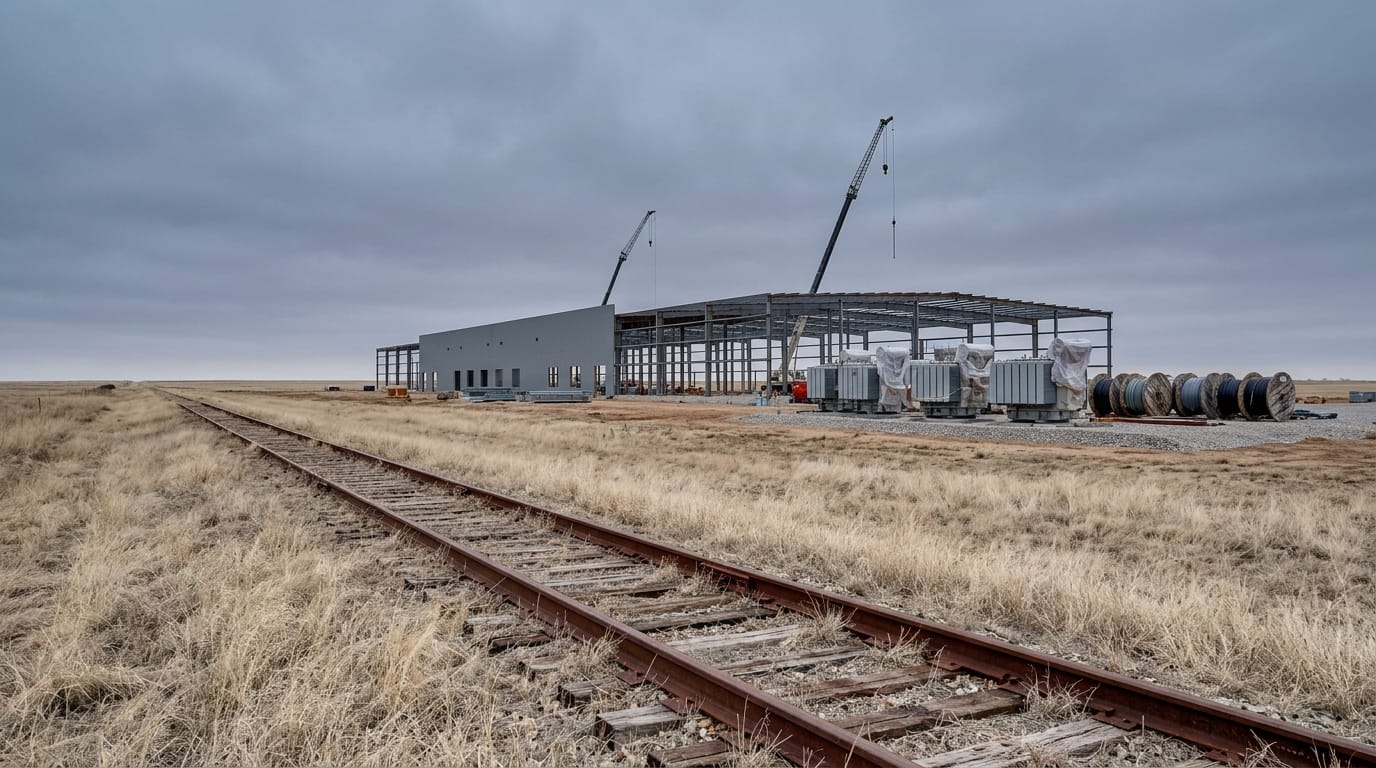
The anchor is Docket No. 5 in Case No. 22-90341, Southern District of Texas, the declaration of Core Scientific's head of capital markets, filed with the chapter 11 petition on December 21, 2022 [15]. The company had 814 megawatts across eight data centers in five states, about 150,000 of its own mining rigs and more than 85,000 hosted for customers [15]. It had financed the build with 215 million dollars of 10 percent secured convertible notes in April 2021 and 299.8 million more in August, about 284 million dollars of equipment financing secured on 91,000 of the rigs, 195 million of net cash from a SPAC merger, and 75 million of unsecured bridge notes [15]. At the petition the convertible notes stood above 550 million dollars of principal, the equipment lenders were owed about 275 million against collateral the company valued at 90 million or less, 70 million of construction invoices were past due, and liquidity was approximately 4 million dollars [15].
The declaration lists the causes: bitcoin down about 65 percent in the year, from 68,789 dollars in November 2021 to about 16,800; power costs of 106 million dollars in the first half of 2022, about 40 percent of cost of revenue; a hosting customer in its own chapter 11 that had stopped paying about 7 million dollars of power charges; and the construction overcommitment [15]. None of the eight data centers had failed. What failed was the calendar on which the debt had to be serviced, set by the 2021 price of the asset the buildings produced. Sprague's roads, whose traffic proved insufficient to meet fixed charges, are the same sentence with new nouns.
The reorganization ran the receivership pattern at speed. The plan went effective on January 23, 2024; the old common stock was cancelled, equipment lender and noteholder debt was converted into equity to remove 400 million dollars of debt, and the company relisted the next day with 724 megawatts in five states [16]. By February 2025 the company had signed twelve-year contracts to host an AI cloud provider's hardware across about 590 megawatts at six sites, with 10.2 billion dollars of projected revenue over their term [17]. In July 2025 the tenant agreed to buy the company for stock; on October 30, 2025, stockholders voted it down [18]. The second quarter 2026 earnings deck records where the track went: over 430 of the 590 megawatts billing by mid-July, the tenant's payments routed into a lockbox tied to 3.3 billion dollars of senior secured notes due 2031 [19]. Same buildings, 2022 to 2026. What changed is who holds the claim on them, twice.
The scale on the other side of the industry sits in a public ledger rather than a docket. L2Beat, a research group whose categories and value-secured metric are its own construction, listed on the day of drafting 22 rollups, 3 validiums and optimiums and 74 other scaling projects on Ethereum, with Base at 15.63 billion dollars and Arbitrum One at 10.51 billion of value secured, ten rollups above 100 million, four below a million, and an archive of 100 discontinued projects [20, 21]. A large mileage connecting nothing in particular. The parallel is drawn by the reader; the text states the structure and stops.
 Sagix

The week the paper repriced the track
The modern bond belongs to the tenant in those buildings. On June 11, 2026, CoreWeave priced 1.25 billion dollars of 9.625 percent senior unsecured notes and 2 billion euros of 8.5 percent notes, both due July 15, 2032, at par [22]. By mid-October the dollar notes traded near 79.5 cents and yielded about 15 percent [23]. On November 6 the yield passed 16 percent, and five-year credit default swaps, by Deutsche Bank's count, topped 1,289 basis points before easing to about 1,155 [24]. The borrower's second-quarter numbers were 35.6 billion dollars of debt principal, 640 million of net interest expense in the quarter, a 626 million net loss and a 104 billion dollar backlog [23, 25]. The structure is the Northern Pacific's: the next megawatt waits on the next bond sale, and the backlog is the land grant, worth what somebody later pays for it.
The hyperscalers pay differently. Alphabet's third-quarter release shows operating cash flow of 42.3 billion dollars against 51.4 billion of capital expenditure, free cash flow of minus 9.1 billion on the company's own definition, with 29.0 billion of debt and 12.4 billion of equity raised in the same quarter [26]. It holds 265 billion in cash and securities [26]. Microsoft doubled cash spent on property and equipment to 39.4 billion dollars in the September quarter, against 58.0 billion of operating cash flow, and guided the December quarter above 50 billion [27, 28]. Neither is Cooke's railroad. Both are now issuers. Goldman's tally of AI-linked debt reached about 500 billion dollars by late September, with hyperscalers at 194 billion against 108 billion of investment-grade issuance in all of 2025 [29], and JPMorgan's Cembalest put the long-duration portion at 68 percent of new long-duration Treasury borrowing this year [30]. The build moved from retained earnings to the bond market in a year.
Then the vote. Democrats took both chambers on November 3, and the governors-elect of Texas, Georgia and Ohio had each campaigned on some form of pause on new data centers [31, 32]; Goldman, in a note reported secondhand, put about 45 percent of planned US capacity in states likely to tighten rules [34]. On Thursday, November 5, the Nasdaq Composite fell 5.5 percent to 24,315 and into correction, the S&P 500 fell 4.4 percent, the Dow 1,833 points, and the Philadelphia semiconductor index 12 percent, its worst day since March 2020 [33, 34]. AMD lost 17.3 percent, Nvidia 9.2, CoreWeave 9.8 [33]; Oracle fell 6.9 percent and printed a 52-week low the next morning [35]. The VIX rose more than 65 percent [34]. Friday took some of it back, the Nasdaq up 1.1 percent and the chip index about 4, and the Nasdaq still closed a fourth straight losing week [36].
The 1873 reading is not that the data centers will fail. Sprague's roads were built and most of them ran. The reading is that a moratorium in Austin is the Vienna exchange: it changes nothing about the track and everything about whether the next bond sells, and construction waited on exactly that [3]. Oracle's five-year CDS went from about 151 to 252 basis points between June and October while its earnings estimates rose [37]. The question for a holder of this paper is the one the bonanza farmers answered: where the claim sits when the traffic is late, and whether you are still solvent when the restructured claim is offered. CoreWeave reports on November 10 and Nvidia on November 17 [25, 35]. These figures will be stale by then. Sprague wrote his in 1910.
 Sagix

Educational purpose only: This content is provided exclusively for educational and historical research purposes. It should not be construed as investment advice, financial planning guidance, policy recommendations, or official economic analysis. Any contemporary parallels or policy discussions are presented as academic analysis, not recommendations for action. Historical patterns provide context for learning but do not predict future financial system outcomes or investment performance.
AI-assisted research disclosure: This historical analysis was researched and written with substantial assistance from artificial intelligence technology (Claude, Anthropic). While extensive efforts were made to verify all statistical claims, citations, and institutional analysis against authoritative sources, readers should independently verify any information before relying on it for academic, professional, investment, or policy purposes.
Accuracy and liability limitations: While extensive effort has been made to ensure historical accuracy through authoritative sources, the authors make no warranties about completeness, accuracy, or currency of information. Historical interpretation involves scholarly judgment and academic debate. Economic data may contain revisions, measurement inconsistencies, or reporting variations across time periods and institutional sources. The authors and publisher assume no responsibility for errors, omissions, or consequences arising from the use of this information, including any errors resulting from AI assistance. Users assume full responsibility for decisions or actions taken based on this content.
Investment risk warning: Historical financial analysis does not constitute investment advice or recommendations. Past performance, whether historical or hypothetical, does not guarantee future results. All investments carry risk of loss. Readers should conduct their own research and consult qualified financial advisors before making investment decisions.
No professional relationship: This content does not create any professional, advisory, fiduciary, or client relationship between the reader and The Genesis Address Publishing LLC, its authors, or affiliated entities. Readers seeking financial, investment, legal, regulatory, or policy guidance should consult qualified professionals licensed in their jurisdiction.
Methodological note: This analysis synthesizes findings from central bank research departments, National Bureau of Economic Research publications, peer-reviewed academic journals, and authoritative government historical records. The numbered citation system allows readers to verify specific claims against original sources rather than relying on secondary interpretations.
References to modern financial systems, cryptocurrency protocols, or DeFi mechanisms are made for educational comparison purposes only. These comparisons do not constitute endorsements, recommendations, or predictions about the performance or suitability of any current financial products or services.
Historical analysis of financial crises is provided for educational understanding of systemic risk patterns. This content does not predict future crises or recommend specific crisis preparation strategies. Readers should consult qualified professionals for personalized risk management advice.
Publication information: Last updated: Nov 8 2026| Series: The Druid Deep Dive | Publisher: The Genesis Address Publishing LLC
Sources and references
[1] National Bureau of Economic Research. "Increases in Railroad Mileage for United States" (series A02082USA374NNBR, annual, 1831 to 1911). NBER Macrohistory Database, retrieved from FRED, Federal Reserve Bank of St. Louis. https://fred.stlouisfed.org/data/A02082USA374NNBR.
[2] Giesecke, Kay, Francis A. Longstaff, Stephen Schaefer, and Ilya Strebulaev. "Corporate Bond Default Risk: A 150-Year Perspective." Working paper, March 2010 version (published in Journal of Financial Economics 102, no. 2 (2011): 233-250). https://www.anderson.ucla.edu/documents/areas/fac/finance/longstaff_corporate3.10.pdf.
[3] Sprague, O. M. W. History of Crises under the National Banking System. National Monetary Commission, Senate Document No. 538, 61st Congress, 2nd Session. Washington: Government Printing Office, 1910. Chapter I, "The crisis of 1873," pp. 1-107. https://fraser.stlouisfed.org/title/633.
[4] Dutta, Harsha. "Unequal Legacies of Financial Crises: Evidence from the Panic of 1873." Working paper, Hong Kong University of Science and Technology, November 16, 2024. https://bmphd.hkust.edu.hk/sites/default/files/2024-12/JMP_Harsha_Dutta.pdf.
[5] Richardson, Gary, and Tim Sablik. "Banking Panics of the Gilded Age, 1863-1913." Federal Reserve History, Federal Reserve Bank of Richmond, December 4, 2015. https://www.federalreservehistory.org/essays/banking-panics-of-the-gilded-age.
[6] Mixon, Scott. "The Crisis of 1873: Perspectives from Multiple Asset Classes." The Journal of Economic History 68, no. 3 (September 2008): 722-757. https://doi.org/10.1017/S0022050708000624.
[7] Fairweather, Hanford W. "The Northern Pacific Railroad and Some of Its History." The Washington Historical Quarterly 10, no. 2 (1919): 95-99, with comment by Hazard Stevens. https://journals.lib.washington.edu/index.php/WHQ/article/view/5960/5034.
[8] Langemo, Cathy A. "Lincoln signed NPRR charter." Dakota Datebook, Prairie Public Broadcasting, May 18, 2022. https://news.prairiepublic.org/show/dakota-datebook-archive/2022-05-18/lincoln-signed-nprr-charter.
[9] U.S. House of Representatives, Select Committee to Investigate the Alleged Credit Mobilier Bribery (Luke P. Poland, chairman). "Credit Mobilier Investigation." House Report No. 77, 42nd Congress, 3rd Session, February 18, 1873. https://li.proquest.com/elhpdf/histcontext/1577-H.rp.77.pdf.
[10] Berman, Milton. "Oakes Ames." EBSCO Research Starters (Salem Press), 2024. https://www.ebsco.com/research-starters/biography/oakes-ames.
[11] National Bureau of Economic Research. "US Business Cycle Expansions and Contractions." Business Cycle Dating Committee. https://www.nber.org/research/data/us-business-cycle-expansions-and-contractions.
[12] McCroskey, Lauren. "Bonanza Farming in North Dakota." National Register of Historic Places Multiple Property Documentation Form, State Historical Society of North Dakota, September 25, 1990. National Park Service. https://npgallery.nps.gov/NRHP/GetAsset/NRHP/64500377_text.
[13] Cameron, Linda A. "Bonanza Farms, Red River Valley." MNopedia, Minnesota Historical Society. https://www.mnhs.org/mnopedia/search/index/bonanza-farms-red-river-valley.
[14] Sandstrom, Tessa. "Jay Cooke and Company and the bonanzas." Dakota Datebook, Prairie Public Broadcasting, May 16, 2022. Cites Hiram M. Drache, The Day of the Bonanza (1964). https://news.prairiepublic.org/show/dakota-datebook-archive/2022-05-16/jay-cooke-and-company-and-the-bonanzas.
[15] Bros, Michael. "Declaration of Michael Bros in Support of the Debtors' Chapter 11 Petitions and First Day Relief." In re Core Scientific, Inc., et al., Case No. 22-90341 (DRJ), U.S. Bankruptcy Court for the Southern District of Texas, Docket No. 5, December 21, 2022. https://cases.stretto.com/public/X217/12024/PLEADINGS/1202412212280000000051.pdf.
[16] Core Scientific, Inc. Form 8-K, event date January 23, 2024, with Exhibit 99.3, "Core Scientific Emerges from Chapter 11 with Strengthened Balance Sheet and Enhanced Competitive Position." U.S. Securities and Exchange Commission. https://www.sec.gov/Archives/edgar/data/1839341/000119312524013078/d661343d8k.htm and https://www.sec.gov/Archives/edgar/data/1839341/000119312524013078/d661343dex993.htm.
[17] Core Scientific, Inc. Form 8-K, Exhibit 99.1, "Core Scientific and CoreWeave Announce $1.2 Billion Expansion at Denton, TX Site," February 26, 2025. U.S. Securities and Exchange Commission. https://www.sec.gov/Archives/edgar/data/1839341/000162828025008312/ex991-coreweavepressrelease.htm.
[18] Core Scientific, Inc. Form 8-K, event date October 30, 2025, "Termination of Material Definitive Agreement," and Form 8-K dated October 31, 2025 reporting the special meeting vote. U.S. Securities and Exchange Commission. https://www.sec.gov/Archives/edgar/data/1839341/000114036125039808/ef20057995_8k.htm and https://www.sec.gov/Archives/edgar/data/1839341/000114036125040020/ef20058085_8k.htm.
[19] Core Scientific, Inc. Form 8-K, July 28, 2026, Exhibit 99.2, "Second Quarter 2026 Earnings Call" presentation. https://investors.corescientific.com/sec-filings/all-sec-filings/content/0001839341-26-000012/q2fy26earningsdeck728am.htm.
[20] L2BEAT. "Layer 2s: Summary." Accessed October 15, 2026. https://l2beat.com/layer2s/summary.
[21] L2BEAT. "Layer 2s: Archived." Accessed October 15, 2026. https://l2beat.com/layer2s/archived.
Publisher: The Genesis Address Publishing LLC
[22] CoreWeave, Inc. "CoreWeave Announces Pricing of $1.25 Billion of Senior Notes and €2 Billion of Senior Notes." Press release, Business Wire, June 11, 2026; filed as Exhibit 99.1 to Form 8-K. https://www.businesswire.com/news/home/20260611950890/en/CoreWeave-Announces-Pricing-of-$1.25-Billion-of-Senior-Notes-and-%E2%82%AC2-Billion-of-Senior-Notes and https://www.sec.gov/Archives/edgar/data/0001769628/000176962826000278/crwv-20260611.htm.
[23] Osman, Jim. "CoreWeave Bonds Are Warning Of A Bigger Problem For AI Stocks." Forbes, October 14, 2026. Bond price and yield cited to Barron's; debt, interest and liquidity figures cited to CoreWeave's second-quarter filing. https://www.forbes.com/sites/jimosman/2026/10/14/coreweave-bonds-are-warning-of-a-bigger-problem-for-ai-stocks/.
[24] CNBC. "The AI 'credit card' is getting costlier as CoreWeave bond yield tops 16%." November 6, 2026. CDS figures attributed to Deutsche Bank. https://www.cnbc.com/2026/11/06/coreweave-bond-yield-tops-16percent-as-ai-credit-stress-rises.html.
[25] SiliconANGLE. "CoreWeave coasts to solid earnings beat, sending stock higher after hours." August 11, 2026; and CoreWeave, Inc., "CoreWeave Announces Date of Third Quarter 2026 Financial Results and Conference Call," investor relations notice. https://siliconangle.com/2026/08/11/coreweave-coasts-solid-earnings-beat-sending-stock-higher-hours/ and https://investors.coreweave.com/news/news-details/2026/CoreWeave-Announces-Date-of-Third-Quarter-2026-Financial-Results-and-Conference-Call/default.aspx.
[26] Alphabet Inc. "Alphabet Announces Third Quarter 2026 Results." Earnings release, October 28, 2026, including consolidated statements of cash flows and the reconciliation of free cash flow. https://s206.q4cdn.com/479360582/files/doc_financials/2026/q3/2026q3-alphabet-earnings-release.pdf.
[27] Microsoft Corporation. Form 8-K, Exhibit 99.1, earnings release for the quarter ended September 30, 2026, including the cash flows statement. U.S. Securities and Exchange Commission. https://www.sec.gov/Archives/edgar/data/0000789019/000119312526436122/msft-ex99_1.htm.
[28] Data Studios. "Microsoft Q1 FY27 results: Azure +48% to $33.2B, capex $45.2B, $677B backlog." October 2026. Reports the December-quarter guidance given on the earnings call. https://www.datastudios.org/post/microsoft-q1-fy27-results-azure-48-percent-33-2-billion-capex-45-2-billion.
[29] AI Weekly, summarizing Financial Times reporting. "Goldman Sachs Tallies $500B in AI-Linked Debt Issued in 2026, Track to Hit $750B by Year-End." September 30, 2026. https://aiweekly.co/alerts/ft-goldman-sachs-tallies-500b-in-ai-linked-debt-issued-in-2026-track-to-hit.
[30] 24/7 Wall St. "AI Companies' Debt Now Equals 68% of New Long-Term U.S. Treasury Borrowing This Year, JPMorgan Finds." September 10, 2026. Figures attributed to Michael Cembalest, J.P. Morgan Asset Management. https://247wallst.com/investing/2026/09/10/ai-companies-debt-now-equals-68-of-new-long-term-u-s-treasury-borrowing-this-year-jpmorgan-finds/.
[31] TechTarget. "Data center boom could hit a political wall after midterms." November 2026. Quotes the Texas, Ohio and Georgia governors-elect on data center pauses; Goldman figure cited to Reuters. https://www.techtarget.com/news/data-center-boom-could-hit-a-political-wall-after-midterms/874019/.
[32] Daily Reporter. "Data center opponents gain power in midterm elections." November 5, 2026. https://dailyreporter.com/2026/11/05/data-center-opponents-power-texas-georgia-midterms/.
[33] CBS News. "Dow sheds more than 1,800 points as midterm results spur investor exodus from tech and AI." November 5, 2026. https://www.cbsnews.com/news/stocks-midterm-elections-tech-companies-ai-data-centers/.
[34] Yahoo Finance. "Stock market today: Dow plunges 1,800 points, Nasdaq enters correction in AI trade meltdown," live coverage, November 5, 2026; and "Stock market today: Nasdaq and S&P 500 rebound, Dow slips to cap bruising week for AI stocks," November 6, 2026. https://finance.yahoo.com/markets/live/stock-market-today-thursday-november-5-dow-sp-500-nasdaq-plunge-chip-stocks-melt-down-193726491.html and https://finance.yahoo.com/markets/live/stock-market-today-friday-november-6-dow-sp-500-nasdaq-jobs-report-earnings-135953863.html.
[35] 24/7 Wall St., via Yahoo Finance. "Older Nvidia Chips Just Cost Oracle Its Microsoft AI Deal." November 7, 2026. https://finance.yahoo.com/technology/ai/articles/older-nvidia-chips-just-cost-180844578.html.
[36] Reuters. "US STOCKS-Nasdaq rebounds but posts fourth straight weekly decline." November 6, 2026, as carried by Devdiscourse. https://www.devdiscourse.com/article/international/4002997-us-stocks-nasdaq-rebounds-but-posts-fourth-straight-weekly-decline.
[37] Kramer, Michael. "Why Nvidia's stock is dodging the AI credit scare that is crushing Broadcom and Oracle." MarketWatch, via Yahoo Finance, October 10, 2026. CDS and estimate data from LSEG. https://finance.yahoo.com/markets/stocks/articles/why-nvidia-stock-dodging-ai-123000722.html.
Publisher: The Genesis Address Publishing LLC