The Druid Deep Dive, Episode 13: Weimar: what survived the mark (1921-1923)
By November 1923 the paper mark was about seven percent of the money Germans used. Private dollar-indexed notes and foreign cash had replaced it, and the stabilization was built on them. Episode 13 traces who survived, and Argentina's 2023 decree freeing the unit of account.
By November 1923 the paper mark was, on the most careful reconstruction available, a small residual of the money Germans used. Stabilization capped issuance, defended a dollar peg and rode on substitutes the public had already adopted. Episode 13 traces who survived, and reads Argentina's 2023 decree on contract denomination against it.
The Druid Deep Dive, episode 13. Ancient wisdom for modern DeFi. Historical period: Germany, 1921 to 1924.
Episode 12 ended with the rule that a speculation is sized by who was exposed. In Germany everyone was exposed, because what failed was the unit in which everything else was priced. The legend is the wheelbarrow, and it is incomplete. By the time the Rentenmark arrived in November 1923, private bodies had been issuing dollar-indexed money for a year and, on one reconstruction that leans on an estimate of foreign cash, the paper mark had shrunk to a residual. The state then capped issuance, defended a dollar peg and built its unit on substitutes the public had already adopted. Argentina in 2023 freed the contract and declined to adopt the substitute, and that difference, not the rhyme, is the comparison. This is the companion to episode 8 on Brazil, where the state banks were the presses.
[GHOST: bookmark card https://www.sagix.io/ddd12/]
A debt in gold, a currency in paper
Germany left gold in 1914 and covered its banknotes with government paper, financing the war by borrowing rather than taxing [5]. After 1918 came heavy social spending, a domestic war debt and, from 1921, a reparations bill fixed in a unit Germany could not print [5, 1]. The Reparation Commission's schedule of 5 May 1921 set the total at 132 billion gold marks in three bond series of 12, 38 and 82 billion, with an annual payment of 2 billion gold marks plus 26 percent of the value of German exports, and one billion gold marks due within 25 days in gold or foreign currency [6].
Expectations came loose in the week of Walther Rathenau's assassination in June 1922, when the forward market stopped pricing the mark to recover [2, 9]. Then the Ruhr: France and Belgium occupied it in January 1923 over reparations arrears, the government answered with passive resistance, and it paid the idle workers by discounting treasury bills at the Reichsbank [1, 2, 10].
The legend's numbers are correct. Between January 1922 and August 1923 wholesale prices rose by a factor of 25,723 while Reichsbank notes in circulation rose by a factor of 5,748 [1]. In October 1923 prices rose 29,500 percent in the month on the Hanke-Krus series, doubling every 3.7 days [7]. Holtfrerich's wholesale series gives 24,432 percent for the same month, his exchange-rate series 29,607 [3, 9]. At the end of October, over 99 percent of the Reichsbank notes outstanding had been put into circulation within the previous thirty days [1]. The gap between the price factor and the note factor is the flight from the mark [1].
The money that was not the mark
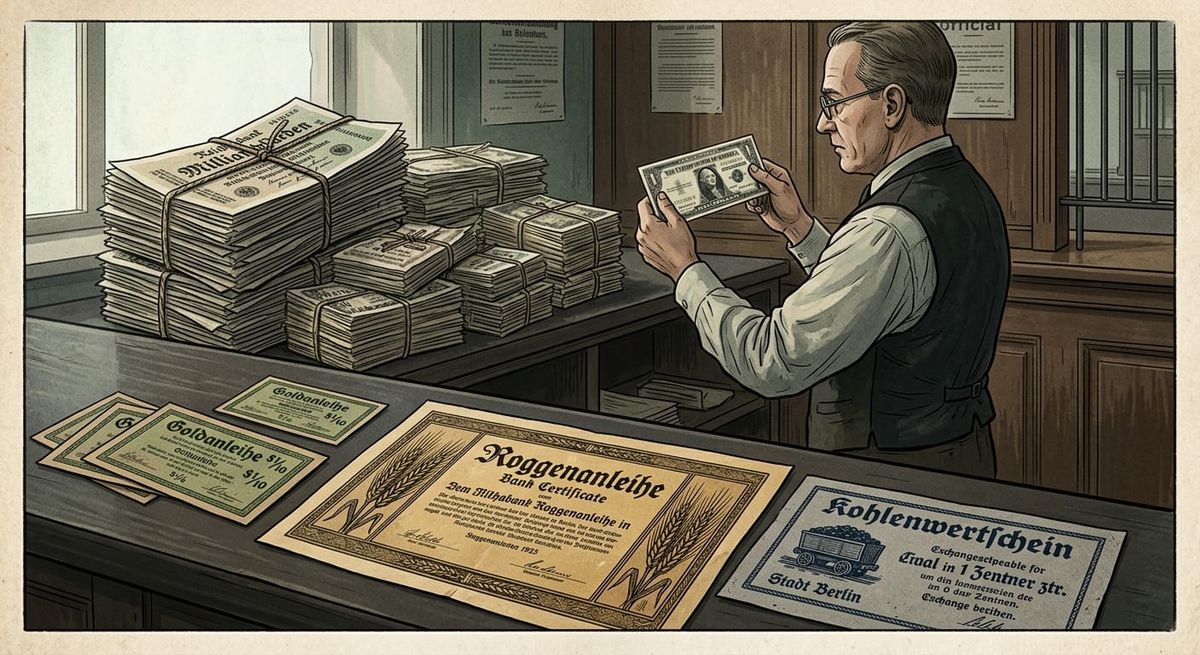
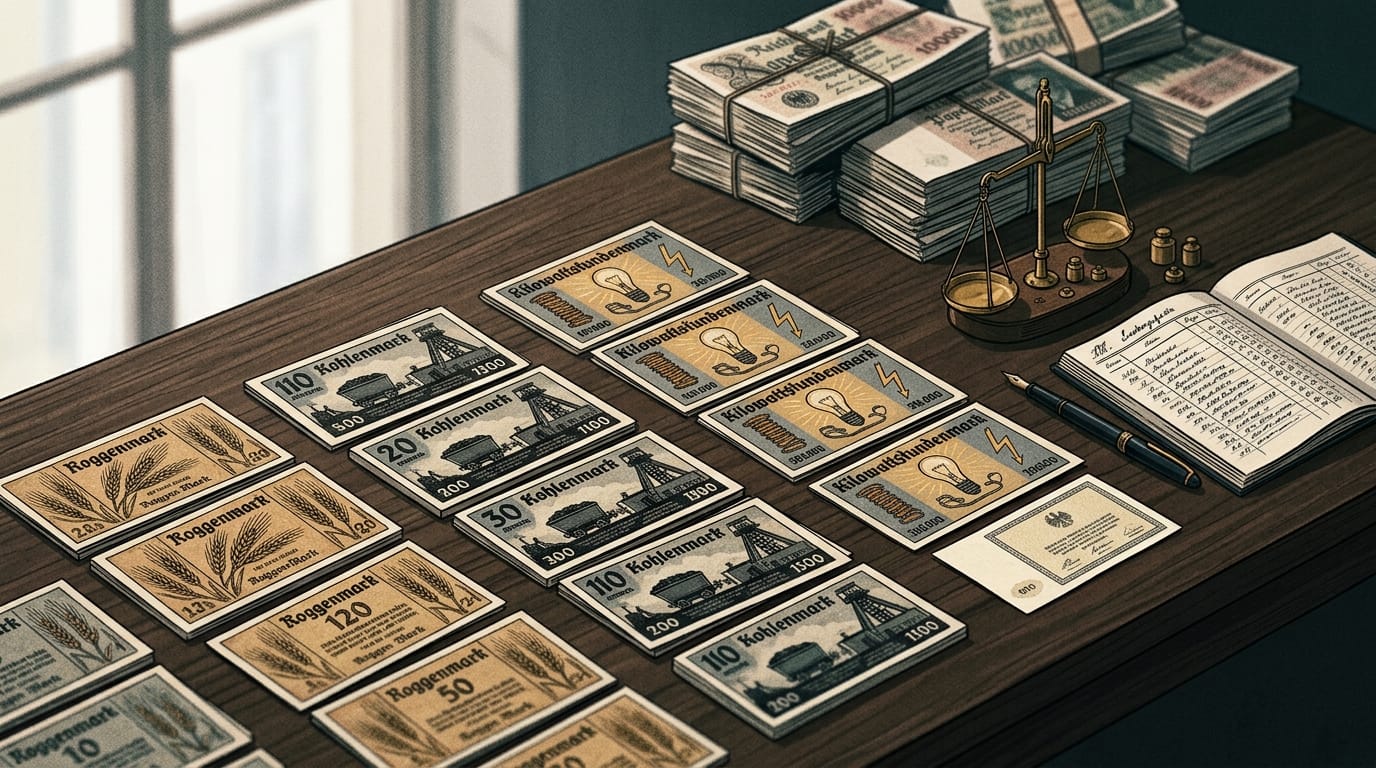
What Germans held instead is the part usually cut. Gustavo Franco, later Brazil's central bank governor in the years of the Real, reconstructed it. In the autumn of 1922 farmers refused to sell grain for paper, and a private rye bank, the Roggenrentenbank, issued its first bill denominated in pounds of rye in December 1922 [3, 4]. By August 1923 the Frankfurt financial press listed 34 such "material value" loans, issued by states, cities, utilities and churches, denominated in rye, coal, potash, gold and sterling, and worth about 14.7 million dollars in total [3]. None was convertible into the commodity, which served only as an index; payment was in paper marks at the day's quotation, in notes small enough to circulate [3].
The government copied the private sector with a dollar-indexed gold loan on 14 August 1923, in denominations down to one-tenth of a dollar. Its issue of roughly 120 million dollars was nearly as large as the gold value of every Reichsbank note then outstanding, about 131 million dollars in July [3]. A government order of 23 October 1923 then allowed stable-value emergency money to be licensed on one condition, that the issuer deposit part of the state's own gold loan as cover, with notes denominated in gold marks at 4.20 or less; the Bundesbank's exhibit treats notes so covered as legal tender and puts the number of further issuers at some 600 [23, 4].
Sargent reports the rough contemporary estimate that by October 1923 the real value of foreign currencies circulating in Germany was at least equal to, and perhaps several times, the real value of Reichsbank notes [1, 8, 22]. How much foreign currency is the soft joint in every account. Holtfrerich put the stock at 476 to 715 million dollars, Bresciani-Turroni at 120 to 950 million, and Franco took a conservative 440 million for his reconstruction of the money supply on 15 November 1923 [9, 8, 3]. On it, stable-value money came to roughly 523 million dollars against roughly 41 million of Reichsbank notes and ordinary emergency money, the paper mark at about seven percent of the money in use on the day the Rentenmark was born [3]. Foreign cash is 84 percent of that stable stock. Strip it out and the mark is nearer a third of what remains. The seven percent is one reconstruction, not a census; the claim that survives every band is that by November 1923 the mark had become a residual.
Franco reads the summer of 1923 from that stock: the explosion coincides with the spread of indexed money and the end of the mark's monopoly as a means of payment, so the final months measure a collapse of demand as much as an acceleration of the printing [3]. Cagan credited rumours of reform for the same late collapse [21]. People issued rye and dollar paper because the mark was already failing; the two readings describe one collapse from two ends.
A peg for a country already on the dollar
A decree of 15 October 1923 established the Rentenbank and a new unit, the Rentenmark, equal to one trillion paper marks. The decree capped the total issue at 3.2 billion Rentenmarks and the amount that could go to the government at 1.2 billion, at a moment when the government was financing virtually all of its spending by printing [1]. On 15 November the Reichsbank stopped discounting treasury bills, and on 20 November the exchange rate was fixed at 4.2 trillion paper marks to the dollar [1, 2].
What backed it? Officially, a mortgage on German farms and factories, subscribed in paper marks, which Franco says had no economic basis and Bresciani-Turroni called fictitious [3, 8]. Sargent calls the unit change cosmetic and locates the substance in the issue limit and the fiscal regime change [1]. Franco's alternative is that the public read the Rentenmark as one more stable-value note, convertible into a gold-indexed bond on a mechanism it had used for a year, while the state spent reserves to hold 4.2 trillion to the dollar [3]. The honest version needs both: the public had already left the mark, and the state then capped issuance and defended a dollar peg. Two days after the first Rentenmarks were issued, the Reichsbank stopped accepting private emergency money and presented it to the issuers for redemption [23].
The fiscal side was real. On the tax line of Sargent's revenue table, receipts rose from 63.2 million gold marks in November 1923 to 503.5 million in January 1924 [1]. The redenomination recorded what the inflation had already done. Germany's war debt of 154 billion marks was worth 15.4 pfennig when the Rentenmark was introduced [5].
Who survived, on the firm evidence
A 2025 study by Brunnermeier, Correia, Luck, Verner and Zimmermann digitised the balance sheets and share prices of about 700 German joint-stock companies [2]. It is the best ledger there is, and it is a ledger of listed firms: the small saver, the mortgage creditor and the pensioner of the legend are not in Saling's yearbook, so what follows answers whether leverage hedged equity, not who survived in the street.
Debtors survived, and grew. Firms' liabilities-to-assets ratios fell by about 20 percentage points between 1917 and 1924, debts outstanding in 1917 were effectively wiped out by 1922, and bankruptcies fell as inflation rose [2]. The real book value of firms' equity rose 119 percent between 1919 and 1924 [2].
Shareholders did worse than folk memory says. Real total returns on portfolios of nonfinancial stocks averaged between minus 25 and minus 36 percent a year from 1919 to 1923, and the most leveraged quintile beat the least leveraged by 7 to 11 percentage points a year, enough to hedge about a third of the decline [2]. Investors mistook nominal gains for real ones, as Bresciani-Turroni argued and Braggion, von Meyerinck and Schaub have shown in bank client records [8, 11].
Wage earners recovered fastest: real wages were at or near pre-war levels by mid-1924, while union unemployment had peaked at 28.2 percent in December 1923 [3]. Holders of nominal claims did not recover at all. Savings, bonds, mortgages and policies written in marks went to nothing, and the state, the largest debtor, was the largest beneficiary [5].
The survivor set was anything not denominated in the failing unit: foreign notes, stable-value paper, commodities, property, and equity in firms that owed marks to someone else. The order of survival was set by denomination and by which side of the nominal contract one sat on, not by the quality of the asset.
[GHOST: bookmark card https://www.sagix.io/episode-8-brazilian-hyperinflation-the-ultimate-portfolio-stress-test-1980-1994/]
The modern parallel: a decree on contract denomination
The anchor in Argentina is Decree 70/2023, published in the Boletín Oficial on 21 December 2023 and in force from 30 December [13, 14]. Its Articles 250 and 251 rewrote Articles 765 and 766 of the Civil and Commercial Code so that a debt may be denominated in any currency whether or not it is legal tender, the debtor is discharged only by paying in the currency agreed, and no judge may alter the currency or the form of payment [14]. It freed the contract, not the unit of account; the peso remains legal tender for taxes and formal wages. Its footing is narrower than a statute's: the Senate rejected it on 14 March 2024 by 42 votes to 25, the Chamber of Deputies never voted, so it stands until both chambers reject it, with its labour chapter suspended by the courts and the civil-code articles untouched [24, 25]. INDEC recorded consumer prices up 25.5 percent in December 2023 alone and 211.4 percent over the year [12].
The second document defines the instrument. Law 27.739, published 15 March 2024, defines a virtual asset as a digital representation of value that can be traded or transferred and used for payment or investment, and excludes from that definition both Argentine legal tender and currencies issued by other states [15]. A dollar stablecoin is therefore a virtual asset in Argentine law: not the dollar, and not money. The same law created a registry of service providers at the securities regulator, the CNV, whose Resolution 994/2024 reaches any platform with an .ar domain, local on-ramps or more than 20 percent of its business in Argentina, and obliges each to state that registration "no implica licencia ni supervisión" by the CNV [15]. The venue is registered. The instrument is neither licensed nor backed. Set that beside October 1923, when the German state licensed private dollar-indexed notes on condition they were covered by its own gold loan, then replaced them with its own unit, and the two moves are opposites: one socialised the substitute, the other tolerated it and declined to stand behind it.
Chainalysis, a surveillance vendor that sells to the same regulators, supplies the scale. Between July 2023 and June 2024 stablecoins made up 61.8 percent of Argentina's crypto transaction volume against a global average of 44.7 percent, on an estimated 91.1 billion dollars of value received, and retail-sized stablecoin transfers under 10,000 dollars were growing faster than any other asset type [16]. Value received counts flows, not a money stock, and is not comparable to Franco's table; cash dollars still dwarf on-chain balances for Argentine households. The IMF's December 2025 stablecoin paper says the same for the region as a whole [18].
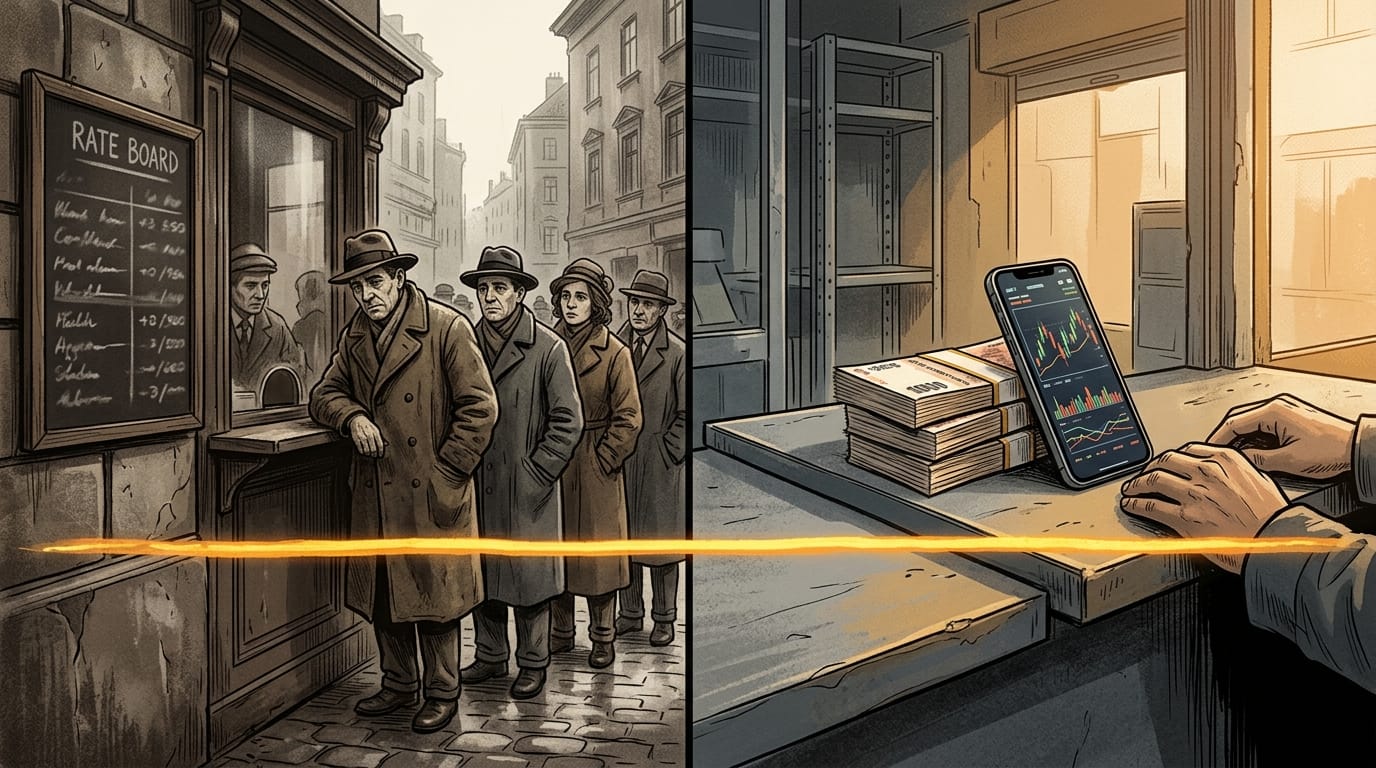
Two neighbours show the response Sargent describes for Austria and Hungary in 1922: an exchange control office set up to make holding foreign money difficult or illegal, which citizens held anyway [1]. Turkey's central bank, by a regulation of 16 April 2021, barred crypto assets from payments and said nothing about holding them [19]. Nigeria's central bank cut exchanges off from the banks in February 2021, then reconnected them on 22 December 2023 on conditions: naira only on platforms, no foreign-exchange positions, no transfers abroad, withdrawals to a bank account at most twice a quarter [20]. Each line runs between holding the foreign unit and settling in it; Germany drew the same one, and its November 1923 money supply shows how much had crossed [1, 3].
Portfolio lessons
First, denomination decides survival before asset quality does. Every claim written in marks failed regardless of the debtor's solvency; every claim written in rye, coal, gold or dollars survived regardless of how thin its cover was [3, 5]. The first question to ask of any holding is what unit it is promised in and who can print it. Episode 8 was about the printers; this one is about the printed.
Second, the hedge that worked in Germany was being the debtor, and the Druid will not run it. Equity lost a quarter to a third of its real value every year, and the part that survived did so because the firm owed marks to someone else [2]. Zero leverage stays the rule. The narrower lesson is about the other side of the contract: never be the unsecured lender in a unit someone else controls. A mark bond, a peso term deposit and a stablecoin issuer's unsecured liability are one instrument in three costumes.
Third, separate the unit from the claim. The gold-loan notes held their value because their unit was set in a market outside Berlin, yet they were liabilities of the German state, which withdrew them within weeks [3, 23]. A dollar stablecoin has the same split: the unit is the dollar, which no issuer can print, and the claim is the issuer's, which can fail while the dollar does not. Indexing protects against the sovereign's unit. It does nothing about the counterparty, and that is episode 14's subject.
Fourth, controls slow the flight and record it; they do not stop it. Austria's exchange office, Nigeria's naira-only rule and Argentina's own controls each drew a line at settlement, and the money crossed at a price [1, 20, 17]. The four-layer liquidity framework from episode 9, applied to the exit: the cost of leaving a failing unit is the depth of the on-ramp on the day it narrows, and sizing should assume it narrows.
Fifth, the transfer is not booked on the day the peg holds. Creditors in marks lost over four years, most of it before 1922; the conversion of 154 billion marks of war debt into 15.4 pfennig recorded a loss the inflation had already taken [2, 5]. The survivor was not the one who guessed the date but the one already denominated elsewhere, with nothing to sell into the last month, when prices doubled every four days. Survival over optimization is the point of this series, and 1923 is the clearest case on record.
 Sagix
Sagix
 Sagix
Sagix
 Sagix
Sagix
Educational purpose only: This content is provided exclusively for educational and historical research purposes. It should not be construed as investment advice, financial planning guidance, policy recommendations, or official economic analysis. Any contemporary parallels or policy discussions are presented as academic analysis, not recommendations for action. Historical patterns provide context for learning but do not predict future financial system outcomes or investment performance.
AI-assisted research disclosure: This historical analysis was researched and written with substantial assistance from artificial intelligence technology (Claude, Anthropic). While extensive efforts were made to verify all statistical claims, citations, and institutional analysis against authoritative sources, readers should independently verify any information before relying on it for academic, professional, investment, or policy purposes.
Accuracy and liability limitations: While extensive effort has been made to ensure historical accuracy through authoritative sources, the authors make no warranties about completeness, accuracy, or currency of information. Historical interpretation involves scholarly judgment and academic debate. Economic data may contain revisions, measurement inconsistencies, or reporting variations across time periods and institutional sources. The authors and publisher assume no responsibility for errors, omissions, or consequences arising from the use of this information, including any errors resulting from AI assistance. Users assume full responsibility for decisions or actions taken based on this content.
Investment risk warning: Historical financial analysis does not constitute investment advice or recommendations. Past performance, whether historical or hypothetical, does not guarantee future results. All investments carry risk of loss. Readers should conduct their own research and consult qualified financial advisors before making investment decisions.
No professional relationship: This content does not create any professional, advisory, fiduciary, or client relationship between the reader and The Genesis Address LLC, its authors, or affiliated entities. Readers seeking financial, investment, legal, regulatory, or policy guidance should consult qualified professionals licensed in their jurisdiction.
Methodological note: This analysis synthesizes findings from central bank research departments, National Bureau of Economic Research publications, peer-reviewed academic journals, and authoritative government historical records. The numbered citation system allows readers to verify specific claims against original sources rather than relying on secondary interpretations.
References to modern financial systems, cryptocurrency protocols, or DeFi mechanisms are made for educational comparison purposes only. These comparisons do not constitute endorsements, recommendations, or predictions about the performance or suitability of any current financial products or services.
Analysis of international monetary systems and policies is presented for historical educational purposes. Different jurisdictions have varying regulatory frameworks, and this content should not be interpreted as applicable to any specific jurisdiction's current legal or regulatory environment.
Historical analysis of financial crises is provided for educational understanding of systemic risk patterns. This content does not predict future crises or recommend specific crisis preparation strategies. Readers should consult qualified professionals for personalized risk management advice.
Publication information: Last updated: September 13, 2026 | Series: The Druid Deep Dive | Publisher: The Genesis Address LLC
Sources and references
[1] Sargent, Thomas J. "The Ends of Four Big Inflations." In Inflation: Causes and Effects, edited by Robert E. Hall, 41-98. University of Chicago Press for the National Bureau of Economic Research, 1982. https://www.nber.org/system/files/chapters/c11452/c11452.pdf.
[2] Brunnermeier, Markus, Sergio Correia, Stephan Luck, Emil Verner, and Tom Zimmermann. "The Debt-Inflation Channel of the German (Hyper)Inflation." American Economic Review 115, no. 7 (July 2025): 2111-2150. https://doi.org/10.1257/aer.20230685. Working paper version, May 24, 2024: https://arxiv.org/pdf/2405.13296.
[3] Franco, Gustavo H. B. "The rentenmark miracle and the German stabilization." Chapter 10 of Aspects of the Economics of Hyperinflations: Theoretical Issues and Historical Studies of Four European Hyperinflations of the 1920s. PhD dissertation, Princeton University, 1986. Author's copy. http://www.gustavofranco.com.br/uploads/files/Ch10%281%29.PDF.
[4] Deutsche Bundesbank, Money Museum. "When gold and silver go on holiday... Rye money and rye loans during the Weimar Republic." Special exhibit text. https://www.bundesbank.de/resource/blob/616602/e6a2f4aef2190c3ae1d28fe0fb6e9534/mL/rye-money-and-rye-loans-during-the-weimar-republic-data.pdf.
[5] Deutsche Bundesbank. "Inflation: lessons learnt from history." October 15, 2012. https://www.bundesbank.de/en/tasks/topics/inflation-lessons-learnt-from-history-666006.
[6] Reparation Commission. "Schedule of payments, May 5, 1921, prescribing the time and manner for securing and discharging the entire obligation of Germany for reparation under Articles 231, 232 and 233 of the Treaty of Versailles." In Papers Relating to the Foreign Relations of the United States, The Paris Peace Conference, 1919, Volume XIII. U.S. Department of State, Office of the Historian. https://history.state.gov/historicaldocuments/frus1919Parisv13/ch34subch4.
[7] Hanke, Steve H., and Nicholas Krus. "The Hanke-Krus Hyperinflation Table." From "World Hyperinflations," Cato Working Paper no. 8, August 15, 2012. https://www.cato.org/sites/cato.org/files/pubs/pdf/hanke-krus-hyperinflation-table.pdf.
[8] Bresciani-Turroni, Costantino. The Economics of Inflation: A Study of Currency Depreciation in Post-War Germany. London: George Allen and Unwin, 1937.
[9] Holtfrerich, Carl-Ludwig. The German Inflation 1914-1923: Causes and Effects in International Perspective. Berlin and New York: De Gruyter, 1986.
[10] Feldman, Gerald D. The Great Disorder: Politics, Economics, and Society in the German Inflation, 1914-1924. Oxford University Press, 1993.
[11] Braggion, Fabio, Felix von Meyerinck, and Nic Schaub. "Inflation and Individual Investors' Behavior: Evidence from the German Hyperinflation." The Review of Financial Studies 36, no. 12 (2023): 5012-5045.
[12] Instituto Nacional de Estadística y Censos (INDEC). "Índice de precios al consumidor (IPC). Diciembre de 2023." Informes técnicos vol. 8, no. 7. Buenos Aires, January 11, 2024. https://www.indec.gob.ar/uploads/informesdeprensa/ipc_01_24DBD5D8158C.pdf.
[13] República Argentina. Decreto de Necesidad y Urgencia 70/2023, "Bases para la Reconstrucción de la Economía Argentina." Boletín Oficial, December 21, 2023. Full text at Infoleg: https://servicios.infoleg.gob.ar/infolegInternet/anexos/395000-399999/395521/norma.htm.
[14] Allende & Brea. "Modificaciones al Código Civil y Comercial de la Nación." Client bulletin, January 3, 2024. https://allende.com/reforma-argentina/desregulacion-economica/modificaciones-al-codigo-civil-y-comercial-de-la-nacion-01-03-2024/.
[15] Comisión Nacional de Valores. Resolución General 994/2024, "Registro de Proveedores de Servicios de Activos Virtuales." Boletín Oficial de la República Argentina, March 25, 2024 (reciting Ley 27.739, B.O. March 15, 2024, and Article 4 bis of Ley 25.246). https://www.boletinoficial.gob.ar/detalleAviso/primera/305110/20240325.
[16] Chainalysis. "2024 Latin America Crypto Adoption: The Rise of Stablecoins." Excerpt from the 2024 Geography of Cryptocurrency Report, October 2024. https://www.chainalysis.com/blog/2024-latin-america-crypto-adoption/.
[17] Chainalysis. "Latin America Emerges as a Crypto Powerhouse Amid Volatile Growth." Excerpt from the 2025 Geography of Cryptocurrency Report, October 2, 2025. https://www.chainalysis.com/blog/latin-america-crypto-adoption-2025/.
[18] Adrian, Tobias, Parma Bains, Marianne Bechara, Eugenio M. Cerutti, Stephanie Forte, Federico Grinberg, Alessandro Gullo, Martina Hengge, Kathleen Kao, Tommaso Mancini-Griffoli, Soledad Martinez Peria, Marcello Miccoli, Marco Reuter, and Nobuyasu Sugimoto. "Understanding Stablecoins." IMF Departmental Paper 2025/009. International Monetary Fund, December 2025. https://www.imf.org/en/publications/departmental-papers/issues/2025/12/02/understanding-stablecoins-570602.
[19] Central Bank of the Republic of Türkiye. "Press Release on Payments Area (2021-17)." April 16, 2021. https://www.tcmb.gov.tr/wps/wcm/connect/EN/TCMB+EN/Main+Menu/Announcements/Press+Releases/2021/ANO2021-17.
[20] Central Bank of Nigeria. "Circular to all Banks and Other Financial Institutions: Guidelines on Operations of Bank Accounts for Virtual Assets Service Providers (VASPs)." FPR/DIR/PUB/CIR/002/003, December 22, 2023. https://www.cbn.gov.ng/out/2024/fprd/guidelines%20on%20operations%20of%20bank%20accounts%20for%20virtual%20asset%20providers.pdf.
[21] Cagan, Phillip. "The Monetary Dynamics of Hyperinflation." In Studies in the Quantity Theory of Money, edited by Milton Friedman, 25-117. University of Chicago Press, 1956.
[22] Young, John Parke. European Currency and Finance. Commission of Gold and Silver Inquiry, United States Senate, Serial 9, vols. 1 and 2. Washington: Government Printing Office, 1925.
[23] Jungmann-Stadler, Franziska. "Notgeld." Historisches Lexikon Bayerns, published June 13, 2006, updated December 3, 2018. Bayerische Staatsbibliothek. https://www.historisches-lexikon-bayerns.de/Lexikon/Notgeld.
[24] Honorable Senado de la Nación Argentina. "El DNU 70/2023 no obtuvo la aprobación del Senado." Press release, March 14, 2024. https://www.senado.gob.ar/prensa/21509/noticias.
[25] Tiempo Argentino. "La Corte lleva un año y nueve meses sin tratar el capítulo laboral del DNU 70/2023." December 21, 2025. https://www.tiempoar.com.ar/ta_article/la-corte-lleva-un-ano-y-nueve-meses-sin-tratar-el-capitulo-laboral-del-dnu-702023/.
Publisher: The Genesis Address LLC