The Druid Deep Dive, Episode 15: The Medici network: a holding company with no court above it (1397-1494)
The Medici bank ran branches in eight cities on 28,800 florins of family capital, less than the Peruzzi held in 1312, and came apart after one branch lent twice its capital to a duke. Episode 15 reads a Singapore judgment on the Multichain bridge against it: separate books, one set of keys.

The Medici bank was the largest Florentine firm on record and a smaller business than the Peruzzi had run a century earlier. It was built as a chain of legally separate partnerships under one name, so that no branch could sink the house. Episode 15 traces how that design held in a Bruges courtroom and failed in a Florentine ledger, and reads a Singapore judgment on a cross-chain bridge against it.
The Druid Deep Dive, episode 15. Ancient wisdom for modern DeFi. Historical period: Florence and its branches, 1383 to 1494.
Episode 14 closed Season 3 on the difference between a peg and a promise. Season 4 opens on the firms that made promises across borders, with no court able to enforce them. The famous version of the Medici bank is wrong where it matters: it was not the biggest bank of its age, and it did not fall because Lorenzo preferred poets to ledgers. It was built as a network of separate partnerships so that one branch could not bring down the rest, a design that held when a Milanese merchant sued in Bruges and did nothing when a branch manager lent twice the branch's capital to a duke. Episode 9, part 4 was a hub, one house in London where everything cleared. This is the other shape: many houses, one name, and the question of where the trust sat.
 Sagix

 Sagix

A firm that failed in one piece
The Bardi and the Peruzzi were one partnership each. The company in Florence owned every branch, and the men who ran London or Bruges were salaried factors, paid "for the donation of their time," who could be moved or dismissed from home [1]. In 1312 the Peruzzi company had a capital of 80,000 florins, shared by eight members of the family and nine outsiders [1]. The legend has Edward III of England defaulting on 1.5 million florins and sinking both houses in the 1340s. Hunt's reading of the English records argues that the firms lacked the resources to have lent on that scale, and disputes the account that the English loans brought them down [2]. A unitary firm fails in one piece.
Florence drew the lesson forty years later. Padgett and McLean date the invention of the partnership system to 1383, in the political settlement after the Ciompi revolt, when domestic money-changers were pulled into the councils of the state and carried their habit of short, renewable partnerships into international trade [3, 4]. Five such systems were founded in that one year, one of them by Vieri di Cambio de' Medici, in whose Rome branch Giovanni di Bicci learned the trade, and forty-eight existed in Florence before 1400 [3]. The form was a set of legally separate partnerships linked through one controlling partner, each with its own books, and a bookkeeping change dates its arrival. Of the surviving Florentine company ledgers from 1259 to 1377, none is kept in bilateral format; of those from 1382 to 1399, all five are [3]. The device "protected owners (to some extent)" against ruin, in Padgett's phrase [3]. The qualification in the parentheses is this episode.
A combination of partnerships
De Roover, working from the surviving partnership agreements and a Bruges ledger fragment, describes the Medici house as not one partnership but a combination of them. Each enterprise, the Florence bank, each branch and the three workshops, was a separate legal entity with its own name, capital and books, and the branches charged one another commission as if they belonged to different firms [1]. He calls it a holding company in all but name: the Medici held at least half of each subsidiary's capital and kept the trade name after any dissolution, because the goodwill was in the name [1].
The Bruges agreement of July 25, 1455, is the specimen. The branch's capital was set at 3,000 pounds groat, of which the Medici put up 1,900, the retiring manager 600 and the new manager Angelo Tani 500; Tani supplied one sixth of the capital and took one fifth of the profits [1]. He could extend credit to merchants and artisans only, which ruled out loans to princes, and could not sell exchange on credit to lords spiritual or temporal unless they paid in advance, on penalty of 25 pounds groat per offence [1]. A balance sheet went to Florence every year as of March 24 [1]. The contract is a risk policy written as a job description, and nearly every later failure is one of its clauses relaxed.
The size of the thing is where the legend parts from the ledger. Goldthwaite calls the firm the largest on record and gives 72,000 florins of capital in 1451, 54,000 of it from the Medici themselves; no single company, he finds, could control a significant share of the business [5]. De Roover's figure from the 1458 tax return is smaller and measures something else. The family's own stake in the capital of the Florence bank and six branches abroad came to 28,800 florins, not counting Rome, accumulated profits or the deposits the Medici placed with their own branches [1]. Set either number beside the Peruzzi's 80,000 of 1312 and the largest bank of the fifteenth century was a smaller firm than the largest of the fourteenth. What it had instead of capital was a network, with the papacy's money in the Rome branch, which earned the most, and a correspondent in every city without a branch [5, 1]. The 1427 tax census shows export firms running on each other's credit, with credit-to-asset ratios averaging 5 to 1 in the banking sectors, and the credit tracked kinship, neighbourhood and political office [3]. The trust was manufactured socially and measured in current accounts.
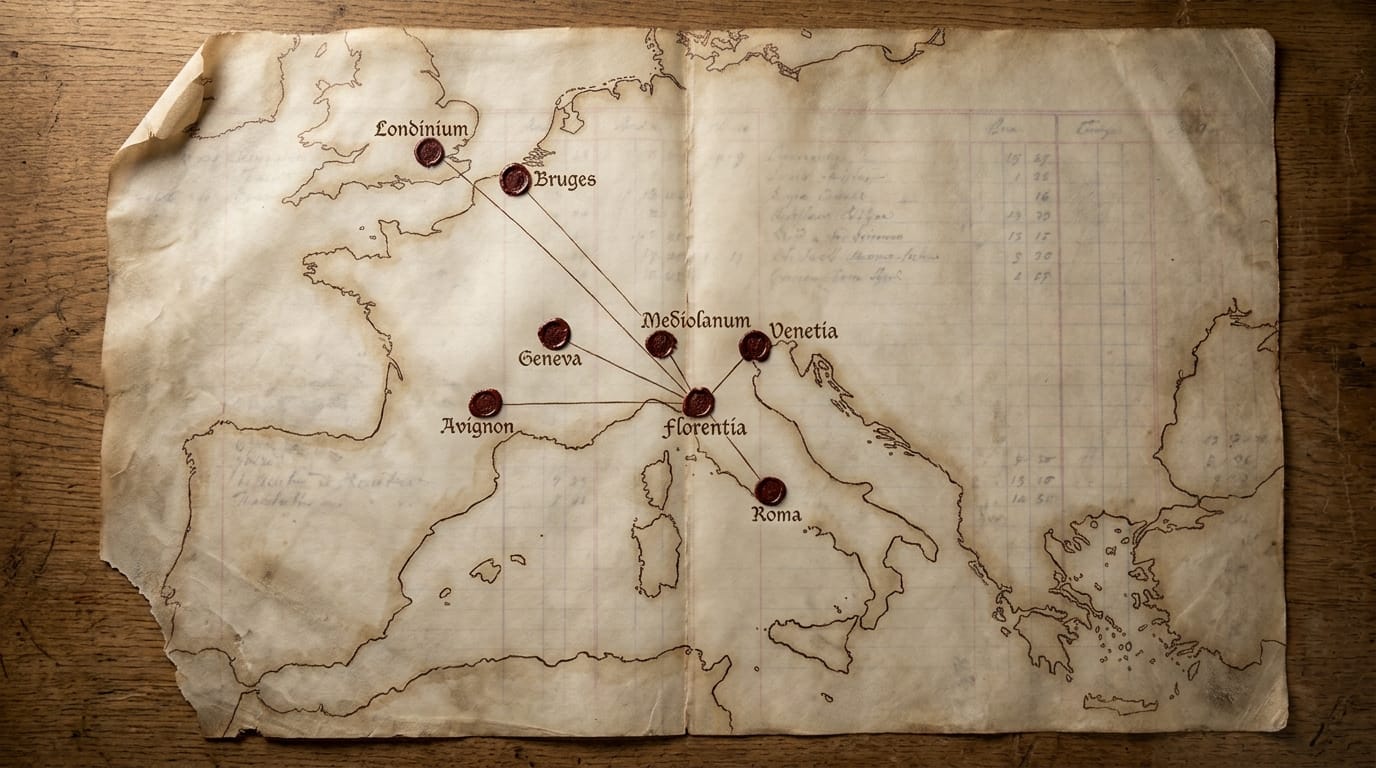
Ruffini against Portinari, Bruges, 1455
The structure was tested in court the same year. A Milanese merchant, Damiano Ruffini, sued Tommaso Portinari, then acting manager at Bruges, over nine badly packed bales of wool bought from the Medici branch in London. Portinari's answer was that the bales had never belonged to Bruges and the plaintiff should sue London. Ruffini replied that the two branches were one company with one master. Portinari swore the opposite, and on July 30, 1455, the municipal court dismissed the claim against Bruges while upholding Ruffini's right to sue the London manager [1]. De Roover compares it to suing one Standard Oil company over another's goods because the Rockefellers owned both, except that this was decided in the fifteenth century with no precedent [1]. The ring-fence held.
The ring-fence could not make the branches independent of each other in fact. Correspondence was the only means by which Florence kept in touch with the branches [1]. A bill between Italy and London ran three months to maturity, between Italy and Bruges two [1]. The Bruges balance sheet for the year to March 24, 1464, left for Florence on May 14 [1]. De Roover's verdict is the sentence to keep: the absence of any satisfactory system of inspection and internal check was a serious weakness, so that a manager's mistakes could rarely be caught in time [1]. Separate books kept the losses legally apart. They did not keep them small, and they did not keep them from the name.
The branch that lent to a duke
Cosimo, who ran the house from 1429 to 1464, distrusted the ambitious Portinari and kept him below partner for a quarter of a century; he was made governor at Bruges only in 1465, after Cosimo's death [1]. Piero and Lorenzo relaxed the grip, and Francesco Sassetti, the general manager who was supposed to audit the branches, sided with Portinari against the cautious Tani [1]. Then the clause came out. When the Bruges agreement was renewed in 1471, Portinari was permitted to lend up to 6,000 pounds groat to Charles the Bold, Duke of Burgundy, twice the branch's entire capital, and by 1478 the Burgundian government owed the Medici 9,500 pounds groat [1]. The agreement's stated reason was the prince's good qualities and his friendship for Portinari, by then his councillor [1]. Charles fell at Nancy in 1477, and the loans were still being wound up in 1500 [1]. The Medici withdrew from Bruges in 1480 and liquidated the branch in 1481 [1]. When Piero di Lorenzo fled Florence in 1494 and the crowd sacked the palace, destroying most of the books, the bank was, in Goldthwaite's words, "on the verge of bankruptcy when its doors were forcibly closed" [5, 7, 1].
Two revisions belong here. The first is that the Medici fell alone. Goldthwaite finds that the rest of the Florentine banking community was barely touched when the Medici struggled, and he locates the cause in management under Lorenzo rather than in a general deterioration that, he observes, nobody has ever properly documented [5]. The network outlived its most famous node. The second is that the structure was a growth engine. It was the opposite. Florentine firms stayed small and short-lived because partners were few, estates were divided among heirs, and a 1408 law that let outside investors put in capital with limited liability was used by almost no one to raise serious capital [5]. Whether the bank ran on partners' money or outside deposits was de Roover's closing question; no surviving balance sheet answers it [6]. The lesson of 1343 had been learned so well that the firm could not get big enough to matter, and so badly that one relaxed clause in one branch could still consume the name.
 Sagix

The modern parallel: a user agreement, a judgment and a winding-up order
The anchor is a judgment of the High Court of Singapore, Fantom Foundation Ltd v Multichain Foundation Ltd and another, neutral citation 2024 SGHC 173, delivered on July 8, 2024 [8]. Multichain Foundation Ltd, a Singapore company limited by guarantee, operated a cross-chain bridge and router. It locked a user's source assets on one blockchain and released a wrapped token of equal value on another, which the judge likens to an IOU [8]. The user agreement, as the claimant pleaded it, promised that the bridge was controlled by decentralised multi-party computation nodes incapable of one-person control and that source assets were held one to one as collateral in a decentralised management account [8]. That is the Bruges contract: a promise about how the branch may and may not behave, written for people who could not watch it.
The facts, the judge notes, are primarily the claimant's account, since the defendants never appeared [8]. On July 7, 2023, over 127 million US dollars of assets were moved out of the bridge wallet into other wallets and then onward, leaving the foundation effectively without assets of value [8]. The claimant's position, which the court records the foundation had itself admitted in a public post, was that the breach was possible because the chief executive held ultimate privileges and control over the assets in the bridge [8]. Fantom's own deposits in the bridge stood at 61,829.70 US dollars on July 6, 2023, and the wrapped tokens held against them were worth 3,209.12 dollars by September 18, about five cents on the dollar [8]. Fantom's public statement puts the losses across nine chains at more than 210 million dollars, about a third of them in its own ecosystem; the court's 127 million is the bridge wallet on the day, and neither figure is a census [9, 8].
The law moved at a Medici pace. The claim was filed on September 18, 2023; default judgment came on January 30, 2024; damages of 2,187,870.55 US dollars were assessed on July 8, 2024; and on May 9, 2025, Justice Kwek Mean Luck granted the winding-up application and appointed KPMG Singapore as liquidators, the foundation's chief executive having, by press accounts, been taken by the Chinese authorities before the exploit [8, 10, 11]. The theory that distributed systems lack a single point of failure, the judge adds, "is not always borne out in reality" [8].

Chainalysis, which sells surveillance software to the exchanges and regulators that then cite it, put bridge hacks at 2 billion dollars across thirteen incidents by August 2022, 69 percent of everything stolen that year, and gave the reason: bridges feature a "central storage point of funds" [12]. The 2026 case is Kelp DAO. On April 18, 2026, an attacker drained 116,500 rsETH, about 292 million dollars and roughly 18 percent of the token's supply, from a bridge whose reserve backed wrapped versions of rsETH on more than twenty networks [13]. LayerZero Labs' incident report says the application was running a single-verifier configuration, so one attestation from its compromised verifier was enough to release the reserve [14]. Kelp replied that the single-verifier setup was LayerZero's documented default and the compromised infrastructure was LayerZero's own [15]. The two accounts disagree about whose choice it was. They agree on the structure: more than twenty branches, one reserve, one signer.
Portfolio lessons
First, count the trust points, not the branches. The Medici appeared in eight cities on the 1458 tax return and ran on one name and one general manager's judgment; Multichain appeared on dozens of chains and ran on one person's keys; rsETH appeared on more than twenty networks and ran on one verifier's attestation [1, 8, 14]. A network's survival is set by the number of independent things that must fail, and a deployment map says nothing about that number. The hub layer of the four-layer framework asks this of the routing asset; ask it of the bridge.
Sign up for Sagix Apothecary
Second, legal separation is a defence in a courtroom, not in a run. Ruffini lost in Bruges, and the Medici still paid for Bruges out of Florence, carrying its losses into the books of the next partnership [1]. Fantom's wrapped tokens traded at five cents on the dollar within weeks of the reserve leaving, whatever the user agreement said [8]. Value a wrapped asset by the reserve behind it and the keys above it, never by the document.
Third, the clause that bans lending to the sovereign is in the contract because the people nearest the sovereign will want it out. The 1471 agreement that let Portinari lend twice the capital to Charles the Bold gave the duke's friendship for Portinari as its reason [1]. On a chain, the sovereign is whoever can act without a court: a validator set, a sequencer, a foundation's key holder. Episode 7 was the London version of the same loan. The question for any yield that depends on such a party is what happens when it declines to pay and nobody can make it.
Fourth, the monitoring lag is the position. A Bruges balance sheet took seven weeks to reach Florence and a bill three months to mature; Kelp's pause came 46 minutes after the drain and still arrived after 292 million dollars had left [1, 13]. Size any claim behind a bridge as if the reserve could be gone before anyone reacts, because that is the record.
Fifth, the network outlives the node, so hold the node you can see. Florentine banking was barely touched by the Medici's failure, and Fantom's chain kept running while the bridge's wrapped tokens did not [5, 8]. The native asset on the chain that issued it is the Florence bank; every wrapped version is a branch, and the branch can be liquidated while the house still stands. Diversify across issuers and reserves, not across copies of the same reserve on different chains, and carry no leverage against any of them. Survival over optimization is the rule of this series, and the Medici, who learned it in 1343 and unlearned it in 1471, are its cleanest case of both.
Educational purpose only: This content is provided exclusively for educational and historical research purposes. It should not be construed as investment advice, financial planning guidance, policy recommendations, or official economic analysis. Any contemporary parallels or policy discussions are presented as academic analysis, not recommendations for action. Historical patterns provide context for learning but do not predict future financial system outcomes or investment performance.
AI-assisted research disclosure: This historical analysis was researched and written with substantial assistance from artificial intelligence technology (Claude, Anthropic). While extensive efforts were made to verify all statistical claims, citations, and institutional analysis against authoritative sources, readers should independently verify any information before relying on it for academic, professional, investment, or policy purposes.
Accuracy and liability limitations: While extensive effort has been made to ensure historical accuracy through authoritative sources, the authors make no warranties about completeness, accuracy, or currency of information. Historical interpretation involves scholarly judgment and academic debate. Economic data may contain revisions, measurement inconsistencies, or reporting variations across time periods and institutional sources. The authors and publisher assume no responsibility for errors, omissions, or consequences arising from the use of this information, including any errors resulting from AI assistance. Users assume full responsibility for decisions or actions taken based on this content.
Investment risk warning: Historical financial analysis does not constitute investment advice or recommendations. Past performance, whether historical or hypothetical, does not guarantee future results. All investments carry risk of loss. Readers should conduct their own research and consult qualified financial advisors before making investment decisions.
No professional relationship: This content does not create any professional, advisory, fiduciary, or client relationship between the reader and The Genesis Address Publishing LLC, its authors, or affiliated entities. Readers seeking financial, investment, legal, regulatory, or policy guidance should consult qualified professionals licensed in their jurisdiction.
Methodological note: This analysis synthesizes findings from central bank research departments, National Bureau of Economic Research publications, peer-reviewed academic journals, and authoritative government historical records. The numbered citation system allows readers to verify specific claims against original sources rather than relying on secondary interpretations.
References to modern financial systems, cryptocurrency protocols, or DeFi mechanisms are made for educational comparison purposes only. These comparisons do not constitute endorsements, recommendations, or predictions about the performance or suitability of any current financial products or services.
Analysis of international monetary systems and policies is presented for historical educational purposes. Different jurisdictions have varying regulatory frameworks, and this content should not be interpreted as applicable to any specific jurisdiction's current legal or regulatory environment.
Historical analysis of financial crises is provided for educational understanding of systemic risk patterns. This content does not predict future crises or recommend specific crisis preparation strategies. Readers should consult qualified professionals for personalized risk management advice.
Publication information: Last updated: October 15, 2026 | Series: The Druid Deep Dive | Publisher: The Genesis Address Publishing LLC
Sources and references
[1] de Roover, Raymond. The Medici Bank: Its Organization, Management, Operations, and Decline. Business History Series, Graduate School of Business Administration, New York University. New York: New York University Press; London: Oxford University Press, 1948. A reprint, with appendixes, of three articles in The Journal of Economic History 6, no. 1 (1946): 24-52; 6, no. 2 (1946): 153-172; and 7, no. 1 (1947): 69-82. Scanned copy consulted at https://gwern.net/doc/history/medici/1948-deroover-themedicibank.pdf.
[2] Hunt, Edwin S. "A New Look at the Dealings of the Bardi and Peruzzi with Edward III." The Journal of Economic History 50, no. 1 (March 1990): 149-162. https://doi.org/10.1017/S0022050700035762.
[3] Padgett, John F. "Transposition and Refunctionality: The Birth of Partnership Systems in Renaissance Florence." Chapter 6 in John F. Padgett and Walter W. Powell, The Emergence of Organizations and Markets. Princeton: Princeton University Press, 2012. Pre-publication text, December 2011, hosted by the History, Culture and Society Workshop, Department of Sociology, Harvard University. https://history-culture-society-workshop.sociology.fas.harvard.edu/sites/g/files/omnuum1906/files/history-culture-society-workshop/files/padgett_dec2011-1.pdf.
[4] Padgett, John F., and Paul D. McLean. "Organizational Invention and Elite Transformation: The Birth of Partnership Systems in Renaissance Florence." American Journal of Sociology 111, no. 5 (March 2006): 1463-1568. https://doi.org/10.1086/498470.
[5] Goldthwaite, Richard A. "The Medici Bank and the World of Florentine Capitalism." Past and Present 114 (February 1987): 3-31. Scanned copy consulted at https://gwern.net/doc/history/medici/1987-goldthwaite.pdf.
[6] de Roover, Raymond. "The Decline of the Medici Bank." The Journal of Economic History 7, no. 1 (May 1947): 69-82. Abstract at https://ideas.repec.org/a/cup/jechis/v7y1947i01p69-82_05.html.
[7] Encyclopaedia Britannica. "Piero di Lorenzo de' Medici." https://www.britannica.com/biography/Piero-di-Lorenzo-de-Medici.
[8] General Division of the High Court of the Republic of Singapore. Fantom Foundation Ltd v Multichain Foundation Ltd and another, 2024 SGHC 173, Originating Claim No 621 of 2023 (Assessment of Damages No 2 of 2024), Mohamed Faizal JC, judgment reserved July 8, 2024. https://www.elitigation.sg/gd/s/2024_SGHC_173.
[9] Fantom Foundation. "Fantom Foundation Awarded Default Judgement Against Multichain." Fantom Insights, March 4, 2024. https://blog.fantom.foundation/fantom-foundation-awarded-default-judgement-against-multichain/.
[10] Fantom Foundation. "Fantom Foundation Update on Judgment Against Multichain." Fantom Insights, July 8, 2024. https://blog.fantom.foundation/fantom-foundation-update-on-judgment-against-multichain/.
[11] Park, Danny. "Sonic Labs secures court order to liquidate Multichain Foundation to recoup losses from $210 million exploit." The Block, May 15, 2025. https://www.theblock.co/post/354439/sonic-labs-secures-court-order-to-liquidate-multichain-foundation-to-recoup-losses-from-210-million-exploit.
[12] Chainalysis. "Vulnerabilities in Cross-chain Bridge Protocols Emerge as Top Security Risk." Chainalysis blog, August 2, 2022. https://www.chainalysis.com/blog/cross-chain-bridge-hacks-2022/.
[13] Malwa, Shaurya. "2026's biggest crypto exploit: $292 million gets drained from Kelp DAO with wrapped ether stranded across 20 chains." CoinDesk, April 18, 2026. https://www.coindesk.com/tech/2026/04/19/2026-s-biggest-crypto-exploit-kelp-dao-hit-for-usd292-million-with-wrapped-ether-stranded-across-20-chains.
[14] LayerZero Labs. "LayerZero Labs KelpDAO Incident Report." May 20, 2026. https://layerzero.network/blog/layerzero-labs-kelpdao-incident-report.
[15] Rodrigues, Francisco, and Shaurya Malwa. "Kelp DAO hits back at LayerZero for trying to shift the blame after a massive exploit." CoinDesk, April 20, 2026. https://www.coindesk.com/tech/2026/04/20/kelp-dao-claims-layerzero-s-default-settings-are-what-actually-caused-the-usd290-million-disaster.
Publisher: The Genesis Address Publishing LLC