The Druid Deep Dive, Episode 11: The South Sea bubble: when Parliament joined the pump (1720)
Britain converted its national debt into South Sea Company stock in 1720, and the share price became state policy. Episode 11 traces the conversion machine, the Bubble Act's real purpose, and its modern mirror in digital asset treasury companies trading below net asset value.
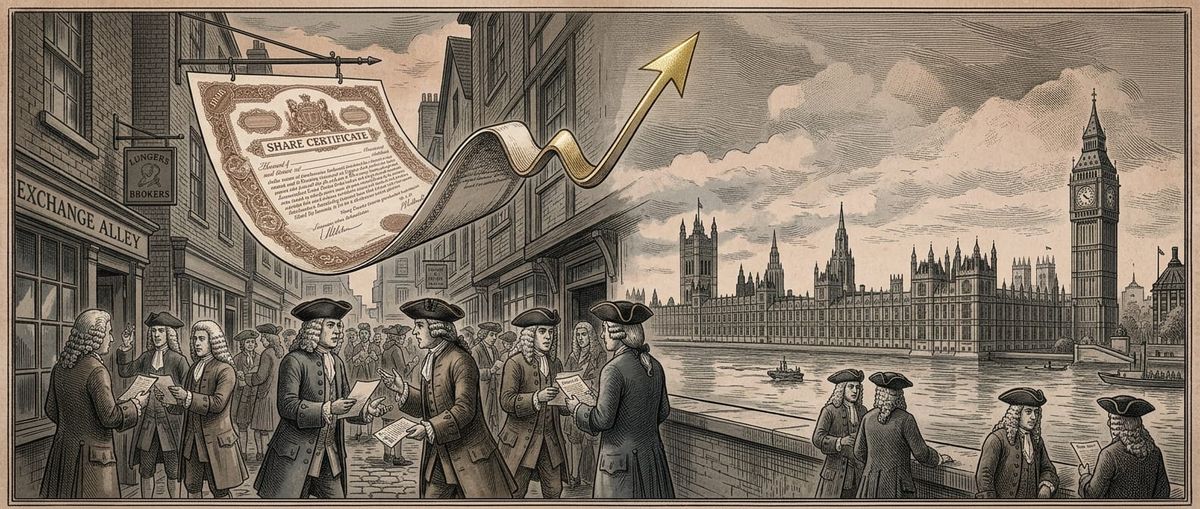
The Druid Deep Dive, episode 11. Ancient wisdom for modern DeFi. Historical period: Britain, 1711 to 1721.
Episode 10 ended with John Law's Mississippi shares collapsing in Paris and Law himself slipping out of France under an assumed name. The obvious question was whether anyone had been watching. Someone had. London ran the same experiment in the same year, with a Parliament instead of a Regent, and got the same result on a faster clock. The two bubbles were not merely contemporaneous. Law's conversion of French state debt into Mississippi Company shares was the explicit template for the South Sea scheme, capital moved between Paris and London as each market rose and fell, and modern research treats 1720 as a single global event spanning three countries. Across Paris, London and the Dutch Republic, more than 50 companies saw their share prices rise between 100 percent and 800 percent in under a year, then surrender nearly all of it within two months [1].
 Sagix
Sagix
What distinguishes the South Sea bubble from its French twin is the role of the state. In Paris, Law ran the scheme and the Regent enabled it. In London, the Treasury was paid for the privilege, ministers held stock they never bought, and the one major piece of securities legislation passed at the peak was drafted for the sponsor's benefit. This episode is about what happens when the entity setting the rules is also long the asset.
A kingdom drowning in annuities
Britain emerged from two decades of war against France with a national debt that had not existed within living memory. A state that owed essentially nothing in 1693 owed roughly £50 million by the late 1710s, much of it in the form of long-term annuities: fixed government payments running for decades, expensive to service and legally difficult to redeem or refinance. The South Sea Company had been founded in 1711, nominally to trade with Spanish South America, in practice as a vehicle for holding government debt in exchange for interest payments and a trade monopoly that never earned serious money [2].
On January 22, 1720, Chancellor of the Exchequer John Aislabie presented the company's proposal to the House of Commons: the South Sea Company would take responsibility for the national debt by persuading holders of annuities and redeemable securities, roughly £31.5 million in total, to convert their government claims into company stock [2, 3]. The Bank of England submitted a rival proposal, the two institutions bid against each other for the franchise, and the South Sea Company won, in part by raising its cash offer to the Treasury above £7.5 million and in part through payments of a less official character [3, 4]. The Commons accepted the company's terms on February 2 and the conversion act received royal assent on April 7 [3].
Note what was actually sold. The government did not sell an asset. It sold the right to convert its own liabilities into someone else's equity, and it collected a fee that depended on the conversion succeeding. From the first day, the state's fiscal interest and the company's share price pointed in the same direction.
The conversion machine
The mechanics rewarded a rising price by design. For every £100 of debt the company retired, it was authorized to create £100 of new stock at par. The conversion itself, however, happened at market value. If the market priced a £100 par share at £300, then retiring £300 of annuities consumed only one share and left two authorized shares free for the company to sell for cash [5]. The arithmetic made the share price the company's actual product. The higher the price at conversion, the fewer shares each annuitant received, and the larger the surplus the company could sell into the rally it was itself producing [5].
So the company produced the rally. It ran four cash subscriptions between April and August at successively higher prices, requiring only small down payments with the balance due in installments, and it lent money to investors against the security of its own shares, so that the same capital could be pledged back into the stock that collateralized it [5, 3]. Recent scholarship on the company's cash management argues that its price-support operations were deliberate and central, not incidental [7]. The result was a price curve with no eighteenth-century precedent: from about £128 in January 1720, South Sea stock passed £300 in the spring and reached the neighborhood of £1,000 in midsummer, before falling to roughly £200 by the end of September [6, 3].
Readers of episode 10 will recognize every component. Law's bank lent against Mississippi shares, Law's company set the price at which state debt converted into equity, and Law's system likewise depended on each stage of the pyramid being priced off the stage before it. The South Sea directors did not hide the debt; John Blunt had studied the Paris operation closely and compressed its timeline.
Parliament joins the pump
The company's political engineering was as systematic as its financial engineering. Fictitious stock, granted on paper with no payment required, was allotted to ministers, courtiers and members of both Houses, who could later "sell" the holdings back to the company and pocket the price appreciation as cash [5, 2]. The King lent his name as the company's governor [3]. Aislabie, the scheme's sponsor in the Commons, took allocations on terms unavailable to the public [3].
The clearest artifact of capture is the Bubble Act, which received royal assent in June 1720 near the peak of the boom. The statute is remembered as an early attempt at investor protection, since it prohibited joint-stock companies from operating without a charter from Parliament or the Crown. The historical record supports a different reading. Ron Harris's study of the act's passage found direct evidence of the South Sea Company's involvement and concluded it was special-interest legislation for the company, designed to suppress the swarm of rival share promotions competing for the same speculative capital the company needed for its subscriptions [8]. The Federal Reserve Bank of New York's historical account reaches the same conclusion, describing the act as the government hampering rival investment opportunities to divert capital toward South Sea shares [4]. The same statute, in the same breath, chartered two new marine insurance corporations that had paid handsomely for the privilege [8]. Regulation arrived at the top of the market, written by the incumbent, aimed at the competition.
When enforcement of the act against smaller companies began in August, it did not protect anyone. Forced selling of the suppressed companies' shares spilled into forced selling of everything, including South Sea stock bought on margin and installment [4].
 Sagix
Sagix
The collapse and the reckoning
By late September the price was near £200, and a rescue announcement briefly worth a hundred points, a tentative agreement for the Bank of England to absorb South Sea stock at £400, was abandoned within weeks [6]. Parliament opened an investigation in December. The company's cashier, Robert Knight, fled to the Continent with the ledger recording the fictitious stock grants [3]. Aislabie was expelled from the Commons, stripped of gains the inquiry put at £45,000, and imprisoned in the Tower [3, 5]. Parliament confiscated the directors' estates to compensate investors, reducing Blunt's fortune from over £180,000 to £1,000, and Robert Walpole rose to power managing the settlement, restructuring the company's obligations and, his critics said, screening the court from the inquiry's reach [5, 3].
The conversion, it should be said, was never reversed. The annuitants who exchanged government claims for company stock near the top kept their stock. The debt-for-equity swap transferred risk from the state to the crowd, and when the equity collapsed, the transfer stood.
What actually happened, and to whom
The Druid's standing rule is to check the legend against the ledger, and the South Sea legend needs checking in both directions. Julian Hoppit's study of the bubble's afterlife argues that the popular picture of universal ruin is a later construction, that verifiable bankruptcies and estate sales in 1720 and 1721 were fewer than the mythology implies, and that the Bubble, in his phrase, "has itself been bubbled" [9]. Exposure was concentrated among those who bought late, on installment, or with borrowed money, which is a portfolio observation, not a moral one.
Nor was everyone fooled. Temin and Voth's reconstruction of Hoare's Bank's daily trading shows a sophisticated investor that judged the stock overvalued and bought anyway, riding the bubble profitably because no coordinating event yet existed to make attacking it pay [10]. Isaac Newton is the counterexample: Odlyzko's forensic work on the surviving records concludes the famous tale, early gains cashed out, re-entry near the top, heavy losses, is almost certainly true in substance even though it rests on scraps of evidence and a quotation he probably never said [6]. Knowing it is a bubble does not protect you. It merely changes the story you tell yourself while participating.
One more complication, because the record demands it: the conversion scheme was not the whole of 1720. Frehen, Goetzmann and Rouwenhorst's cross-sectional price data, hand-collected across the three markets, shows the sharpest gains in Atlantic trade and, above all, newly chartered insurance companies, evidence that genuine financial innovation, not only debt-conversion arithmetic, powered part of the boom [1, 11]. Bubbles recruit real innovation as cover. That was true of insurance in 1720 and it complicates any story that reduces the year to a single fraud.
The modern parallel: when the sponsor makes the market
Three centuries later, the debt-for-equity conversion machine is running again, this time in reverse gear: instead of a company converting government debt into its own equity, public companies convert their own equity into crypto assets. By early 2026, more than 200 publicly listed companies held digital assets on their balance sheets, collectively above $115 billion [12]. The digital asset treasury model works like this: issue shares at a premium to the net asset value of the tokens held, use the proceeds to buy more tokens, report the rising tokens-per-share, and let the premium justify the next issuance. As with the South Sea conversion, the sponsor's profit engine is the gap between the market price of its paper and the value of what the paper claims, and the engine runs only while the price rises.
The 1720 features reappear with unusual fidelity. Token foundations sell locked or discounted tokens into these vehicles in exchange for equity, converting an illiquid claim into a liquid one at a ratio the sponsor's own market sets [13]. One arrangement disclosed on the SEC's EDGAR system in August 2025 deserves to be read alongside the South Sea subscription books: a distilling company raised a $220 million private placement to become a token treasury vehicle, allocated $82 million to buy tokens directly from the token's own foundation at a fixed $3.40 per token, and the foundation committed to spend 100 percent of the net cash proceeds repurchasing its own token in the open market within 90 days [14]. Issuer, market maker and price setter, converging on the same balance sheet, disclosed in an exhibit rather than a green book.
The financing wave was broad. At least 40 treasury companies raised more than $15 billion through private investments in public equity between April and November 2025, only five of them focused on bitcoin [15]. The installment-and-lockup structure produced familiar dynamics: in one case study, the stock fell roughly 40 percent on the day the resale registration became effective, while the private placement investors still exited with nearly 15 times their money in nine days [16]. Analytics firms now observe that these stocks gravitate toward their private placement issuance prices once lockups expire [17]. And the machine has inverted: by late 2025 the market-to-net-asset-value ratio had fallen below 1.00 for most treasury companies, including the largest [13]. Below that line, issuing shares to buy tokens destroys value per share, and the reflexive loop that built the structures runs backward, in some cases pushing companies to sell the asset in order to buy back their own stock [13].
The third South Sea ingredient, the state as counterparty, has also returned in structural form. A March 2025 executive order established a federal strategic bitcoin reserve, and states including New Hampshire, Arizona and Texas have enacted reserve laws of their own [18, 19]. The Druid draws no conclusion about how those positions perform. The 1720 lesson is narrower and more useful: when the rule-setter holds the asset, read every subsequent rule the way Harris read the Bubble Act, by asking whose inventory it protects [8].
Portfolio lessons
First, price the machine, not the story. The South Sea Company and the treasury company share a signature: an entity whose earnings are a function of its own security's price. Any structure that must issue paper above intrinsic value to keep operating carries its failure mode in its charter, and the honest question to ask before allocating is what the entity does on the day the premium reaches 1.0. In 1720 the answer was subscriptions on installment and loans against its own stock [5]. In 2025 it was private placements and, at the end, asset sales to fund buybacks [13].
Second, the exit is the entry. When the sponsor is the dominant market maker in its own paper, liquidity is a description of the sponsor's balance sheet, not of the market. The annuitants who converted at £800 discovered this, as did placement investors watching lockups expire [16]. Position sizes in any sponsor-run market should be set on the assumption that the exit price is the sponsor's price, not the screen's.
Third, size the damage by exposure, not by peak prices. Hoppit's revision matters for portfolio construction: the bubble's harm concentrated in late, leveraged, undiversified buyers [9]. A portfolio diversified across asset classes, geographies and time horizons limits the claim any single conversion machine can make on it, and zero leverage removes the mechanism, installment payments then, margin now, by which a drawdown becomes a liquidation.
Fourth, knowing is not enough. Hoare's Bank knew and rode the bubble anyway; Newton knew the mathematics of anything better than any man alive and re-entered near the top [10, 6]. The defense against a machine built to reward participation is not superior insight, it is process: rules for entry, sizing and rebalancing that are written before the summer of £1,000 arrives and are not renegotiated during it. Survival over optimization was the correct objective in 1720. Nothing in the intervening three centuries has changed it.
 Sagix
Sagix
 Sagix
Sagix
 Sagix
Sagix
Educational purpose only: This content is provided exclusively for educational and historical research purposes. It should not be construed as investment advice, financial planning guidance, policy recommendations, or official economic analysis. Any contemporary parallels or policy discussions are presented as academic analysis, not recommendations for action. Historical patterns provide context for learning but do not predict future financial system outcomes or investment performance.
AI-assisted research disclosure: This historical analysis was researched and written with substantial assistance from artificial intelligence technology (Claude, Anthropic). While extensive efforts were made to verify all statistical claims, citations, and institutional analysis against authoritative sources, readers should independently verify any information before relying on it for academic, professional, investment, or policy purposes.
Accuracy and liability limitations: While extensive effort has been made to ensure historical accuracy through authoritative sources, the authors make no warranties about completeness, accuracy, or currency of information. Historical interpretation involves scholarly judgment and academic debate. Economic data may contain revisions, measurement inconsistencies, or reporting variations across time periods and institutional sources. The authors and publisher assume no responsibility for errors, omissions, or consequences arising from the use of this information, including any errors resulting from AI assistance. Users assume full responsibility for decisions or actions taken based on this content.
Investment risk warning: Historical financial analysis does not constitute investment advice or recommendations. Past performance, whether historical or hypothetical, does not guarantee future results. All investments carry risk of loss. Readers should conduct their own research and consult qualified financial advisors before making investment decisions.
No professional relationship: This content does not create any professional, advisory, fiduciary, or client relationship between the reader and The Genesis Address LLC, its authors, or affiliated entities. Readers seeking financial, investment, legal, regulatory, or policy guidance should consult qualified professionals licensed in their jurisdiction.
Methodological note: This analysis synthesizes findings from central bank research departments, National Bureau of Economic Research publications, peer-reviewed academic journals, and authoritative government historical records. The numbered citation system allows readers to verify specific claims against original sources rather than relying on secondary interpretations.
References to modern financial systems, cryptocurrency protocols, or DeFi mechanisms are made for educational comparison purposes only. These comparisons do not constitute endorsements, recommendations, or predictions about the performance or suitability of any current financial products or services.
Historical analysis of financial crises is provided for educational understanding of systemic risk patterns. This content does not predict future crises or recommend specific crisis preparation strategies. Readers should consult qualified professionals for personalized risk management advice.
Publication information: Last updated: August 16, 2026 | Series: The Druid Deep Dive | Publisher: The Genesis Address LLC
Sources and references
[1] Frehen, Rik G.P., William N. Goetzmann, and K. Geert Rouwenhorst. "New Evidence on the First Financial Bubble." Journal of Financial Economics 108, no. 3 (2013): 585-607. NBER Working Paper 15332. https://www.nber.org/papers/w15332.
[2] Littleton, Charles. "A Trojan horse in the House of Lords? The South Sea Company and the peerage." The History of Parliament. January 9, 2020. https://historyofparliament.com/2020/01/09/south-sea-company-and-peerage/.
[3] Dale, Richard. The First Crash: Lessons from the South Sea Bubble. Princeton University Press, 2004.
[4] Narron, James, and David Skeie. "Crisis Chronicles: The South Sea Bubble of 1720, Repackaging Debt and the Current Reach for Yield." Federal Reserve Bank of New York, Liberty Street Economics. November 8, 2013. https://libertystreeteconomics.newyorkfed.org/2013/11/crisis-chronicles-the-south-sea-bubble-of-1720repackaging-debt-and-the-current-reach-for-yield.
[5] Harvard Library. "The Crash." The South Sea Bubble, 1720. CURIOSity Digital Collections. https://curiosity.lib.harvard.edu/south-sea-bubble/feature/the-crash.
[6] Odlyzko, Andrew. "Newton's financial misadventures in the South Sea Bubble." Notes and Records: The Royal Society Journal of the History of Science 73, no. 1 (2019): 29-59. https://royalsocietypublishing.org/doi/full/10.1098/rsnr.2018.0018.
[7] Economic History Society. "The South Sea Bubble 300 Years On." November 2020. https://ehs.org.uk/the-south-sea-bubble-300-years-on/.
[8] Harris, Ron. "The Bubble Act: Its Passage and Its Effects on Business Organization." The Journal of Economic History 54, no. 3 (1994): 610-627. https://ideas.repec.org/a/cup/jechis/v54y1994i03p610-627_01.html.
[9] Hoppit, Julian. "The Myths of the South Sea Bubble." Transactions of the Royal Historical Society 12 (2002): 141-165. https://discovery.ucl.ac.uk/12397/.
[10] Temin, Peter, and Hans-Joachim Voth. "Riding the South Sea Bubble." American Economic Review 94, no. 5 (2004): 1654-1668. https://www.aeaweb.org/articles?id=10.1257/0002828043052268.
[11] Yale School of Management, International Center for Finance. "South Sea Bubble 1720 Project." Historical financial research data. https://som.yale.edu/centers/international-center-for-finance/data/historical-financial-research-data/south-seas-bubble-1720.
[12] Coindesk. "Digital asset treasuries must now earn their keep." April 4, 2026. https://www.coindesk.com/opinion/2026/04/04/digital-asset-treasuries-must-now-earn-their-keep.
[13] CoinDesk Research. "State of the Blockchain 2025." https://www.coindesk.com/research/state-of-the-blockchain-2025.
[14] U.S. Securities and Exchange Commission, EDGAR. "Heritage Distilling (Nasdaq: CASK) and Story Foundation Announce the Launch of $360M $IP Token Reserve." Exhibit 99.1, Form 8-K. August 2025. https://www.sec.gov/Archives/edgar/data/1788230/000164117225022916/ex99-1.htm.
[15] Reuters. "Crypto treasury companies pivot to fringe tokens, stoking volatility fears." November 10, 2025. Republished by Kitco News. https://www.kitco.com/news/off-the-wire/2025-11-10/crypto-treasury-companies-pivot-fringe-tokens-stoking-volatility-fears.
[16] NYDIG Research. "The Art of the (Crypto Treasury) Deal." July 2025. https://www.nydig.com/research/the-art-of-the-crypto-treasury-deal.
[17] Yahoo Finance. "Crypto Treasury Stocks at Risk of 50% Crash After PIPE Deals, CryptoQuant Warns." September 26, 2025. https://finance.yahoo.com/news/crypto-treasury-stocks-risk-50-124757404.html.
[18] Proskauer Rose LLP. "Crypto in the Capitol: States Take the Lead on Strategic Bitcoin Reserves." July 23, 2025. https://www.proskauer.com/blog/crypto-in-the-capitol-states-take-the-lead-on-strategic-bitcoin-reserves.
[19] U.S. Congress. "S.954, BITCOIN Act of 2025." 119th Congress (2025-2026). https://www.congress.gov/bill/119th-congress/senate-bill/954/text.
Publisher: The Genesis Address LLC