The Druid Deep Dive, Episode 16: Scottish free banking: what held it up (1727-1845)
For a century Scotland's banknotes were issued by rival banks, cleared weekly and held at par with no central bank. Episode 16 finds what held them, a note exchange, partners' estates and London, then reads 22 rollups against it: they have the exchange and the delay clause, and no liability.

For a century Scotland's banknotes were issued by rival banks, cleared weekly and held at par with no central bank. Episode 16 finds what held them, a note exchange, partners' estates and London, then reads 22 rollups against it: they have the exchange and the delay clause, and no liability.
The Druid Deep Dive, episode 16. Ancient wisdom for modern DeFi. Historical period: Scotland, 1727 to 1845.
Episode 15 followed a banking network that ran across borders without a central authority. Scotland ran a currency that way. From 1727 to 1845 Scottish banknotes were issued by rival banks, redeemed in coin, and cleared against one another every week with no central bank in the system [1, 14]. The record is good enough to be the free banking school's exhibit A and contested enough that the critics have a literature of their own. What follows asks what held the notes at par, then reads the rollups that settle to Ethereum against it: they have the exchange and the delay clause, and nothing that resembles the liability.
 Sagix

Two banks, then thirty
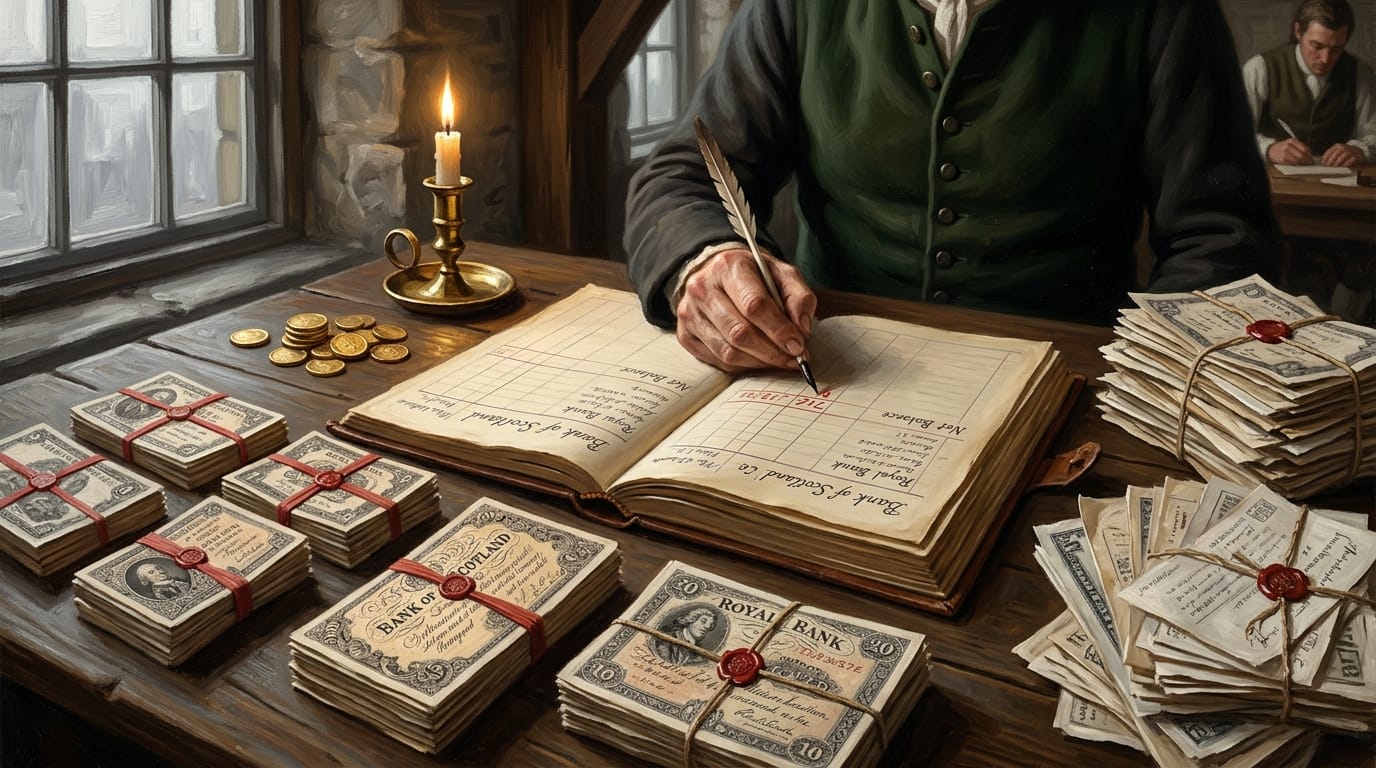
The Bank of Scotland, chartered in 1695, let its monopoly lapse by 1716; a royal charter of 1727 created the Royal Bank of Scotland to compete with it, welcomed by customers who resented the old bank's restrictive practices, and a third charter went in 1746 to the British Linen Company, a linen trader that drifted into banking [1, 14, 5]. These three had limited liability. Every other issuer in Scotland was a partnership whose partners were liable to their last acre [1].
Competition began with the notes: each bank's agents collected the other's paper and presented it in bulk for coin, a practice Kroszner calls note dueling and credits with forcing both to hold reserves [1]. Then came the cash account, a line of credit the borrower could draw and repay at will [2]. Then the option clause. By the 1750s a Bank of Scotland note promised payment on demand or, at the directors' option, six months later with interest at the legal ceiling of five percent, and by the early 1760s nearly every issuer carried the same clause [1, 3]. Smith reported that the exchange between Dumfries, where bills were paid in Scotch notes, and Carlisle, where they were paid in coin, ran four percent against Dumfries [2, 9].
Kroszner's count gives 31 banks in Scotland in 1772, 37 in 1810 and 36 in 1830 [1]. By 1844 there were 19 banks of issue with 363 branches, one office for every 6,600 people against one for every 9,405 in England [5, 6].
The exchange, and what it did to reserves
The Act of 1765 is where the legend and the archive part. It banned the option clause and notes under one pound, required every note to be payable on demand without any reserved power of delay, and gave the holder of an unpaid note summary diligence against the banker, with interest from the date of demand [3, 1]. Kroszner and Goodspeed both record that the big established banks lobbied for it [1, 11].
What replaced the option clause was private. By 1770 to 1771 a general note exchange met weekly in Edinburgh, netted every bank's holdings of every other bank's paper, and settled the balances in coin, securities or deposits [1]. It had no capital rule and no liquidity rule; a member had to settle its net balance by the end of the week, and that was the system's only prudential regulation [1]. Boston's Suffolk system in episode 3 did the same work with one bank at the centre; Edinburgh had none.
The exchange made every bank's notes good at par across the country, since a rival's note could be cleared within the week, and it taught the banks how little coin they needed. Kroszner puts specie reserves at about half of demandable liabilities after 1765 and at roughly two to three percent by the early nineteenth century; Sechrest's sample of six provincial companies shows the ratio falling from ten to twenty percent to between 0.5 and 3.2 percent over the same span [1, 9]. A system that clears weekly can run on a thin reserve. It can also run out of one faster, and the place the Scottish banks went when they ran out was London.
 Sagix

The Ayr Bank: what failure cost, and who paid
Douglas, Heron and Company, the Ayr Bank, opened with the express purpose, in Smith's phrase, of relieving the distress of the country, and by his account ran a little more than two years before it stopped, in June 1772 [2, 12]. It subscribed £160,000 of capital, lent upwards of £800,000 at five percent, had about £200,000 of notes out when it stopped, and had drawn and redrawn upwards of £600,000 of bills on London to keep its coffers stocked [2]. Thirteen Edinburgh private bankers fell with it, by Checkland's count [7, 5].
Then the system did what it was built to do. The Edinburgh public banks saw a rise in specie demand that lasted a day, and over 1773 and 1774 they retired the Ayr Bank's notes themselves [5, 6, 12]. The bank's 241 partners, liable without limit, were assessed at something like five to ten times the par value of their shares, and a £500,000 bond secured on £3,000,000 of mortgages over their estates, authorised by an Act of 1774, paid creditors at five percent while the assets were sold [5, 6, 1, 11]. White says the creditors were paid in full; Kroszner says noteholders eventually received most of their nominal value, after a wait [5, 1]. The winding-up ran to 1827 [12]. Goodspeed's reading is that the 1765 Act made it worse, by removing the one clause that would have let a solvent, illiquid bank avoid a fire sale [11]. The law that cleaned up the notes took away the mechanism that would have slowed the run.

The disputed record
Scotland's claim to stability rests on counts, and the counts depend on where the clock starts. White's table for 1809 to 1830 gives Scottish bank failures at 4.0 per thousand banks per year against 18.1 for England [5, 6]. Sechrest extended the Scottish series back to 1772 to take in the Ayr Bank and the seven failures of 1773 to 1808, and got 14.88 per thousand against an English 14.90, a difference he found not statistically significant [5, 9]. White's reply is that the figures are populations, not samples, and that period by period the Scottish rate stays lower [10]. For the English crisis of 1825 and 1826 the rates are 46.4 and 53.1 per thousand against 12.0 and 11.1 in Scotland [5]. The firmer number is losses to noteholders: £32,000 for all Scotland from 1695 to 1841 [5, 6].
The second dispute is over the word free. In 1797 the Bank of England stopped paying coin and the Scottish banks stopped with it, though the Restriction Act of May 1797 never covered them; Selgin's reconstruction is that no creditor sued, because most noteholders were also borrowers on cash accounts [19]. Rothbard's reading is that Scottish redemption was in name only, before 1797 as well as after, and that the banks pyramided on London rather than on gold [8]. White concedes the usual redemption medium was a draft on London [10]. Sechrest adds the lender: roughly £400,000 of the government's 1793 bill issue went to Scottish banks, and in 1830 the two senior chartered banks drew credits of £700,000 between them at the Bank of England [8, 9]. Kroszner's phrase for the Bank of England is shadow central bank: no legal duty to Scotland, and a reserve the Scottish banks could not do without [1].
Read together, the two readings describe one system. Competition and the exchange kept the notes at par and the reserves thin; liability absorbed the failures; and London held the coin.
Parliament closes the list
The one-pound note had beaten off an 1826 attempt on it, with Walter Scott in print as Malachi Malagrowther and two committees concluding the system worked [16, 15]. The Act of 21 July 1845 was different. It provided that no banker might issue notes in Scotland unless already issuing in the year to 1 May 1845, certified each issuer's authorised circulation at its average for that year, allowed issue above that amount only against gold and silver coin held at the head office, and kept the one-pound floor [4]. Kroszner calls the result a cartel [1]. Then came the large failures. The Western Bank of Scotland stopped in 1857, and the panic subsided only when the other banks guaranteed its noteholders [13]. The City of Glasgow Bank stopped in October 1878 with liabilities exceeding assets by £5.2 million, about half a percent of United Kingdom output; its 1,819 shareholders faced calls of £500 a share in November and £2,250 the following April, only about a third met the first in full, and depositors and noteholders were paid in full [13]. Unlimited-liability banks in Britain went from 141 in 1849 to two in 1889 once the Companies Act of 1879 let them convert [13]. The device that had paid the Ayr Bank's creditors was retired for what it did to the Glasgow bank's shareholders.
The list Parliament certified in 1845 has only shortened since. Three banks issue notes in Scotland today, Bank of Scotland, Clydesdale and the Royal Bank, under Part 6 of the Banking Act 2009, and at 28 February 2026 they had £4.84 billion of notes in circulation, backed at all times by Bank of England notes, United Kingdom coin or a deposit at the Bank of England, at least sixty percent of it in notes and coin [17, 18]. The competitive note issue ended in 1845. The private note did not.
The modern parallel: twenty-two issuers, one reserve
A rollup balance is a claim on assets held in a contract on the base chain, redeemable through that contract, which is the structure of a Scottish note, a claim on coin in Edinburgh or London. The exchange exists too: since the Dencun upgrade activated EIP-4844 on 13 March 2024, every rollup posts its data to the same ledger and settles to the same asset [20, 21].
The option clause exists as well, and nobody has banned it. Optimism's documentation states that the Standard Bridge delays a withdrawal claim by seven days so the fault proof system can filter out invalid claims; Arbitrum's states that a user whose transaction the sequencer will not include may force it onto the chain after 24 hours [22, 23]. A note payable on demand or six months later at the directors' option and a withdrawal payable seven days after the claim unless challenged are one device: a deferral written on the face of the instrument, in exchange for a form of safety.
What the public reads instead of a balance sheet is a stage. Buterin's 2022 milestones run from stage 0, where a multisig posts state roots with no proof system, through stage 1, where a proof system rules and a council of at least six of eight may override it only for bugs, to stage 2, where no group can post a false root [24]. L2BEAT, which applies the framework, calls itself a public goods company financed in the open; its disclosure lists a partnership fund to which Arbitrum Orbit, Superchain and other rated ecosystems contribute, so some of the graded pay for the grading [26]. On its rollups tab on 15 October 2026 it lists 22 rollups, twelve at stage 0, six at stage 1 and four at stage 2; the three largest, Base, Arbitrum One and OP Mainnet, all stage 1, secure $28.1 billion of the $32.7 billion on the list, and the four stage 2 rollups together secure under a million dollars [25]. The sound end of the system holds almost none of the money.
Then the Ayr Bank. Aztec Connect was a privacy rollup on Ethereum. On 13 March 2023 Aztec Labs announced it would sunset the system, citing the cost of running it alongside its new network; the sequencer sent its last rollup on 31 March 2024, and on 1 May 2024 the ownership and governance roles of the rollup contract were irrevocably renounced [28, 27]. L2BEAT lists the exit window as infinite, since the contracts cannot be upgraded, and the only withdrawal path as a manual tool [27]. On 15 June 2026 someone found a bug in the immutable contract. PeckShield, a security vendor, estimated the loss at about $2.17 million, including 1,158 ETH and 150,000 DAI, as reported by The Block; L2BEAT records roughly $2.3 million [29, 27]. Aztec Labs, the Foundation said, held no admin keys over it [29].
The structure is stated here and left. In 1772 the issuer stopped and 241 partners' estates stood behind the paper for fifty-five years. In 2024 the issuer stopped, renounced control and left an immutable contract with the door open. The door protects a user against the operator. It protects no one against the code, and there is no estate.
Portfolio lessons
First, count the exits, not the issuers. Scotland's notes held at par because any holder could clear them at a weekly exchange and, on paper, demand coin [1, 3]. A rollup balance is sound to the extent the holder can leave through the base chain without the operator's consent, and the stage is a rough measure of that; nearly all the value on L2BEAT's list sits on stage 1 chains, where a council can still intervene [24, 25]. Six rollups whose exits all run through one kind of council are one exposure wearing six names.
Second, a deferral clause disclosed in advance is a liquidity term, not a fraud. The seven-day withdrawal window is the option clause with the interest left off, and the 1765 ban on the original is Goodspeed's candidate for why 1772 ran so hard [11, 22]. The lesson from the four-layer framework is to price the window before it is needed: what may be wanted inside seven days does not belong on an optimistic rollup, and an allocation that assumes instant redemption has mistaken a note for coin.
Third, ask who pays when an issuer fails, and if the answer is nobody, size accordingly. The Ayr Bank's creditors were paid out of £3,000,000 of mortgaged estates; the City of Glasgow Bank's out of calls totalling £2,750 a share that ruined the shareholders [11, 13]. A rollup's users have the operator's reputation, worth nothing once the keys are renounced, and the code, which is what a bug reaches. The honest size for a code exposure is the size one can lose: survival over optimization, applied to code.
Fourth, the statute that closes the list chooses the survivors, and the survivors then have the large failures. The 1845 Act froze the roster, and the two biggest Scottish collapses came in 1857 and 1878, inside the cartel [4, 13]. When entry closes, exposure can no longer be spread across new issuers, and the survivors grow larger and harder to let fail. The moment to watch for in rollups is the one that turns a list of twenty-two into a list of three, remembering that Scotland's three are still issuing 181 years on, every note backed one for one at the central bank the system once did without [17].
 Sagix

 Sagix

Educational purpose only: This content is provided exclusively for educational and historical research purposes. It should not be construed as investment advice, financial planning guidance, policy recommendations, or official economic analysis. Any contemporary parallels or policy discussions are presented as academic analysis, not recommendations for action. Historical patterns provide context for learning but do not predict future financial system outcomes or investment performance.
AI-assisted research disclosure: This historical analysis was researched and written with substantial assistance from artificial intelligence technology (Claude, Anthropic). While extensive efforts were made to verify all statistical claims, citations, and institutional analysis against authoritative sources, readers should independently verify any information before relying on it for academic, professional, investment, or policy purposes.
Accuracy and liability limitations: While extensive effort has been made to ensure historical accuracy through authoritative sources, the authors make no warranties about completeness, accuracy, or currency of information. Historical interpretation involves scholarly judgment and academic debate. Economic data may contain revisions, measurement inconsistencies, or reporting variations across time periods and institutional sources. The authors and publisher assume no responsibility for errors, omissions, or consequences arising from the use of this information, including any errors resulting from AI assistance. Users assume full responsibility for decisions or actions taken based on this content.
Investment risk warning: Historical financial analysis does not constitute investment advice or recommendations. Past performance, whether historical or hypothetical, does not guarantee future results. All investments carry risk of loss. Readers should conduct their own research and consult qualified financial advisors before making investment decisions.
No professional relationship: This content does not create any professional, advisory, fiduciary, or client relationship between the reader and The Genesis Address Publishing LLC, its authors, or affiliated entities. Readers seeking financial, investment, legal, regulatory, or policy guidance should consult qualified professionals licensed in their jurisdiction.
Methodological note: This analysis synthesizes findings from central bank research departments, National Bureau of Economic Research publications, peer-reviewed academic journals, and authoritative government historical records. The numbered citation system allows readers to verify specific claims against original sources rather than relying on secondary interpretations.
References to modern financial systems, cryptocurrency protocols, or DeFi mechanisms are made for educational comparison purposes only. These comparisons do not constitute endorsements, recommendations, or predictions about the performance or suitability of any current financial products or services.
Analysis of international monetary systems and policies is presented for historical educational purposes. Different jurisdictions have varying regulatory frameworks, and this content should not be interpreted as applicable to any specific jurisdiction's current legal or regulatory environment.
Historical analysis of financial crises is provided for educational understanding of systemic risk patterns. This content does not predict future crises or recommend specific crisis preparation strategies. Readers should consult qualified professionals for personalized risk management advice.
Publication information: Last updated: October 15, 2026 | Series: The Druid Deep Dive | Publisher: The Genesis Address Publishing LLC
Sources and references
[1] Kroszner, Randall. "Free Banking: The Scottish Experience as a Model for Emerging Economies." Policy Research Working Paper 1536. World Bank, November 1995. https://documents1.worldbank.org/curated/en/719951468760530224/pdf/multi_page.pdf.
[2] Smith, Adam. An Inquiry into the Nature and Causes of the Wealth of Nations. Book II, Chapter II. Edited by Edwin Cannan, 1904. Library of Economics and Liberty. https://www.econlib.org/library/Smith/smWN7.html.
[3] Parliament of Great Britain. Bank Notes (Scotland) Act 1765, 5 Geo. 3 c. 49. legislation.gov.uk. https://www.legislation.gov.uk/apgb/Geo3/5/49.
[4] Parliament of the United Kingdom. Bank Notes (Scotland) Act 1845, 8 & 9 Vict. c. 38. legislation.gov.uk. https://www.legislation.gov.uk/ukpga/Vict/8-9/38.
[5] Sechrest, Larry J. "Scottish Free Banking." Chapter 5 of Free Banking: Theory, History, and a Laissez-Faire Model. Westport: Quorum Books, 1993. Mises Institute online edition. https://mises.org/online-book/free-banking-theory-history-and-laissez-faire-model/5-scottish-free-banking.
[6] White, Lawrence H. Free Banking in Britain: Theory, Experience and Debate, 1800-1845. 2nd edition. London: Institute of Economic Affairs, 1995. First edition Cambridge University Press, 1984. https://iea.org.uk/wp-content/uploads/2016/07/upldbook115pdf.pdf.
[7] Checkland, S. G. Scottish Banking: A History, 1695-1973. Glasgow and London: Collins, 1975.
[8] Rothbard, Murray N. "The Myth of Free Banking in Scotland." Review of Austrian Economics 2, no. 1 (1988): 229-245. https://mises.org/online-book/review-austrian-economics/myth-free-banking-scotland.
[9] Sechrest, Larry J. "White's Free-Banking Thesis: A Case of Mistaken Identity." Review of Austrian Economics 2, no. 1 (1988): 247-257. https://mises.org/online-book/review-austrian-economics/whites-free-banking-thesis-case-mistaken-identity.
[10] White, Lawrence H. "Free Banking in Scotland: Reply to a Dissenting View." Cato Journal 10, no. 3 (Winter 1991). https://cato.org/cato-journal/winter-1991/free-banking-scotland-reply-dissenting-view.
[11] Goodspeed, Tyler Beck. "Legislating Instability." Research Briefs in Economic Policy no. 55. Cato Institute, July 6, 2016. Summarizing Legislating Instability: Adam Smith, Free Banking, and the Financial Crisis of 1772. Cambridge, MA: Harvard University Press, 2016. https://cato.org/research-briefs-economic-policy/legislating-instability.
[12] Kosmetatos, Paul. "The winding-up of the Ayr Bank, 1772-1827." Financial History Review 21, no. 2 (August 2014): 165-190. https://ideas.repec.org/a/cup/fihrev/v21y2014i02p165-190_00.html.
[13] Button, Richard, Samuel Knott, Conor Macmanus and Matthew Willison. "Desperate adventurers and men of straw: the failure of City of Glasgow Bank and its enduring impact on the UK banking system." Bank of England Quarterly Bulletin 2015 Q1: 24-35. https://www.bankofengland.co.uk/-/media/boe/files/quarterly-bulletin/2015/desperate-adventures-and-men-of-straw-the-failure-of-city-of-glasgow.pdf.
[14] NatWest Group Heritage Hub. "Founding charter, 1727." History 100, Turning points. https://www.natwestgroup.com/heritage/history-100/objects-by-theme/turning-points/founding-charter-1727.html.
[15] NatWest Group Heritage Hub. "£1 note, 1827." History 100, Serving our customers. https://natwestgroup.com/heritage/history-100/objects-by-theme/serving-our-customers/one-pound-note-1827.html.
[16] Walter Scott Digital Archive, Edinburgh University Library. "The Letters of Malachi Malagrowther." https://www.walterscott.lib.ed.ac.uk/works/prose/malachi.html.
[17] Bank of England. "Scottish and Northern Ireland Banknote Issuance Annual Report 2026." Published October 1, 2026, covering March 1, 2025 to February 28, 2026. https://www.bankofengland.co.uk/banknotes/scottish-and-northern-ireland-banknotes/2026-annual-report.
[18] Bank of England. "Scottish and Northern Ireland banknotes." https://www.bankofengland.co.uk/banknotes/scottish-and-northern-ireland-banknotes.
[19] Selgin, George. "The Scottish Banks and the Bank Restriction, 1797-1821, Part 1." Alt-M, Cato Institute, October 9, 2018. https://cato.org/blog/scottish-banks-bank-restriction-1797-1821-part-1.
[20] Ethereum Foundation, Protocol Support Team. "Dencun Mainnet Announcement." Ethereum Foundation Blog, February 27, 2024. https://blog.ethereum.org/2024/02/27/dencun-mainnet-announcement.
[21] Buterin, Vitalik, Dankrad Feist, Diederik Loerakker, George Kadianakis, Matt Garnett, Mofi Taiwo and Ansgar Dietrichs. "EIP-4844: Shard Blob Transactions." Ethereum Improvement Proposals, created February 25, 2022, status Final. https://eips.ethereum.org/EIPS/eip-4844.
[22] Optimism. "Transaction finality." OP Stack documentation. https://docs.optimism.io/op-stack/transactions/transaction-finality.
[23] Arbitrum. "The Sequencer." Arbitrum documentation, How Arbitrum works. https://docs.arbitrum.io/how-arbitrum-works/sequencer.
[24] Buterin, Vitalik. "Proposed milestones for rollups taking off training wheels." Ethereum Magicians, November 2, 2022. https://ethereum-magicians.org/t/proposed-milestones-for-rollups-taking-off-training-wheels/11571.
[25] L2BEAT. "Scaling summary, Rollups." Accessed October 15, 2026. https://l2beat.com/scaling/summary?tab=rollups.
[26] L2BEAT. "Donate: funding sources." Accessed October 15, 2026. https://l2beat.com/donate.
[27] L2BEAT. "Aztec Connect." Project page, archived. Accessed October 15, 2026. https://l2beat.com/projects/aztecconnect.
[28] Aztec Labs. "Sunsetting Aztec Connect." The Aztec Labs Blog, March 13, 2023. https://medium.com/aztec-protocol/sunsetting-aztec-connect-a786edce5cae.
[29] Hunt, James. "Aztec investigates $2 million exploit of deprecated payments product." The Block, June 18, 2026. https://www.theblock.co/post/405207/aztec-investigates-2-million-exploit-of-deprecated-payments-product.
Publisher: The Genesis Address Publishing LLC


