Crypto as a downstream AI story: the iPhone-to-Uber case
Tom Lee and a retail trading stream agree crypto is a downstream AI story. We test the iPhone-to-Uber case against the x402 Foundation roster, a16z's $1.6M monthly figure, and Solana's Alpenglow activation.

Sagix analysis, October 21, 2026
The chairman of the largest Ethereum treasury and a retail trading livestream arrived at the same sentence this month: crypto is a downstream AI story. Tom Lee put it in Bitmine's October 7 Chairman's Message, as the fourth of four reasons he expects this cycle to be the largest, and said agents will carry digital wallets while crypto keeps humans in the loop [1]. On Wednesday morning, with Solana's Alpenglow upgrade activating mid-stream, Crypto Banter's host told viewers that every token is an AI token, that Uniswap is AI trading and Pyth is AI oracles, and that the users of NEAR intents and Lighter will be agents rather than people [2].
The two speakers share a book as well as a thesis. Bitmine held 6,041,481 ETH as of October 18, about 4.9% of supply [5], and Lee told Token2049 in Singapore the company will stop buying at 5% [3][4]. The stream carries referral codes for the perpetuals venue it uses on air and promotes its own trading terminal [2]. Neither interest makes the argument wrong. It does mean the argument has to be tested on structure rather than taken on enthusiasm, and the structure has a precedent.
The iPhone did not invent the taxi
Apple opened the App Store in the second week of July 2008 and reported 10 million downloads in the first three days [6]. By March 2009 Garrett Camp was working on what an iPhone app for hailing a car would look like, and Uber launched in San Francisco on May 31, 2010 [7]. The taxi existed. GPS existed. Card payments existed. What the iPhone supplied was a device in every pocket that knew where it was, held a payment credential, and could receive software from a store. Uber is the combination, and it could not have been built one year earlier.
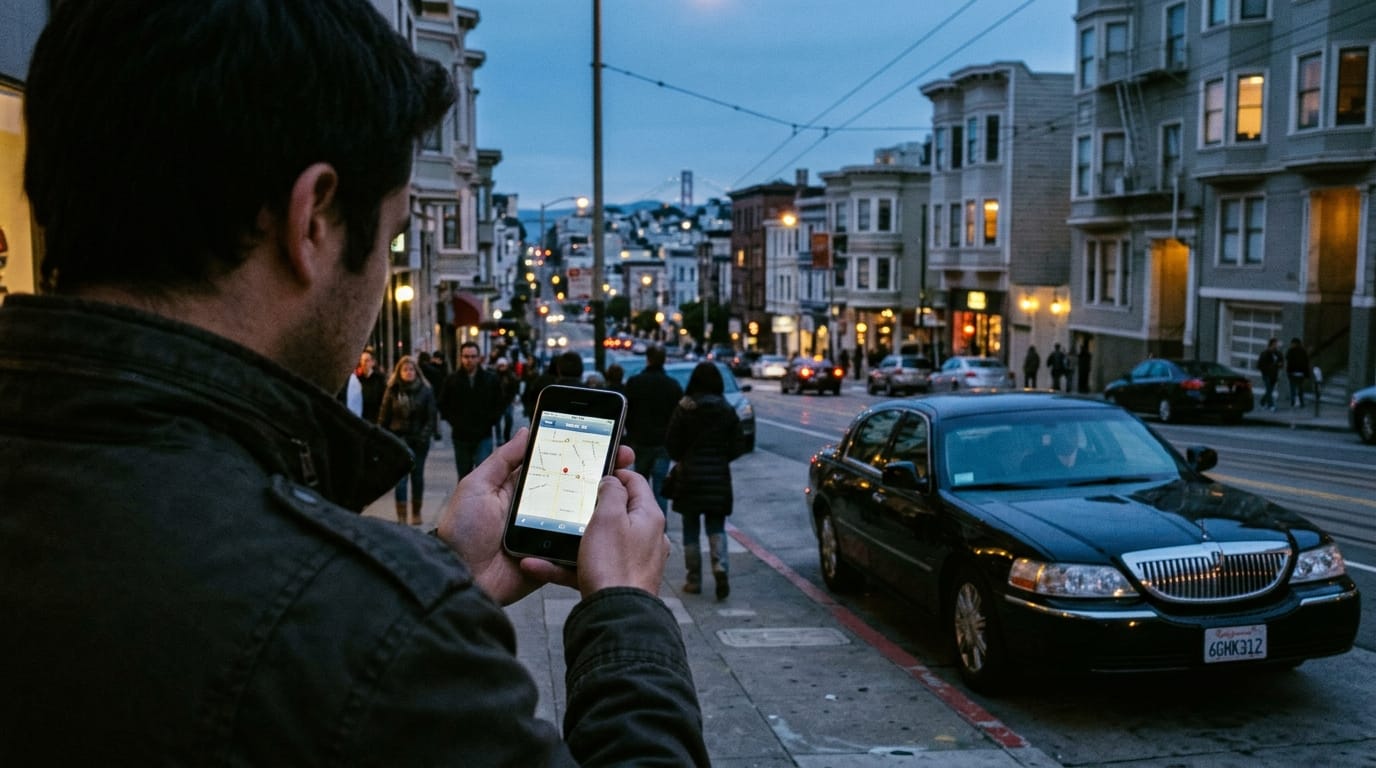
The crypto version of the claim runs the same way. An agent is the new device. It has no card in a physical wallet, no hands to pass a captcha, and it transacts at a cadence no human counterparty keeps. What it needs is a key, a spending rule, and a rail that settles without business hours and without a party on the other end deciding whether to honor the instruction. That is a description of a blockchain, which is why Lee and the stream both reach for one. Lee's phrase for the enforcement half is that crypto keeps humans in the loop; the stream's phrase is that agents will settle on blockchain rails [1][2].
The stream's opening example was the argument in miniature. SpaceX reported third-quarter revenue of $14.58 billion after the close on October 20 [8], and the host spent the first minutes showing viewers a perpetual on the shares trading overnight on a decentralized exchange while the stock market was shut [2]. Whether or not that is an edge for a human trader, it is the only kind of market a software agent can use, because an agent does not wait for 9:30.
The rails are being built by both sides
Marc Andreessen called the convergence the grand unification of AI and crypto on the Latent Space podcast in April, arguing that the internet was built without a native payment layer and that agents and stablecoins can supply one [9]. The more consequential event was quieter. On July 14 the Linux Foundation announced the operational launch of the x402 Foundation, taking over the HTTP-payments protocol Coinbase released in May 2025, with 40 members at launch. The premier tier includes Visa, Mastercard, American Express, Stripe, Adyen, Fiserv, Google, AWS, Cloudflare, Circle, and the Solana Foundation [10].
 The Linux Foundation
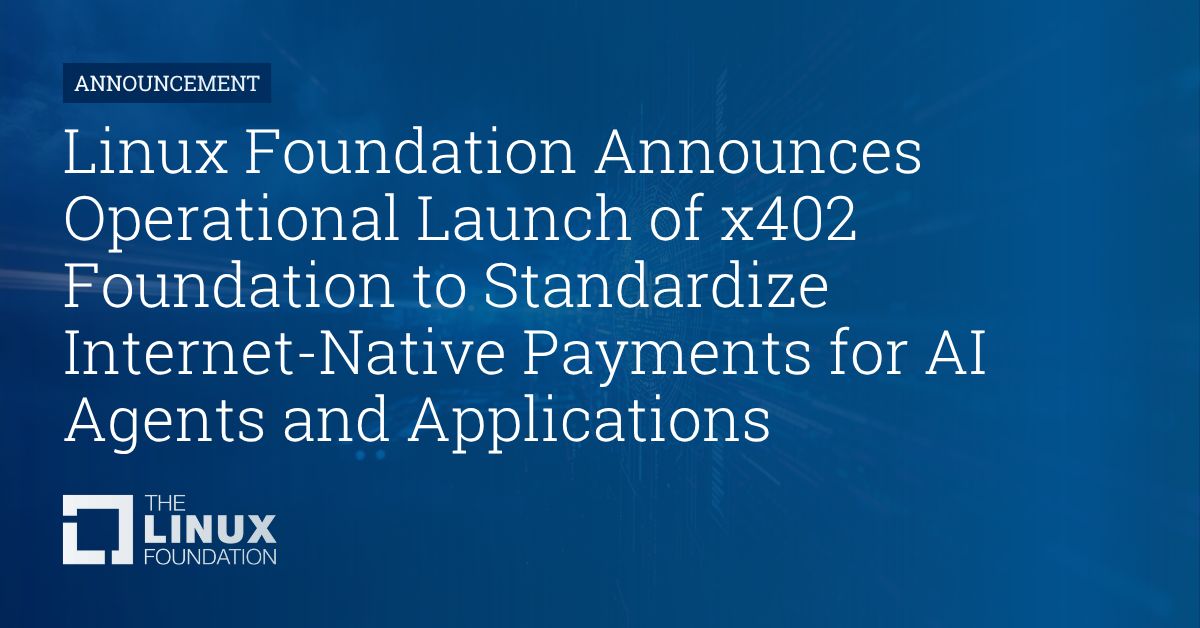
That list answers the question Lee raised on stage in Singapore, where he said agents might carry a Visa card but would more likely carry a crypto wallet [3]. The card networks did not wait to find out. They joined the stablecoin standards body as paying members, which is the behavior of incumbents hedging a rail rather than fighting it. The device layer for agents is contested, and the contest is being settled by committee membership before it is settled by volume.

The number a16z published against itself
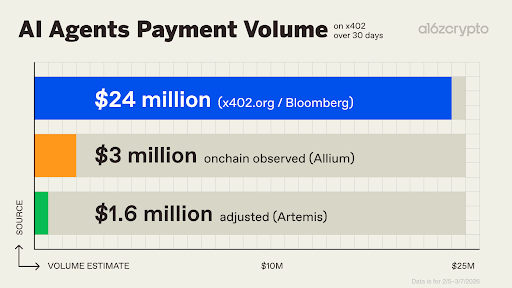
Volume is where the thesis is thinnest, and the clearest statement of that came from a16z. In March, a16z crypto partner Noah Levine wrote that Bloomberg had reported $24 million in agent payments over a 30-day period, citing x402.org, while Allium's onchain data showed roughly $3 million for the same period. After an Artemis Analytics filter for wash trading, the adjusted figure was $1.6 million [11][12]. Most of that activity was developers paying per query for scraping, browser sessions, and image generation, services that already accept cards but where a one-time call does not justify a subscription [11]. Levine's conclusion was that the number is small and the infrastructure built around it is not, and that the companies building it are betting on what the number becomes when agents are default buyers [11].
 Noah Levine
The traffic side of the thesis is further along than the payment side. Imperva's 2026 Bad Bot Report put automated traffic at 53% of all web traffic in 2025, the second year bots held a majority [13]. Imperva sells bot mitigation, so the figure comes with a commercial interest in finding bots, but it is the measurement Lee's remark about nonhumans becoming the dominant source of traffic rests on [3]. Agents already outnumber people on the wire. They do not yet outspend them anywhere.
What Lee's own wireless chart adds
At the Stenger Family Office investor day this month, Lee drew the parallel he thinks governs the AI cycle: the mobile phone industry, which he covered as an analyst, grew from 56 million handsets to 9 billion over 25 years, and the wireless stocks peaked ten years into that run [14]. The companies worth owning after the peak sat lower in the chain. Tower landlords, which collected rent from every carrier. Apple, which arrived in 2007 with a better interface. Domino's, which used the internet to sell pizza and outperformed the companies that built it [14].
The chart cuts both ways for the token thesis. It supports the claim that the real applications arrive after the infrastructure, which is the iPhone-to-Uber point. It also says that subscriber volume exploding did not save the operators' margins, because subscribers churn to the cheapest plan. An agent is the most price-sensitive customer ever designed, and the aggregators the stream names, Jupiter and NEAR intents among them, exist to route it to the best quote. Agents will use Uniswap is a reasonable forecast. It is not the same forecast as Uniswap's fee will hold. On Lee's own clock, with ChatGPT's release in late 2022 marking the start of the cycle, the industry is three years in, and the question of which layer keeps the fee is still open.
Today's data point
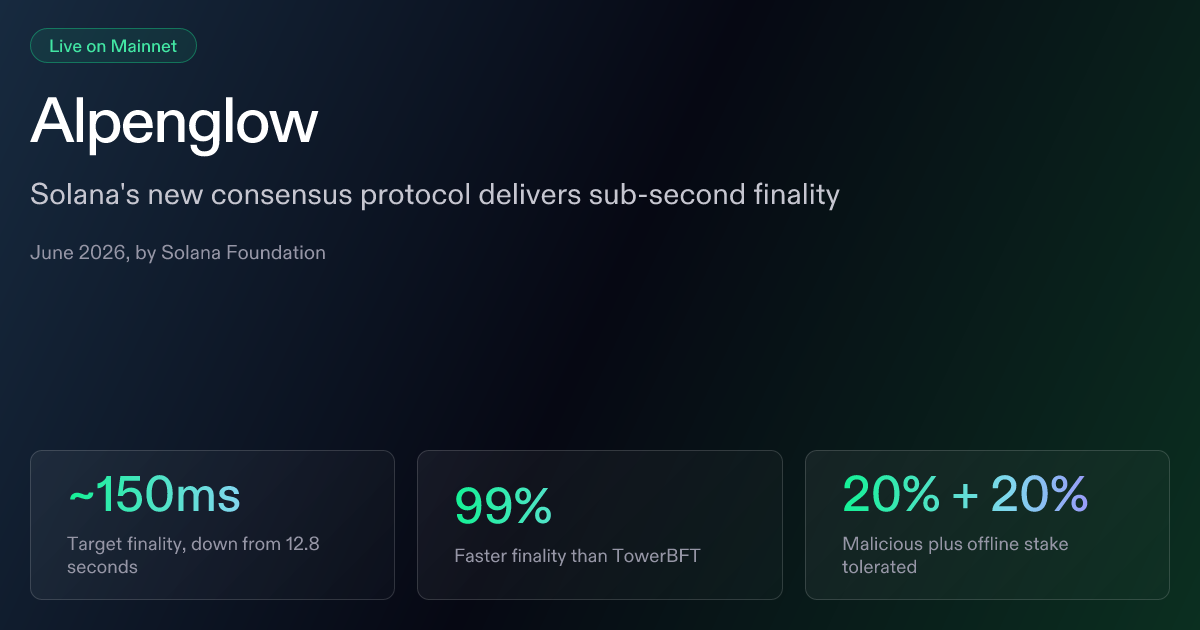
Solana activated Alpenglow on mainnet at the start of epoch 1064 on October 21, replacing the TowerBFT consensus it has run since genesis. The design target cuts finality from about 12.8 seconds to roughly 150 milliseconds, and the Solana Foundation calls the 150-millisecond figure an expectation rather than a constant, with mainnet numbers to be established after activation [15]. The stream treated the upgrade as the thing that makes onchain perpetuals competitive [2]. That is the right frame for a machine counterparty and an irrelevant one for a human. No person notices the difference between 12 seconds and 150 milliseconds. A trading agent prices it.
 Solana Foundation
That is the shape of the downstream story as it stands. The rails exist and the incumbents have joined them. The traffic is already nonhuman. The spending is $1.6 million a month after the wash trades are removed, concentrated in developers paying a cent a query for tools that would otherwise need a subscription.
Someone wins this. The wireless chart does not say the stack earned nothing; it says the winners arrived in sequence, and the sequence ran landlords, then interface, then application. Towers were paid through the overbuild and after it. Apple arrived fifteen years in [14]. Uber, two years after the App Store [6][7].
If agent commerce follows that order, the first layer paid is the one the agent cannot route around, the unit it settles in and the chain that unit clears on, and on current evidence that is a stablecoin clearing on Base and Solana a cent at a time [11].
The interface layer has two parts for an agent: the wallet that holds its keys and spending rules, where Coinbase, Stripe and the card networks are competing now [10], and the router that picks the venue for each trade, which is what Jupiter and NEAR intents are [2]. Neither is decided, and the router is where the churn the wireless chart warns about gets executed.
The application layer is the one the stream named, Uniswap, Aerodrome, Lighter, pump.fun, all built for human users and all expecting agents next [2]. The wireless chart's lesson for that layer is the harshest of the three. Year-three lists in wireless and in the dotcom era were mostly names that did not reach year ten, and the ones that did had something a price-sensitive customer could not route around: depth nobody else had, a product nobody else offered, or ownership of the rail the trade cleared on. Which of the stream's names has that is the question the stream did not ask.
If an iPhone moment comes for agents, it will be dated the way Uber's was, by a product launch and not by a forecast.
 Sagix

 Sagix
Educational purpose only: This content is provided exclusively for educational and historical research purposes. It should not be construed as investment advice, financial planning guidance, policy recommendations, or official economic analysis. Any contemporary parallels or policy discussions are presented as academic analysis, not recommendations for action. Historical patterns provide context for learning but do not predict future financial system outcomes or investment performance.
AI-assisted research disclosure: This analysis was researched and written with substantial assistance from artificial intelligence technology (Claude, Anthropic). While extensive efforts were made to verify all statistical claims, citations, and institutional analysis against authoritative sources, readers should independently verify any information before relying on it for academic, professional, investment, or policy purposes.
Accuracy and liability limitations: While extensive effort has been made to ensure accuracy through authoritative sources, the authors make no warranties about completeness, accuracy, or currency of information. Market interpretation involves judgment and debate. Data may contain revisions, measurement inconsistencies, or reporting variations across time periods and institutional sources. The authors and publisher assume no responsibility for errors, omissions, or consequences arising from the use of this information, including any errors resulting from AI assistance. Users assume full responsibility for decisions or actions taken based on this content.
Investment risk warning: This analysis does not constitute investment advice or recommendations. Past performance, whether historical or hypothetical, does not guarantee future results. All investments carry risk of loss. Readers should conduct their own research and consult qualified financial advisors before making investment decisions.
No professional relationship: This content does not create any professional, advisory, fiduciary, or client relationship between the reader and The Genesis Address Publishing LLC, its authors, or affiliated entities. Readers seeking financial, investment, legal, regulatory, or policy guidance should consult qualified professionals licensed in their jurisdiction.
Methodological note: This analysis synthesizes company filings and statements, standards-body announcements, protocol documentation, and established financial media. The numbered citation system allows readers to verify specific claims against original sources rather than relying on secondary interpretations.
References to modern financial systems, cryptocurrency protocols, or DeFi mechanisms are made for educational comparison purposes only. These comparisons do not constitute endorsements, recommendations, or predictions about the performance or suitability of any current financial products or services.
Publication information: Last updated: October 22, 2026 | Series: Sagix analysis | Publisher: The Genesis Address Publishing LLC
Sources and references
[1] Bitmine Immersion Technologies. "Crypto Bull Underway: This Cycle Likely the Largest." Chairman's Message, with transcript. October 7, 2026. https://www.bitminetech.io/chairmans-message
[2] Crypto Banter. "SpaceX May Have Just Saved Crypto." Livestream, October 21, 2026. https://www.youtube.com/live/Fp1TLWhvPWM
[3] Lee, Tom. "Crypto Spring Turning Into Full Blown Bull Market." Presentation at Token2049, Singapore. October 7, 2026. Video. https://youtu.be/HnS4kP2gLNQ
[4] CoinDesk. "Ether is about to lose a steady buyer as Tom Lee says Bitmine will stop token purchases." October 7, 2026. https://www.coindesk.com/markets/2026/10/07/ether-is-about-to-lose-a-steady-buyer-as-tom-lee-says-bitmine-will-stop-token-purchases
[5] Bitmine Immersion Technologies. "Bitmine Immersion Technologies (BMNR) Announces ETH Holdings Reach 6.04 Million Tokens." Press release. October 19, 2026. https://www.prnewswire.co.uk/news-releases/bitmine-immersion-technologies-bmnr-announces-eth-holdings-reach-6-04-million-tokens-and-total-crypto-and-total-cash--marketable-securities-holdings-of-15-1-billion-302912163.html
[6] Apple Inc. "iPhone App Store Downloads Top 10 Million in First Weekend." Press release. July 14, 2008. https://www.apple.com/newsroom/2008/07/14iPhone-App-Store-Downloads-Top-10-Million-in-First-Weekend/
[7] Kalanick, Travis. "Uber's Founding." Uber Newsroom. December 22, 2010. https://www.uber.com/us/en/newsroom/ubers-founding/
[8] CNBC. "SpaceX (SPCX) Q3 2026 earnings report: Live updates." October 20, 2026. https://www.cnbc.com/2026/10/20/spacex-spcx-earnings-live-updates-q3-2026html.html
[9] Yahoo Finance (Benzinga). "Venture Capitalist Marc Andreessen: 'The Grand Unification Of AI And Crypto Is About To Happen'." April 2026. https://finance.yahoo.com/markets/crypto/articles/venture-capitalist-marc-andreessen-grand-163112162.html
[10] The Linux Foundation. "Linux Foundation Announces Operational Launch of x402 Foundation to Standardize Internet-Native Payments for AI Agents and Applications." Press release. July 14, 2026. https://www.linuxfoundation.org/press/linux-foundation-announces-operational-launch-of-x402-foundation-to-standardize-internet-native-payments-for-ai-agents-and-applications
[11] Levine, Noah. "The honest number behind AI agent payments." a16z crypto. March 2026. https://a16zcrypto.com/posts/article/ai-agent-payments-honest-number
[12] Cointelegraph. "AI agent payment volumes lower than reported, but adoption is growing: a16z." March 12, 2026. https://cointelegraph.com/news/ai-agent-payment-volume-closer-to-1-6m-says-a16z
[13] Imperva (Thales). "2026 Bad Bot Report." Announcement, Imperva Cyber Community. May 5, 2026. https://community.imperva.com/blogs/tim-chang/2026/05/05/the-2026-bad-bot-report-is-here
[14] Lee, Tom. "6 Reasons to Stay Bullish in 2027." Stenger Family Office Investor Day, October 2026. Video. https://youtu.be/77317N1n9qg
[15] Solana Foundation. "Alpenglow." Upgrade page. Accessed October 21, 2026. https://solana.com/upgrades/alpenglow
Publisher: The Genesis Address Publishing LLC