The Druid Deep Dive, Episode 14: The day the peg broke: Bretton Woods to the Nixon shock (1944-1973)
Bretton Woods convertibility served central banks only; Americans were barred from gold until 1974. Episode 14 reads the Gold Pool collapse and Nixon's exception clause against the GENIUS Act and the Fed's proposed two-business-day redemption rule.

For twenty-seven years the dollar was convertible into gold at $35 an ounce, and for all of them no American could present a dollar at the window. The window served central banks, it was defended by selling reserves into the London market, and it closed on a Sunday night with its exception clause already written. Episode 14 reads a stablecoin's redemption policy against it.
The Druid Deep Dive, episode 14. Ancient wisdom for modern DeFi. Historical period: Bretton Woods, New Hampshire, to Camp David, Maryland, 1944 to 1973.
Episode 13 ended on a split: the unit, which no issuer can print, and the claim, which can fail while the unit does not. Bretton Woods was that claim at the scale of the world. The dollar was fixed to gold, every other currency to the dollar, and the arrangement rested on a promise that the Treasury would hand over gold for dollars on demand. The part the legend drops is who could make the demand. Not the public, not American citizens: foreign monetary authorities, and nobody else. A peg is a price. Convertibility is a promise, and a promise has a counterparty and a guest list. This episode is about what the guest list did under pressure, and why the modern redemption window has one too.
 Sagix
A promise with a guest list
In July 1944, at the Mount Washington Hotel, 730 delegates from forty-four nations agreed to create the International Monetary Fund and the International Bank for Reconstruction and Development [1]. Members fixed their currencies to the dollar within a 1 percent band, and the dollar was fixed to gold at $35 an ounce [1]. The Fund came into existence in December 1945 with twenty-nine members, and the system was not fully functional until the end of 1958, when European currencies became convertible [1, 7].
Who could call on the promise had been settled a decade before the conference. On April 5, 1933, Executive Order 6102 required all persons to deliver their gold coin, bullion and certificates to a Federal Reserve Bank by May 1, with a $100 exemption and a penalty of up to $10,000 or ten years in prison [3]. The Gold Reserve Act of January 30, 1934 transferred all monetary gold to the Treasury, prohibited the Treasury and financial institutions from redeeming dollars for gold, and set the dollar at $35 an ounce, 59 percent of its former gold value [4]. Americans did not regain the right to hold gold until Public Law 93-373 took effect on December 31, 1974, three years after the window had closed [5]. The Treasury's window served central banks only, at $35 plus a quarter-percent charge [6]. For the whole life of the system, only foreign governments and their central banks could test the promise. Convertibility was a club.
Defending the price by selling the reserve
The strain was arithmetic. Growing trade needed reserves, gold could not supply them, and dollars filled the gap through US payments deficits, so claims rose while gold did not [7]. When the claims passed the gold depends on which claims are counted: Humpage says 1961 for all dollar claims [8], Bordo says 1964 for official liabilities [7], Bordo, Monnet and Naef say 1966 [6]. On every measure the overhang existed early in the decade, and the claims that could actually present at the window crossed by mid-decade.
The defence ran on two mechanisms. The first was credit: the Federal Reserve's swap lines with foreign central banks grew from $900 million in March 1962 to $11.2 billion by August 1971, cover for dollars that would otherwise have been converted [7, 2]. The second was the market. After London gold hit $40 in October 1960, eight central banks formed the Gold Pool on November 1, 1961, to hold the London price near $35 [2]. The United States took half of the initial $270 million [6]. The Pool was a secondary-market defence: it sold reserve gold into London whenever the price approached $35.20, the level at which a central bank could profit by buying at the window and reselling, "the point at which the system would lose credibility" [6].
For four years it made money. From 1962 to 1965 the Pool ran a cumulative surplus of $1,437 million; from late 1965 to March 1968 a cumulative deficit of $3,692 million [6]. The turn came from sterling, the dollar's first line of defence, which Britain devalued on Saturday, November 18, 1967 [6]. The Pool lost $386.7 million in November, $306.5 million in December and $492 million in March 1968 [6]. Rostow's memo to Johnson on March 14 reads "we lost $372 million today" and warned of perhaps a billion the next day [9]. London was shut the next morning, the Pool was wound up, and the remaining members agreed a two-tier arrangement: official gold would move between central banks at $35, and none would be sold into the private market [2, 7].
Two legends die on the archive. The first is de Gaulle, whose February 1965 announcement that France would convert dollars into gold is the villain of most accounts. The Bank of England's dealers recorded no fresh activity that day, and France had stopped converting by 1966 [6]. From BIS and Bank of England records of who bought at the window, Bordo, Monnet and Naef find that Gold Pool losses accounted for three-quarters of the fall in US gold reserves in the last quarter of 1967, and that the main buyer at the window was the Bank of England settling the Pool's sales [6]. There was no central bank run. US monetary gold fell from $15,258 million to $11,009 million between 1965 and March 1968, and American losses through the Pool were $1,846 million, 44 percent of the drop [6]. The reserve left through the market defence, not through the window.
The second legend is Triffin's. He predicted a deflationary end, the 1930s again [7]. The system exploded into inflation instead, after the Federal Reserve shifted in 1965 to accommodate Vietnam and the Great Society, and US inflation rose from below 2 percent in early 1965 to 6 percent at the end of 1969 [7, 8]. Bordo, Monnet and Naef go further and deny any structural problem before US policy and the sterling crisis combined [6]; the Federal Reserve's essays keep Triffin [2, 8]. The overhang was structural; the trigger was a policy choice in Washington and a devaluation in London.
The Sunday the window shut
After 1968 the system ran on restraint: the major governments tacitly agreed not to convert [7]. The US payments deficit was $9 billion in 1970 and $30 billion by August 1971 [7]. Dollars flooded into Germany, $3 billion in April 1971 alone; on May 5 the Bundesbank let the mark float, and four smaller European currencies followed [7].
What the British asked for in August is the one part the sources do not settle. The Nixon Foundation has the British ambassador asking the Treasury to convert $3 billion into gold as cover for Britain's holdings [13]. A 2021 interview with Garten frames it as a request for "cover" on $3 billion that nobody on the American side could interpret [14]. Bordo writes of French and British intentions to convert [7]. Either way, a member of the club was testing the promise, and its largest member had concluded it could not pay everyone. By Garten's figures, the United States held about 160 percent more gold than official dollars outstanding in 1955, and 25 percent of them in 1971 [14].
Nixon took his economic advisers to Camp David on Friday, August 13. The President's diary lists Connally, McCracken, Burns, Volcker, Stein, Peterson, Haldeman, Ehrlichman, Shultz and Safire; State and the National Security Council were not told, and no options papers were found [10]. Haldeman's notes record Burns' "lonely and unsuccessful attempt to keep the gold window open" [10].
At 9 p.m. on Sunday, August 15, Nixon spoke from the Oval Office. The exit clause was in the sentence that closed the window: convertibility was suspended temporarily, "except in amounts and conditions determined to be in the interest of monetary stability" [11]. The promise became discretionary in the breath that suspended it. Around it came a 90-day wage and price freeze, the first outside wartime, and a 10 percent import surcharge [2, 12].
The attempt to rebuild the peg lasted fifteen months. At the Smithsonian in December 1971 the dollar was devalued against gold by about 8.5 percent to $38 an ounce, a net devaluation of roughly 10.7 percent against the major currencies [8]. Nixon called it "the most significant monetary agreement in the history of the world" [12]. The window stayed shut, so $38 was a price at which the Treasury did not sell gold. The London gold price rose to around $60 by mid-1972 and $90 by early 1973 [8]. On February 12, 1973, the dollar was devalued a further 10 percent, to about $42, and within a month nearly every major currency was floating [8, 12]. The reserve asset was repriced upward; the claim on it received a smaller dollar.

The modern parallel: a window, a guest list and a weekend
The parallel is a structure, not a prediction. The GENIUS Act, signed July 18, 2025, defines a payment stablecoin as a digital asset whose issuer is obligated to convert, redeem or repurchase it for a fixed amount of monetary value [15]. That is the Bretton Woods sentence with the issuer in place of the Treasury. The Federal Reserve's proposed rule reads the obligation as redemption at par [16]. There are two prices again: what the issuer pays whoever can present a token at its window, and what everyone else gets on an exchange.
The guest list is short. Ma, Zeng and Zhang, working from blockchain records of creations and redemptions in 2021 and 2022, found that Tether allowed only six agents in an average month to redeem for cash, with the largest performing 66 percent of redemptions, against 521 redeeming parties at USDC [20]. Tether's minimum ticket is $100,000 and its fee is the greater of 0.1 percent and $1,000 [20]. Their central finding bears on 1968: a wider window steadies the secondary price and raises run risk, so issuers choose how many names go on the list [20].
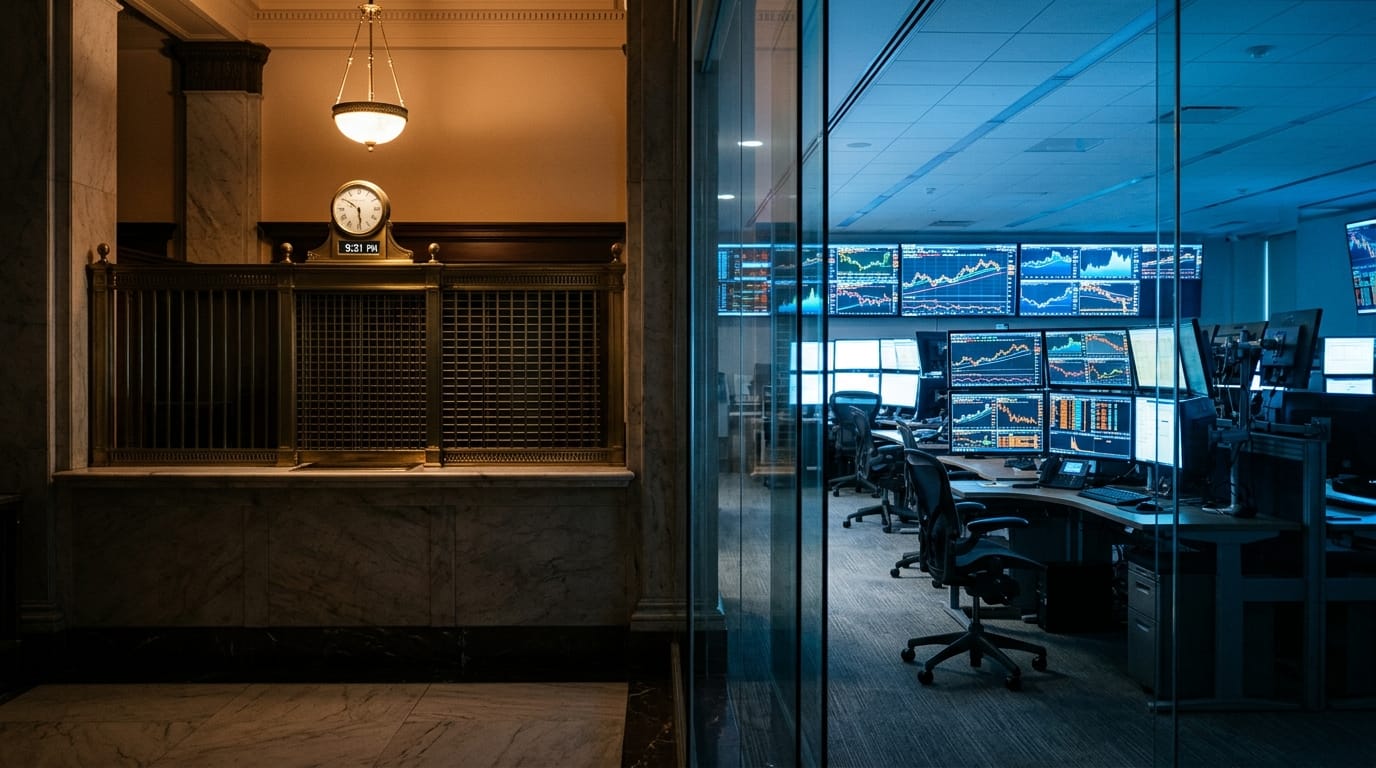
The weekend has already happened once. Silicon Valley Bank entered receivership at 11:37 a.m. on Friday, March 10, 2023, after more than $40 billion of withdrawals in a single day [18]. At 10 p.m. Circle said it could not withdraw $3.3 billion of USDC reserves from the bank, about 8 percent of the total [18]. Primary redemptions fell to almost nothing over the weekend because the window ran on US banking hours [18]. USDC traded as low as 86 cents [18]. Circle's pledge to stand behind the coin, with outside capital if necessary, did not restore the peg, and the Federal Reserve's staff note why: Circle's stockholders' equity at the end of 2023 was $0.34 billion, about a tenth of the sum stuck at the bank [18]. The peg came back after the Treasury, the Federal Reserve and the FDIC announced at 6:15 p.m. on Sunday that all depositors would be protected [19], and held once Circle resumed redemptions on Monday [18]. Closing the window did not stop the run; it moved the run to the secondary market, which never closes [18].
What the statute changed is the location of the exit clause. Under section 4(a)(1)(B), an issuer must publish its redemption procedures, and any discretionary limitation on timely redemption may be imposed only by a regulator [15]. Under section 7(e), a federal regulator may limit redemptions of a state-qualified issuer's stablecoin in unusual and exigent circumstances [15]. The Federal Reserve's proposal of September 24, 2026 would cap a Board-supervised issuer's redemption period at two business days, let the Board extend it on safety and soundness, financial stability or public interest grounds, and require an issuer that falls below one-to-one backing to notify the Board and then liquidate and redeem unless the Board directs otherwise [17]. The proposal also asks a question the Treasury answered for gold in 1934: the Act does not define a payment stablecoin holder, and the Board asks whether it should, and whether a customer means only those who deal directly with the issuer [16]. The guest list is open for comment until November 30, 2026 [16].
The scale is Bretton Woods scale in one respect. Dollar stablecoins stood at about $308 billion in July 2026, with Tether and USDC holding over 80 percent [21]. About 86 percent of USDC's reserves sit in a government money fund that only Circle can buy, while corporate bonds, gold, Bitcoin and secured loans made up nearly 24 percent of Tether's attested reserves at the end of 2025 [21]. One is a window with a short list behind a reserve of mixed quality; the other is a window with a long list behind a reserve that proved, for one weekend, to sit partly in a bank.
Portfolio lessons
First, ask who can present the claim, and how many of them there are. Foreign central banks could; Americans could not; six parties could at the largest stablecoin in an average month. The gap between the two prices is the measure of the promise. The four-layer liquidity framework puts redemption in the backstop layer. This episode adds that the backstop has a door, and the door has a list.
Second, a peg defended by selling reserves drains fastest when a neighbour's peg breaks. The Gold Pool lost more in the four months after sterling devalued than it had made in the three years before, and the reserve left without a single central bank running the window. Watch the reserve, not the price.
Third, read the exit clause before the exit. Nixon's suspension carried its exception in the same sentence. The GENIUS Act moves the discretion from issuer to regulator, and the Federal Reserve's draft lets the regulator lengthen the two days. The clause is in the founding document; read it before the weekend.
Fourth, the window keeps banking hours and the market does not. USDC's window closed with the banks on Friday night and the price found 86 cents on Saturday. Size every position so that it never needs to leave on a Saturday. Episode 9.2 showed what offshore dollar claims do when the home market shuts.
 Sagix

Fifth, the repricing went to the holders of the reserve asset. Gold went from $35 to about $90 within two years of the window closing; the dollar went to $42 and then floated. Holding the unit, the claim and the reserve as separate positions is the only construction that did not depend on being on the guest list.
Season 3 closes here, with the largest peg in history ending as a Sunday broadcast. Episode 15 turns to a bank with no centre at all, the Medici network of separately capitalized branches, and asks what held it together before the princes borrowed.
 Sagix

 Sagix

Educational purpose only: This content is provided exclusively for educational and historical research purposes. It should not be construed as investment advice, financial planning guidance, policy recommendations, or official economic analysis. Any contemporary parallels or policy discussions are presented as academic analysis, not recommendations for action. Historical patterns provide context for learning but do not predict future financial system outcomes or investment performance.
AI-assisted research disclosure: This historical analysis was researched and written with substantial assistance from artificial intelligence technology (Claude, Anthropic). While extensive efforts were made to verify all statistical claims, citations, and institutional analysis against authoritative sources, readers should independently verify any information before relying on it for academic, professional, investment, or policy purposes.
Accuracy and liability limitations: While extensive effort has been made to ensure historical accuracy through authoritative sources, the authors make no warranties about completeness, accuracy, or currency of information. Historical interpretation involves scholarly judgment and academic debate. Economic data may contain revisions, measurement inconsistencies, or reporting variations across time periods and institutional sources. The authors and publisher assume no responsibility for errors, omissions, or consequences arising from the use of this information, including any errors resulting from AI assistance. Users assume full responsibility for decisions or actions taken based on this content.
Investment risk warning: Historical financial analysis does not constitute investment advice or recommendations. Past performance, whether historical or hypothetical, does not guarantee future results. All investments carry risk of loss. Readers should conduct their own research and consult qualified financial advisors before making investment decisions.
No professional relationship: This content does not create any professional, advisory, fiduciary, or client relationship between the reader and The Genesis Address Publishing LLC, its authors, or affiliated entities. Readers seeking financial, investment, legal, regulatory, or policy guidance should consult qualified professionals licensed in their jurisdiction.
Methodological note: This analysis synthesizes findings from central bank research departments, National Bureau of Economic Research publications, peer-reviewed academic journals, and authoritative government historical records. The numbered citation system allows readers to verify specific claims against original sources rather than relying on secondary interpretations.
References to modern financial systems, cryptocurrency protocols, or DeFi mechanisms are made for educational comparison purposes only. These comparisons do not constitute endorsements, recommendations, or predictions about the performance or suitability of any current financial products or services.
Analysis of international monetary systems and policies is presented for historical educational purposes. Different jurisdictions have varying regulatory frameworks, and this content should not be interpreted as applicable to any specific jurisdiction's current legal or regulatory environment.
Historical analysis of financial crises is provided for educational understanding of systemic risk patterns. This content does not predict future crises or recommend specific crisis preparation strategies. Readers should consult qualified professionals for personalized risk management advice.
Publication information: Last updated: [PUBLICATION DATE] | Series: The Druid Deep Dive | Publisher: The Genesis Address Publishing LLC
Sources and references
[1] Ghizoni, Sandra Kollen. "Creation of the Bretton Woods System." Federal Reserve History, Federal Reserve Bank of Atlanta, written as of November 22, 2013. https://www.federalreservehistory.org/essays/bretton-woods-created.
[2] Ghizoni, Sandra Kollen. "Nixon Ends Convertibility of U.S. Dollars to Gold and Announces Wage/Price Controls." Federal Reserve History, written as of November 22, 2013. https://www.federalreservehistory.org/essays/gold-convertibility-ends.
[3] Roosevelt, Franklin D. "Executive Order 6102, Forbidding the Hoarding of Gold Coin, Gold Bullion and Gold Certificates." April 5, 1933. The American Presidency Project, University of California, Santa Barbara. https://www.presidency.ucsb.edu/documents/executive-order-6102-forbidding-the-hoarding-gold-coin-gold-bullion-and-gold-certificates.
[4] Richardson, Gary, Alejandro Komai, and Michael Gou. "Gold Reserve Act of 1934." Federal Reserve History, written as of November 22, 2013. https://www.federalreservehistory.org/essays/gold-reserve-act.
[5] United States Congress. Public Law 93-373, "An Act to provide for increased participation by the United States in the International Development Association and to permit United States citizens to purchase, hold, sell, or otherwise deal with gold in the United States or abroad." August 14, 1974, 88 Stat. 445. https://usc-cdn.house.gov/statutes/pl/93/374.pdf.
[6] Bordo, Michael, Eric Monnet, and Alain Naef. "The Gold Pool (1961-1968) and the Fall of the Bretton Woods System. Lessons for Central Bank Cooperation." NBER Working Paper 24016, National Bureau of Economic Research, November 2017. Published in Journal of Economic History 79, no. 4 (2019): 1027-1059. https://www.nber.org/papers/w24016.pdf.
[7] Bordo, Michael D. "The Operation and Demise of the Bretton Woods System; 1958 to 1971." Hoover Institution Economics Working Paper 16116, February 2017 (also NBER Working Paper 23189). https://www.hoover.org/sites/default/files/research/docs/16116-bordo.pdf.
[8] Humpage, Owen. "The Smithsonian Agreement." Federal Reserve History, written as of November 22, 2013. https://www.federalreservehistory.org/essays/smithsonian-agreement.
[9] Rostow, Walt W. "Memorandum From the President's Special Assistant (Rostow) to President Johnson, Washington, March 14, 1968. Subject: Gold." Document 189 in Foreign Relations of the United States, 1964-1968, Volume VIII, International Monetary and Trade Policy. U.S. Department of State, Office of the Historian. https://history.state.gov/historicaldocuments/frus1964-68v08/d189.
[10] U.S. Department of State, Office of the Historian. "Editorial Note." Document 168 in Foreign Relations of the United States, 1969-1976, Volume III, Foreign Economic Policy; International Monetary Policy, 1969-1972. https://history.state.gov/historicaldocuments/frus1969-76v03/d168.
[11] Nixon, Richard. "Address to the Nation Outlining a New Economic Policy: 'The Challenge of Peace.'" August 15, 1971. The American Presidency Project, University of California, Santa Barbara. https://www.presidency.ucsb.edu/documents/address-the-nation-outlining-new-economic-policy-the-challenge-peace.
[12] U.S. Department of State, Office of the Historian. "Nixon and the End of the Bretton Woods System, 1971-1973." Milestones in the History of U.S. Foreign Relations, 1969-1976. https://history.state.gov/milestones/1969-1976/nixon-shock.
[13] Richard Nixon Foundation. "The Burden of Bretton Woods." February 26, 2016. https://www.nixonfoundation.org/2016/02/the-burden-of-bretton-woods/.
[14] Smick, David. "The Weekend That Changed The World: TIE Founder and Editor David Smick interviews Jeffrey Garten." The International Economy 35, no. 3 (June 22, 2021). https://international.vlex.com/vid/the-weekend-that-changed-941033840.
[15] United States Congress. Public Law 119-27, "Guiding and Establishing National Innovation for U.S. Stablecoins Act" (GENIUS Act). July 18, 2025. Compilation of the enacted text, Office of the Legislative Counsel, via GovInfo. https://www.govinfo.gov/content/pkg/COMPS-18221/pdf/COMPS-18221.pdf.
[16] Board of Governors of the Federal Reserve System. "Implementing the Federal Reserve Board's Responsibilities Under the GENIUS Act." Notice of proposed rulemaking, Docket No. R-1899, RIN 7100-AH29. Federal Register 91, no. 187 (September 29, 2026): 61580-61683. https://www.federalregister.gov/documents/2026/09/29/2026-19860/implementing-the-federal-reserve-boards-responsibilities-under-the-genius-act.
[17] Board of Governors of the Federal Reserve System. Board memorandum accompanying the proposed rule implementing the GENIUS Act for Board-supervised payment stablecoin issuers. September 24, 2026. https://www.federalreserve.gov/newsevents/pressreleases/files/bcreg20260924a1.pdf.
[18] Du, Chuan, Ria Sonawane, and Cy Watsky. "In the Shadow of Bank Runs: Lessons from the Silicon Valley Bank Failure and Its Impact on Stablecoins." FEDS Notes. Board of Governors of the Federal Reserve System, December 17, 2025. https://doi.org/10.17016/2380-7172.3958.
[19] U.S. Department of the Treasury, Board of Governors of the Federal Reserve System, and Federal Deposit Insurance Corporation. "Joint Statement by Treasury, Federal Reserve, and FDIC." March 12, 2023. https://www.federalreserve.gov/newsevents/pressreleases/monetary20230312b.htm.
[20] Ma, Yiming, Yao Zeng, and Anthony Lee Zhang. "Stablecoin Runs and the Centralization of Arbitrage." NBER Working Paper 33882, National Bureau of Economic Research, May 2025. https://www.nber.org/papers/w33882.
[21] Anadu, Kenechukwu, Pablo D. Azar, Sean Baker, Marco Cipriani, Thomas M. Eisenbach, Mattia Landoni, Gabriele La Spada, Marco Macchiavelli, and J. Christina Wang. "Stablecoins and (Non)Crypto Shocks: A 2026 Update." Liberty Street Economics, Federal Reserve Bank of New York, July 31, 2026. https://libertystreeteconomics.newyorkfed.org/2026/07/stablecoins-and-noncrypto-shocks-a-2026-update/.
Publisher: The Genesis Address Publishing LLC