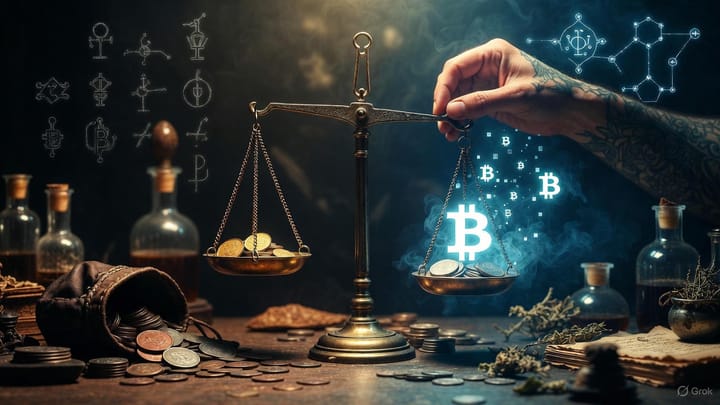
The Druid Deep Dive episode 5: The panic of 1837: Portfolio strategies that survived and thrived
When Jackson's Specie Circular delegitimized paper money overnight, 40% of American banks failed. But investors in New England's Suffolk Banking System survived. The parallels to SEC enforcement shocks and China crypto bans reveal timeless portfolio strategies for policy-induced volatility.

Season 2, Episode 5 | The Druid Deep Dive
When a presidential decree crashed the markets
On July 11, 1836, President Andrew Jackson signed an executive order that would trigger one of America's worst financial catastrophes. The Specie Circular required that all federal land purchases be made exclusively in gold or silver coin, instantly delegitimizing the paper money that had fueled a speculative boom [1]. Within ten months, banks across America suspended specie payments, and by 1843, over 40% of all banks had failed [2].
The Panic of 1837 offers a powerful lesson for modern DeFi participants: sudden regulatory pronouncements can devastate markets built on credit and confidence, but the investors who survived—and even thrived—shared specific portfolio characteristics that remain relevant today.
The crisis emerged from a perfect storm of speculative excess and policy whiplash. Between 1834 and 1836, the number of state-chartered banks grew from 329 to 713, and the volume of paper banknotes per capita increased by 40% [3]. Land sales exploded, reaching a record $25 million in 1836—roughly half of all federal receipts [4]. Speculators borrowed freely from newly chartered "pet banks" that had received federal deposits after Jackson dismantled the Second Bank of the United States.
Then came the policy shock. The Specie Circular drained gold and silver from eastern commercial centers to western land offices. Monetary reserves in New York City deposit banks fell from $7.2 million in September 1836 to just $1.5 million by May 1837 [5]. When banks could no longer meet withdrawal demands, panic ensued. On May 10, 1837, New York City banks suspended specie payments entirely [6].
The key players: who profited and who perished
Andrew Jackson and the "hard money" ideology
Jackson's personal experience with the Panic of 1795 had left him deeply suspicious of paper money and banking elites [7]. His crusade against the Second Bank of the United States and his Specie Circular reflected ideological conviction rather than economic calculation. As Federal Reserve economists later noted, his policies "boosted the demand for specie and revealed the soft spots in an economy based on hard money" [8].
Nicholas Biddle and the revenge of central banking
Nicholas Biddle, president of the Second Bank, had managed a system that restrained the monetary expansion of state banks [9]. After Jackson refused to renew its federal charter, Biddle obtained a Pennsylvania state charter and continued operations. His bank ultimately failed in 1841, but its earlier regulatory function—limiting wildcat banking—was sorely missed during the crisis.
The Suffolk Bank: institutional resilience
While banks failed across America, New England fared substantially better, at least partly because the Suffolk Bank of Boston provided central bank-like services to the region [10]. The Suffolk Banking System required member banks to maintain specie reserves and non-interest-bearing deposits, creating a private clearing network that enforced monetary discipline.
During the panic, Suffolk acted as a lender of last resort, lending reserves to other banks and keeping the payments system operating [11]. Harvard Business School's historical analysis confirms that "New England escaped the worst of the crisis thanks to Boston's conservative banking establishment, which, led by the Suffolk Bank, curbed the excesses of the rural banks" [12].

Cotton kings and concentrated risk
The Cotton Belt suffered the worst devastation. Cotton prices fell 25% in February and March 1837 alone, and since cotton receipts balanced America's trade deficit and provided foreign exchange earnings, the collapse rippled through the entire financial system [13]. Mississippi planters who had concentrated their wealth in cotton-backed credit found themselves bankrupt. Many fled to Texas to escape their creditors [14].
The modern parallel: regulatory shock in crypto markets
The dynamics of 1837—sudden policy pronouncements delegitimizing existing financial instruments, followed by panic selling and liquidity crises—mirror the crypto market's experience with regulatory enforcement.
SEC enforcement as the new Specie Circular
The SEC brought 46 cryptocurrency-related enforcement actions in 2023, a 53% increase from 2022 and the highest since 2013 [15]. These actions, concentrated against major exchanges like Binance and Coinbase, created uncertainty about which digital assets qualify as securities—similar to how the Specie Circular suddenly declared which money was valid for federal transactions.
The Ripple case illustrates the parallel precisely. When the SEC filed charges against Ripple Labs in 2020 for selling unregistered securities, XRP was delisted from major exchanges [16]. The regulatory announcement—not any fundamental change in the protocol—triggered immediate market consequences. Years of litigation followed before partial resolution.
China's crypto bans: multiple policy shocks
China's repeated cryptocurrency crackdowns demonstrate how regulatory announcements can cascade through interconnected markets. In May 2021, when China banned financial institutions from providing cryptocurrency services, Bitcoin fell from approximately $43,000 to $30,000—a 30% drop—within 12 hours [17]. The June 2021 mining ban wiped approximately $400 billion from the total cryptocurrency market [18].
Like Jackson's Specie Circular, these announcements targeted not fraud or failure but the legitimacy of entire asset classes. And like the 1837 panic, the immediate market response reflected panic and liquidity crises rather than fundamental value changes. Bitcoin ultimately recovered to new all-time highs, just as the American economy eventually recovered by 1844 [19].
The Suffolk parallel: DeFi clearing infrastructure
The Suffolk Bank's survival strategy offers a template for DeFi infrastructure. By maintaining reserve requirements and providing clearing services, Suffolk created systemic resilience that individual banks could not achieve alone.
Modern DeFi protocols serving similar functions—DEX aggregators providing liquidity across fragmented markets, cross-chain bridges enabling settlement, and lending protocols requiring collateralization—can be viewed through this historical lens. The protocols that maintain conservative reserve ratios and provide clearing infrastructure may prove more resilient during the next regulatory shock.
Portfolio lessons: strategies that survived 1837
The Panic of 1837 teaches several enduring lessons about portfolio construction during policy-induced volatility.

Lesson 1: Geographic and sectoral diversification
Conditions in the South were much worse than in the East, and the Cotton Belt was dealt the worst blow [20]. Investors concentrated in cotton-backed securities experienced catastrophic losses, while those with diversified holdings across regions and sectors fared better. Virginia, North Carolina, and South Carolina responded by increasing crop diversification—a lesson learned through painful experience.
For DeFi investors, this translates to avoiding concentration in any single protocol, chain, or asset class. A portfolio entirely in Ethereum-based DeFi tokens may appear diversified by holding multiple protocols, but represents 100% exposure to a single ecosystem's regulatory and technical risks.
Lesson 2: Liquidity positioning before policy events
In early 1837, a prudent person might have thought that gold and silver looked like a wise portfolio choice [21]. Those who held liquid assets—rather than land mortgages or illiquid bank shares—could weather the storm and acquire distressed assets at favorable prices.
The parallel for crypto markets is maintaining stablecoin allocations and exchange liquidity during periods of regulatory uncertainty. When the SEC announced enforcement actions against major exchanges in June 2023, investors with liquid positions could respond strategically rather than panic-selling at depressed prices.
Lesson 3: Institutional quality matters more during crises
Banks participating in the Suffolk Banking System survived at higher rates than unaffiliated banks [22]. The institutional infrastructure—reserve requirements, clearing mechanisms, and peer oversight—provided resilience that individual balance sheet strength could not match.
For DeFi portfolios, this suggests prioritizing protocols with robust governance structures, transparent reserve attestations, and integration with broader ecosystem infrastructure. During the 2022-2023 crypto winter, protocols with clear governance and conservative treasury management generally maintained their market positions better than those optimizing solely for yield.
Lesson 4: Policy reversals create opportunities
The depression following 1837 lasted nearly seven years, but the economy eventually recovered. The California gold rush starting in 1848 greatly increased the money supply and ended the deflationary period [23]. Patient investors who maintained positions through the downturn—rather than selling at panic lows—ultimately benefited from the recovery.
Regulatory clarity often follows regulatory uncertainty. The SEC's approval of Bitcoin ETFs in January 2024 represents a policy evolution that rewarded patient investors who maintained positions through the enforcement-heavy 2023 environment [24].
Lesson 5: Watch for clearing infrastructure innovation
One lasting consequence of 1837 was institutional innovation. The credit ratings industry has its origins in the hard times of the late 1830s and early 1840s, when Lewis Tappan founded the Mercantile Agency to provide credit information on businesses [25]. Crisis creates demand for better information and infrastructure.
DeFi investors should monitor similar developments: on-chain credit scoring, risk assessment tools, and insurance protocols that emerge from market stress often become essential infrastructure for the next cycle.
Conclusion: ancient wisdom for modern volatility
The Panic of 1837 demonstrates that policy-induced market crashes have occurred throughout financial history—and that specific portfolio strategies consistently improve survival odds. Geographic diversification, liquidity positioning, institutional quality assessment, and patience through recovery cycles all contributed to investor survival in 1837, and they remain relevant for navigating DeFi's regulatory evolution today.
The Suffolk Bank's survival formula—conservative reserves, clearing infrastructure, and peer discipline—offers a template for evaluating DeFi protocols in an uncertain regulatory environment. The investors who thrived after 1837 were those who recognized that policy shocks, while devastating in the short term, create opportunities for patient capital deployed in resilient institutions.
As Jackson's Specie Circular taught American investors, the definition of "legitimate money" can change overnight by government decree. But the principles of sound portfolio construction—diversification, liquidity, institutional quality, and patience—endure across centuries.
 Sagix
Sagix
 Sagix
Sagix
Sources and references
[1] Federal Reserve Bank of New York. "Crisis Chronicles: The Man on the Twenty-Dollar Bill and the Panic of 1837." Liberty Street Economics (May 2015). https://libertystreeteconomics.newyorkfed.org/2015/05/crisis-chronicles-the-man-on-the-twenty-dollar-bill-and-the-panic-of-1837/
[2] Wikipedia contributors. "Panic of 1837." Wikipedia. December 2025. https://en.wikipedia.org/wiki/Panic_of_1837
[3] Lumen Learning. "The Panic of 1837." United States History I. https://courses.lumenlearning.com/wm-ushistory1/chapter/the-panic-of-1837-and-the-whig-party/
[4] The Economic Historian. "Panic of 1837." The Economic Historian (November 2020). https://economic-historian.com/2020/11/panic-of-1837/
[5] Rousseau, Peter L. "Jacksonian Monetary Policy, Specie Flows, and the Panic of 1837." NBER Working Paper No. 7528 (2000). https://www.nber.org/system/files/working_papers/w7528/w7528.pdf
[6] Federal Reserve Bank of New York. "Crisis Chronicles." Liberty Street Economics (May 2015).
[7] EBSCO Research. "Panic of 1837." EBSCO Research Starters. https://www.ebsco.com/research-starters/history/panic-1837
[8] Federal Reserve Bank of New York. "Crisis Chronicles." Liberty Street Economics (May 2015).
[9] The Economic Historian. "Panic of 1837." The Economic Historian (November 2020).
[10] Rolnick, Arthur J., Bruce D. Smith, and Warren E. Weber. "The Suffolk Bank and the Panic of 1837." Federal Reserve Bank of Minneapolis Quarterly Review 24, no. 2 (Spring 2000): 3-13. https://www.minneapolisfed.org/research/quarterly-review/the-suffolk-bank-and-the-panic-of-1837
[11] Federal Reserve Bank of Minneapolis. "The Suffolk Bank and the Panic of 1837: How a Private Bank Acted as a Lender-of-Last-Resort." Working Papers. https://www.minneapolisfed.org/research/working-papers/the-suffolk-bank-and-the-panic-of-1837-how-a-private-bank-acted-as-a-lenderoflastresort
[12] Harvard Business School Historical Collections. "1837: The Hard Times." Bubbles, Panics & Crashes. https://www.library.hbs.edu/hc/crises/1837.html
[13] Wikipedia contributors. "Panic of 1837." Wikipedia. December 2025.
[14] Encyclopedia.com. "Panic of 1837." Gale Encyclopedia of U.S. Economic History. https://www.encyclopedia.com/history/encyclopedias-almanacs-transcripts-and-maps/panic-1837
[15] Cornerstone Research. "SEC Cryptocurrency Enforcement: 2023 Update." (January 2024). https://www.cornerstone.com/insights/reports/sec-cryptocurrency-enforcement/
[16] Paul, Weiss, Rifkind, Wharton & Garrison LLP. "SEC Enforcement: 2023 Year in Review." Harvard Law School Forum on Corporate Governance (March 2024). https://corpgov.law.harvard.edu/2024/03/13/sec-enforcement-2023-year-in-review/
[17] Yahoo Finance. "9 Biggest Bitcoin Crashes in History." Yahoo Finance (October 2025). https://finance.yahoo.com/news/9-biggest-bitcoin-crashes-history-165617173.html
[18] CNBC. "China's renewed crypto crackdown wipes $400 billion off the market." CNBC (June 2021). https://www.cnbc.com/2021/06/22/china-crypto-crackdown-wipes-nearly-300-billion-off-market-btc-slides.html
[19] CNBC. "Bitcoin is down nearly 30% from its record high—history shows that's normal." CNBC (December 2025). https://www.cnbc.com/2025/12/04/bitcoin-down-nearly-30percent-from-record-high-history-shows-thats-normal.html
[20] Wikipedia contributors. "Panic of 1837." Wikipedia. December 2025.
[21] Federal Reserve Bank of New York. "Crisis Chronicles." Liberty Street Economics (May 2015).
[22] Rolnick, Arthur J., Bruce D. Smith, and Warren E. Weber. "The Suffolk Bank and the Panic of 1837." Federal Reserve Bank of Minneapolis Quarterly Review (Spring 2000).
[23] Wikipedia contributors. "Panic of 1837." Wikipedia. December 2025.
[24] Cornerstone Research. "SEC Cryptocurrency Enforcement: 2023 Update." (January 2024).
[25] Harvard Business School Historical Collections. "1837: The Hard Times." Bubbles, Panics & Crashes.
Legal disclaimers and disclosures
Educational Purpose Only: This content is provided exclusively for educational and historical research purposes. It should not be construed as investment advice, financial planning guidance, policy recommendations, or official economic analysis. Any contemporary parallels or policy discussions are presented as academic analysis, not recommendations for action. Historical patterns provide context for learning but do not predict future financial system outcomes or investment performance.
AI-Assisted Research Disclosure: This historical analysis was researched and written with substantial assistance from artificial intelligence technology (Claude, Anthropic). While extensive efforts were made to verify all statistical claims, citations, and institutional analysis against authoritative sources, readers should independently verify any information before relying on it for academic, professional, investment, or policy purposes.
Accuracy and Liability Limitations: While extensive effort has been made to ensure historical accuracy through authoritative sources, the authors make no warranties about completeness, accuracy, or currency of information. Historical interpretation involves scholarly judgment and academic debate. Economic data may contain revisions, measurement inconsistencies, or reporting variations across different time periods and institutional sources.
Liability Protections: The authors, publishers, and Sagix Apothecary assume no responsibility for errors, omissions, or consequences arising from the use of this information. This includes any errors that may result from AI assistance in research, writing, or data analysis. Users assume full responsibility for any decisions or actions taken based on this content.
Investment Risk Warning: Historical financial analysis does not constitute investment advice or recommendations. Past performance, whether historical or hypothetical, does not guarantee future results. All investments carry risk of loss, and readers should conduct their own research and consult qualified financial advisors before making investment decisions.
No Professional Relationship: This content does not create any professional, advisory, fiduciary, or client relationship between the reader and Sagix Apothecary, its authors, or affiliated entities. Readers seeking financial, investment, legal, regulatory, or policy guidance should consult qualified professionals licensed in their jurisdiction.
Methodological Note: This analysis synthesizes findings from multiple Federal Reserve Bank research departments, National Bureau of Economic Research publications, peer-reviewed academic journals, and authoritative government historical records. The numbered citation system allows readers to verify specific claims against original sources rather than relying on secondary interpretations. All quantitative data and statistical analyses are drawn from the referenced academic literature rather than independent calculation.
Contemporary Financial Systems: References to modern financial systems, cryptocurrency protocols, or DeFi mechanisms are made for educational comparison purposes only. These comparisons do not constitute endorsements, recommendations, or predictions about the performance or suitability of any current financial products or services.
Crisis Analysis: Historical analysis of financial crises is provided for educational understanding of systemic risk patterns. This content does not predict future crises or recommend specific crisis preparation strategies. Readers should consult qualified professionals for personalized risk management advice.
Publication Information: Last Updated: December 2025 | Series: The Druid Deep Dive | Publisher: The Genesis Address LLC