The bank war: Central vs. decentralized money
The Bank War’s deepest lesson: "The real safe haven was never the asset. It was the market depth." Explore the 1830s Panic and why liquidity infrastructure is the "money shot" for the future of decentralized money. Historical lessons for modern DeFi survival.

The Druid Deep Dive Episode 9 Historical period: 1828–1841
The original battle for monetary sovereignty
Nearly two centuries before Bitcoin's whitepaper proposed a peer-to-peer electronic cash system, the United States fought its most consequential battle over who should control money. The Bank War of the 1830s pitted President Andrew Jackson — a populist firebrand who blamed centralized banking for ruining common people — against Nicholas Biddle, the urbane Philadelphia financier who ran what was then the largest monetary corporation on Earth.
The conflict's core question remains strikingly relevant: should monetary power rest with a centralized institution controlled by elites, or should it be distributed among competing entities answerable to local communities? The destruction of America's second central bank left the nation without centralized monetary authority for over seventy-five years [1], a vacuum that produced recurring financial crises but also a wider diffusion of banking services and more efficient capital allocation in the long run [2].
The Second Bank: a hybrid behemoth
Structure and scale
The Second Bank of the United States was chartered by President James Madison in 1816 with $35 million in capital — more than three times the capitalization of its predecessor [3]. The institution operated as a hybrid public-private corporation: the federal government owned 20% of its stock and appointed a fifth of its directors, while four thousand private investors held the remaining 80%, including approximately three thousand Europeans [4]. The Bank accounted for roughly 20% of the nation's total banking capital and held between 30% and 40% of all specie — gold and silver — in the country [5].
This concentration of financial power was by design. The Bank served as the government's fiscal agent, processing tax payments, transferring Treasury funds, and managing public debt [4]. Its twenty-five branches formed an interregional network providing credit across the expanding frontier [3]. Under Biddle's leadership from 1823, the Bank also functioned as a de facto regulator, restraining state banks from over-issuing notes by pressing them to redeem their currency in specie [6].
The governance problem
Yet the Bank's governance structure contained tensions that echo modern DeFi debates. Private stockholders — who elected 80% of the directors — naturally prioritized returns over public welfare [5]. Biddle concentrated enormous personal authority, serving on all but one of the Bank's committees [5]. Foreign shareholders, while prohibited from voting, still held around 20% of the stock [4]. Early in its existence, the Bank had engaged in reckless lending to insiders and political allies, contributing to the devastating Panic of 1819 [7].
Jackson's personal history with banking collapse shaped his worldview. He had lost his fortune during the speculation-fueled boom of the early republic and came to view paper money and centralized credit as tools of aristocratic oppression [8]. When he assumed the presidency in 1829, he warned Congress that the Bank's constitutionality and expediency were "well questioned by a large portion of our fellow citizens" [9].
Key players and the political chess match
Biddle's miscalculation
Nicholas Biddle, despite his skill as a banker, proved less adept as a political strategist. In early 1832 — four years before the Bank's charter was set to expire — he was persuaded by Senators Henry Clay and Daniel Webster to seek early recharter, gambling that Jackson would not dare veto a popular institution during an election year [10]. Both houses of Congress passed the recharter bill, and on July 10, 1832, it arrived on Jackson's desk.
Jackson's unprecedented veto
Jackson's veto message, drafted primarily by Attorney General Roger Taney and Kitchen Cabinet member Amos Kendall [11], was a populist manifesto declaring that government must not bend to "the rich and powerful" at the expense of "the humble members of society — the farmers, mechanics, and laborers" [10]. The message reframed the Bank as a symbol of concentrated privilege whose monopoly powers were "unauthorized by the Constitution, subversive to the rights of States, and dangerous to the liberties of the people" [12].
The recharter bill returned to Congress, where supporters failed to muster the two-thirds majority needed to override [12]. Jackson won reelection in a landslide, interpreting his victory as a mandate to destroy the Bank entirely.
The deposit war
In 1833, Jackson ordered federal deposits withdrawn from the Bank and scattered across select state-chartered institutions — derisively called "pet banks" [12]. Biddle retaliated by restricting loans and tightening credit to engineer an economic contraction, but the strategy backfired: rather than turning public opinion against Jackson, it confirmed his warnings about the Bank's irresponsible power [1]. The charter expired in 1836. The institution collapsed permanently in 1841 [14].
Modern parallel: Bitcoin maximalists vs. CBDCs
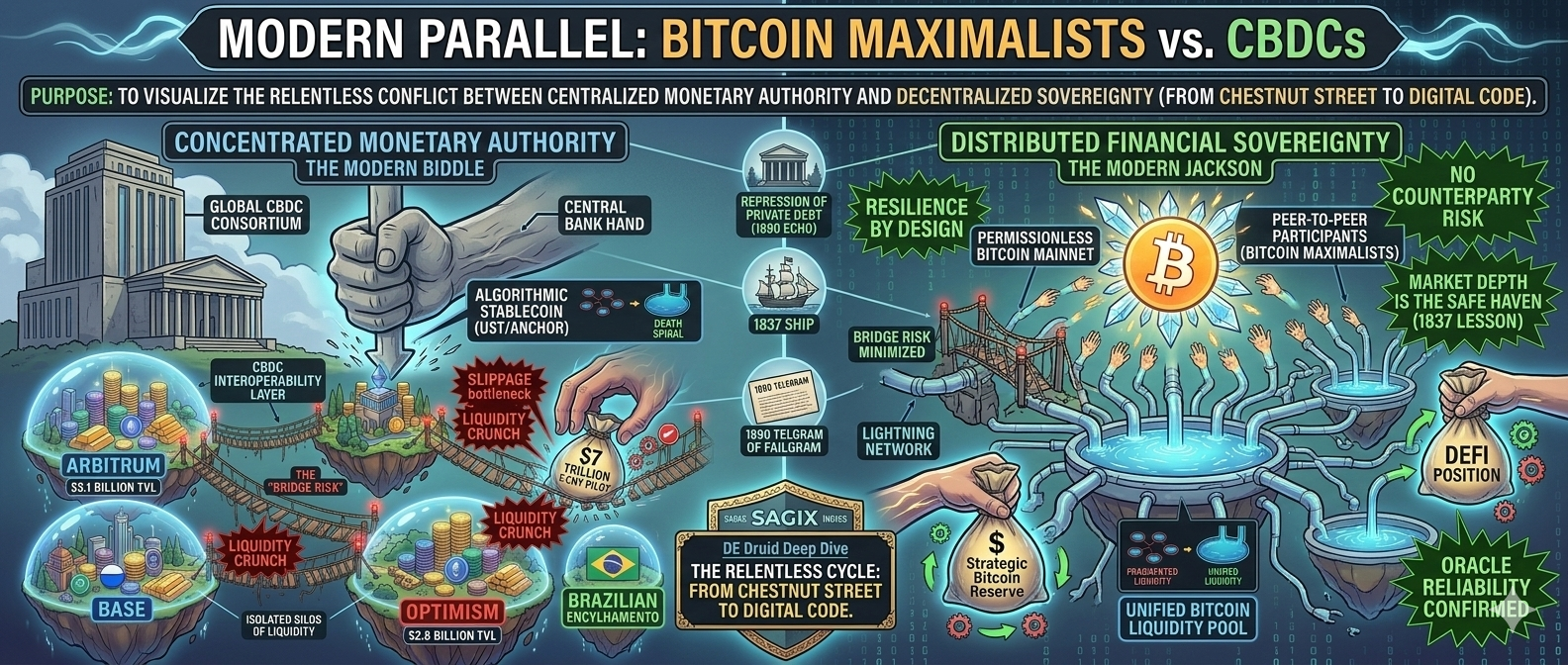
The Bank War's central tension — concentrated monetary authority versus distributed financial sovereignty — has resurfaced in the 21st century. The battleground has shifted from Philadelphia's Chestnut Street to the architecture of digital money itself.
The CBDC question
As of 2025, 137 countries representing 98% of global GDP are exploring Central Bank Digital Currencies, with 49 active pilot projects worldwide [15]. China's digital yuan alone has processed over 7 trillion e-CNY (approximately $986 billion) in transaction volume [15]. These government-issued digital currencies promise efficiency and financial inclusion, but they also introduce unprecedented surveillance capabilities — every transaction potentially monitored, tracked, and even restricted by the issuing authority [16].
The Jacksonian echo in Bitcoin advocacy
The philosophical DNA of Jackson's veto message lives on in Bitcoin maximalism. The parallels are structural, not merely rhetorical: Jackson objected to foreign ownership of the Bank's stock; Bitcoin proponents celebrate that no single entity can control the network. Jackson warned against government-granted monopolies in money; Bitcoin's permissionless architecture ensures anyone can participate in validation and issuance.
In January 2025, President Trump signed an executive order explicitly banning the creation or promotion of a US CBDC, citing threats to "financial system stability, individual privacy, and the sovereignty of the United States" [17]. The same order endorsed open blockchain networks and established a Strategic Bitcoin Reserve [18]. The United States thus became the only major economy to formally prohibit its own CBDC development while simultaneously embracing decentralized cryptocurrency at the federal level [15] — a Jacksonian outcome that would have been unimaginable even five years earlier.
DeFi governance as the modern "Bank War"
Within DeFi, the tension plays out daily. Major protocols operate through governance token voting that concentrates decision-making among large holders — not unlike Biddle's stockholders who elected 80% of the Bank's directors. When Biddle weaponized the Bank's lending power against political opponents, he demonstrated the same vulnerability DeFi critics identify in whale-dominated governance. Stablecoin markets reproduce the conflict even more directly: centralized stablecoins like USDC and USDT operate as quasi-fiscal agents of the traditional system, much as the Second Bank served as the government's exclusive fiscal agent, while decentralized alternatives — DAI, LUSD, and newer overcollateralized designs — attempt monetary stability without concentrating trust in any single issuer.
Portfolio lessons: the safe haven is the pool, not the token
The specie illusion of 1837
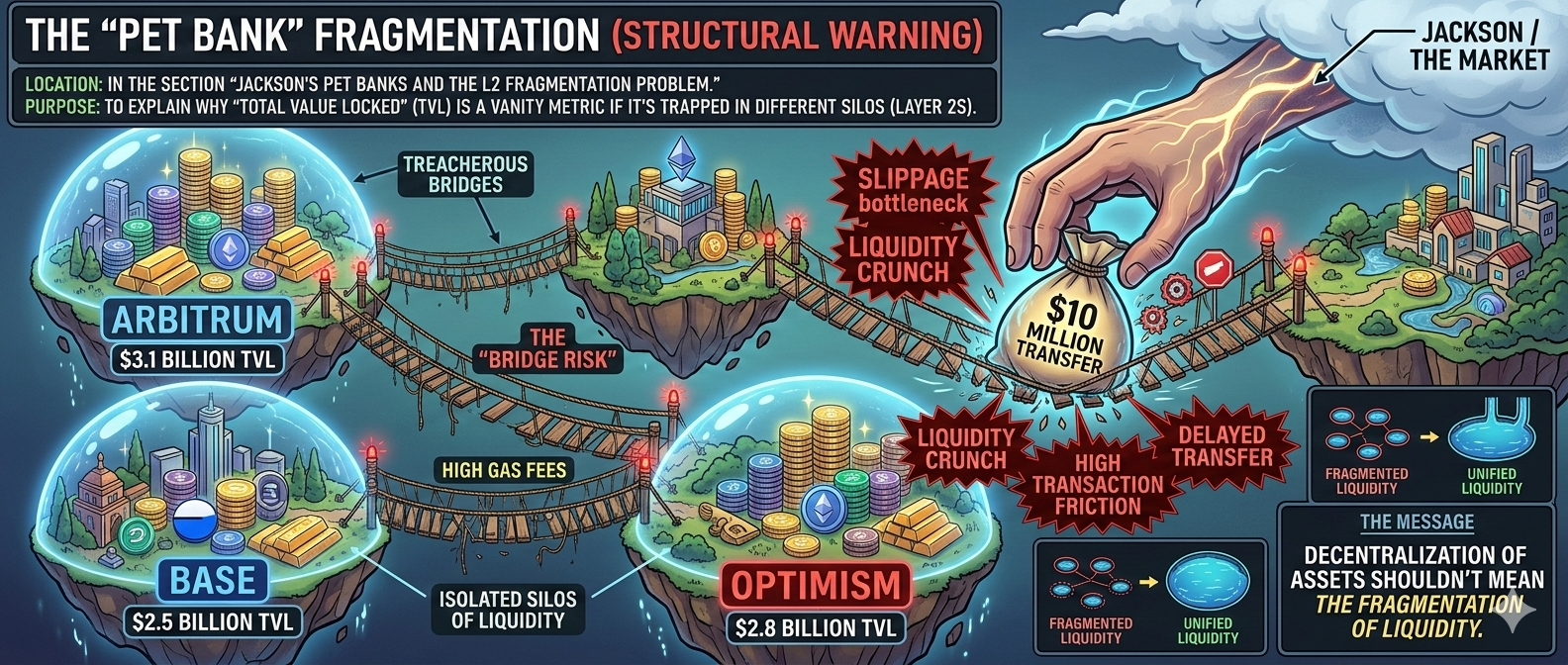
The conventional reading of the Panic of 1837 focuses on which assets people held. Hard-money Jacksonians hoarded gold and silver. Paper-money advocates clung to state bank notes. Both sides assumed the crisis would vindicate their preferred store of value. Neither was right — because when banks across the country suspended specie payments on May 10, 1837, even holders of physical gold found themselves trapped [19]. The asset was "safe," but the infrastructure for exchanging it had evaporated. The US money stock had swollen from $150 million in 1832 to $276 million by 1836 [20]; Jackson's Specie Circular of July 1836 — an executive order demanding that all purchases of public land be paid in gold or silver coin rather than bank notes [22] — was the match that lit the fire. The Circular was a forced liquidity call on the entire system: it required the one asset (specie) that was most scarce, drained it from eastern banks to western land offices, and exposed the fact that the infrastructure connecting them no longer existed. When the bubble burst, the issue was not which money you held but whether you could use it. Farmers with gold in their pockets could not buy supplies because merchants had no way to make change, verify coin purity, or extend credit against it. The depression lasted nearly seven years [19] — not because safe assets didn't exist, but because the markets for those assets had collapsed.
This is the Bank War's deepest lesson, and the one most overlooked: the real safe haven was never the asset. It was the market depth — the clearing infrastructure, the correspondent networks, the liquid exchange mechanisms — that allowed assets to function as money. When Jackson destroyed the Bank, he didn't just remove a central authority. He destroyed the deepest liquidity pool in the American financial system. The Bank had held 30–40% of the nation's specie and operated twenty-five branches that formed the country's only interregional clearing network [5]. Without it, even "safe" assets became illiquid.
Market depth is the DeFi safe haven
This insight translates directly to modern DeFi portfolio construction. Consider what actually happens during a crypto crisis — a regulatory crackdown, a major protocol exploit, a stablecoin depeg. Token holders rush to exit. The ones who survive are not necessarily those who picked the "right" asset, but those whose assets sit in pools with sufficient depth to absorb selling pressure without catastrophic slippage. A governance token with strong fundamentals but $200K in total DEX liquidity is functionally worthless during a panic — just as gold was functionally worthless to a farmer in 1838 Illinois with no functioning bank within a hundred miles.
The practical implication is uncomfortable but critical: evaluating a DeFi position means evaluating the liquidity infrastructure around it as rigorously as the token's fundamentals. This means studying pool depth on major DEXs, the diversity of trading venues where the asset is listed, the health of the automated market maker (AMM) pools that provide exit routes, and the presence of professional market makers who maintain order book depth through volatility. It also means scrutinizing oracle infrastructure — in 1837, the "oracle" was the physical verification of gold purity and the reputation of the state bank issuing the note; when those trust mechanisms broke down, no amount of underlying value could produce a trade. In DeFi, the oracle is the price feed. If Chainlink or Pyth goes stale or deviates during a panic, your deep pool becomes untradeable because the AMM cannot price the swap. Market depth and oracle reliability are not separate concerns — they are two halves of the same liquidity equation. A token listed only on a single DEX with thin liquidity is a concentrated bet not on the protocol's quality but on market infrastructure that may not survive a bank war.
Jackson's pet banks and the L2 fragmentation problem
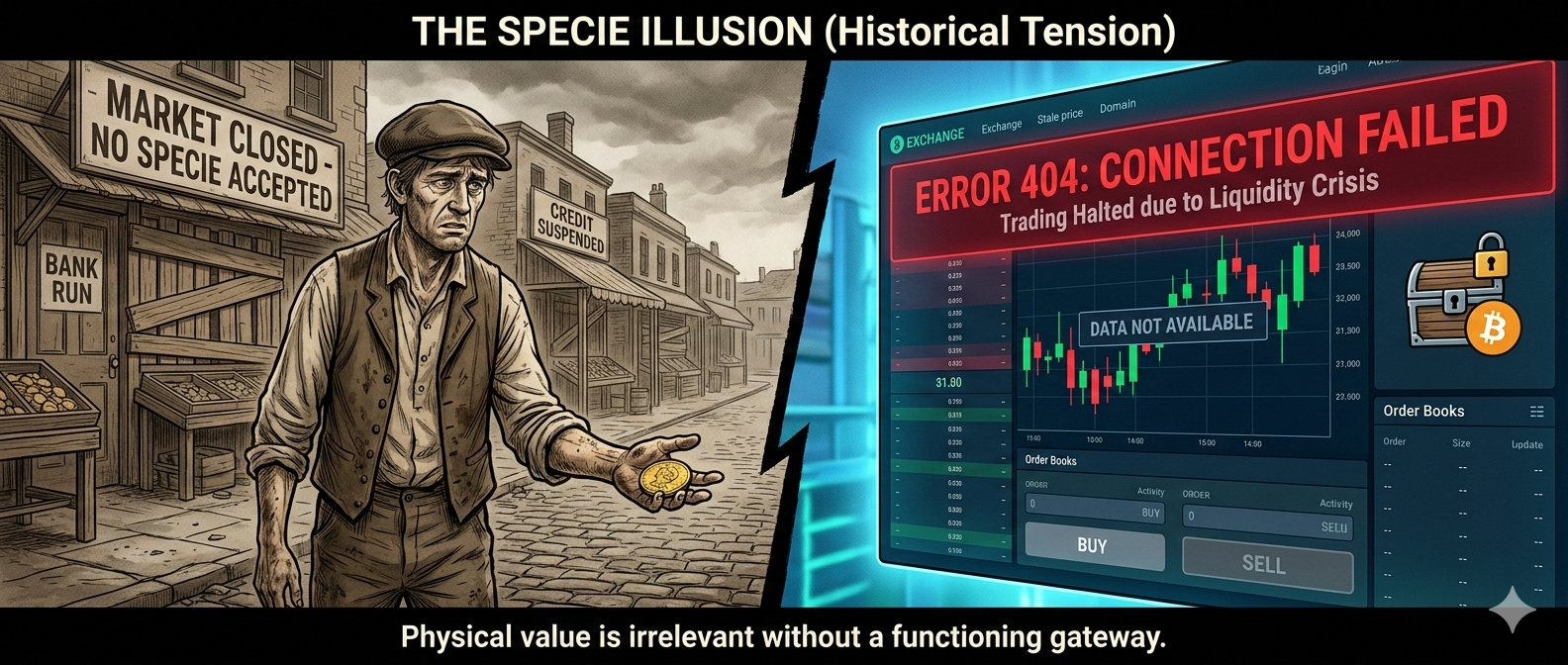
When Jackson scattered federal deposits across dozens of state-chartered "pet banks," he did not destroy liquidity — he fragmented it [12]. The total value in the system remained roughly the same, but it was trapped in isolated silos that could not efficiently clear transactions with each other. A merchant in New York holding notes from an Alabama pet bank had no reliable mechanism to redeem them at par. The clearing network the Second Bank had provided — its twenty-five branches acting as correspondent nodes — was gone [5].
This is the precise structure of the Layer 2 fragmentation problem. Value migrates from Ethereum mainnet to Arbitrum, Optimism, Base, zkSync, and a growing constellation of rollups. A user with liquidity on Base who needs to exit through an Arbitrum pool faces bridging delays, bridging risk, and slippage — the modern equivalent of presenting an Alabama bank note in New York. Cross-chain bridges are today's Suffolk System attempting to restore par circulation across fragmented networks, and they carry their own risks: bridge exploits have historically been among the largest loss events in DeFi. The lesson from Jackson's pet banks is that distributing assets across many custodians is not the same as decentralizing liquidity — and the distinction matters most when the bank war turns hot.
Biddle's revenge and the pendulum of liquidity
Biddle's retaliation — deliberately restricting loans to engineer an economic contraction [13] — demonstrates that liquidity can be weaponized. When the Bank tightened credit in 1833–1834, the goal was to create enough pain to force Congress into restoring its charter. The strategy failed politically but succeeded in inflicting real economic damage, proving that whoever controls liquidity controls the battlefield.
In DeFi, analogous dynamics play out when dominant liquidity providers withdraw from pools during governance disputes, when centralized exchanges delist tokens under regulatory pressure, or when stablecoin issuers freeze addresses. The Bank War's aftermath produced over seventy-five years without a US central bank [1] — followed by the Federal Reserve in 1913, which Rousseau argues embodied the principle that a central bank should be "independent but not excessively so, and must stand ready to monitor its members" [21]. The pendulum between centralized and decentralized liquidity provision is mid-swing in crypto. Strategies that survive are those positioned in deep, diversified pools across both models — not betting on which side wins the bank war, but ensuring that when the war turns hot, there is always a market deep enough to get out.
Further readings:
 Sagix
Sagix
 Sagix
Sagix
 Sagix
Sagix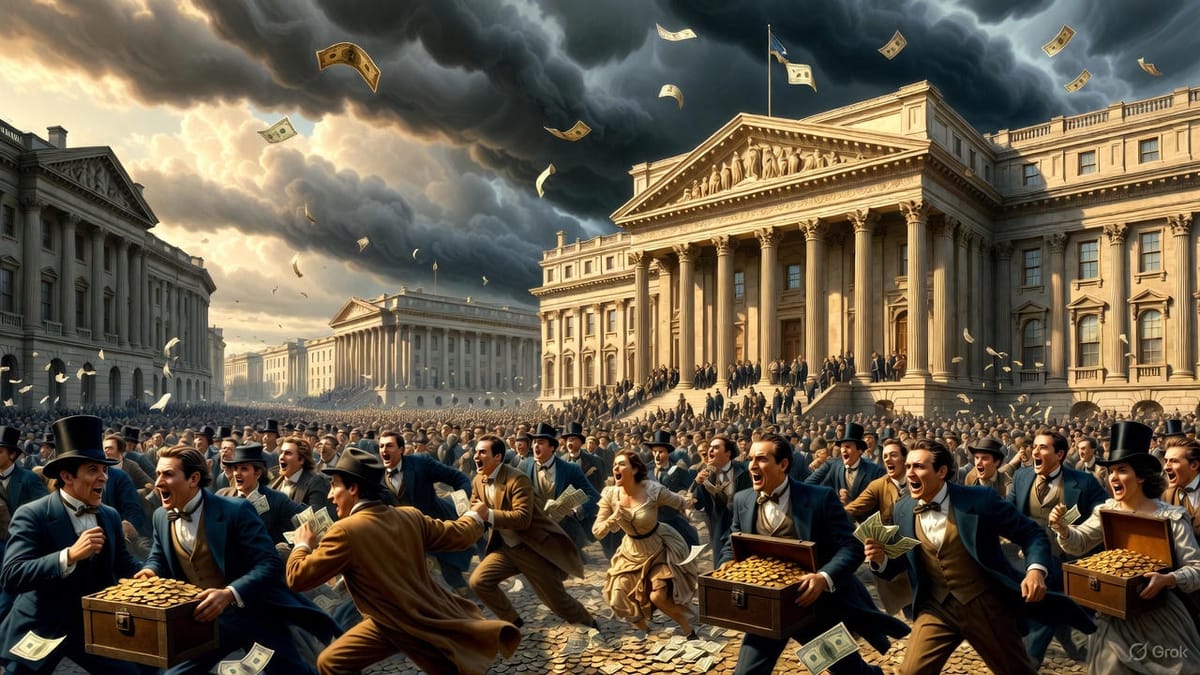
 Sagix
Sagix
Sources and references
[1] Hill, Andrew T. "The Second Bank of the United States." Federal Reserve History, December 2015. https://www.federalreservehistory.org/essays/second-bank-of-the-us
[2] Rousseau, Peter L. "Jackson, the Bank War, and the Legacy of the Second Bank of the United States." AEA Papers and Proceedings, vol. 111 (May 2021): 501–507. https://www.aeaweb.org/articles?id=10.1257/pandp.20211095
[3] Federal Reserve Bank of Philadelphia. "The Second Bank of the United States: A Chapter in the History of Central Banking." Adapted by Federal Reserve History. https://www.federalreservehistory.org/essays/second-bank-of-the-us
[4] "Second Bank of the United States." Wikipedia, citing Hammond, Bray. Banks and Politics in America from the Revolution to the Civil War. Princeton University Press, 1957. https://en.wikipedia.org/wiki/Second_Bank_of_the_United_States
[5] Knodell, Jane. "Rethinking the Jacksonian Economy: The Impact of the 1832 Bank Veto on Commercial Banking." Journal of Economic History, vol. 66, no. 3 (September 2006): 541–574.
[6] The Economic Historian. "Second Bank of the United States: Nicholas Biddle's Central Bank and Its Role in the Nation's Economy (1816–1836)." December 2024. https://www.economic-historian.com/p/second-bank-of-the-united-states
[7] Richmond Federal Reserve. "The Bank War." Econ Focus, Q2 2023. https://www.richmondfed.org/publications/research/econ_focus/2023/q2_economic_history
[8] Gilder Lehrman Institute of American History. "Andrew Jackson and the Bank War." Lesson Plan Resource. https://www.gilderlehrman.org/history-resources/lesson-plan/andrew-jackson-and-bank-war
[9] Feller, Daniel. "King Andrew and the Bank." National Endowment for the Humanities — Humanities Magazine, January/February 2008. https://www.neh.gov/humanities/2008/januaryfebruary/feature/king-andrew-and-the-bank
[10] Morrison, James A. "This Means (Bank) War! Corruption and Credible Commitments in the Collapse of the Second Bank of the United States." Journal of the History of Economic Thought, vol. 37, no. 2 (June 2015): 221–245. https://doi.org/10.1017/S1053837215000061
[11] Andrew Jackson's Hermitage. "Andrew Jackson & the Bank War." https://thehermitage.com/andrew-jackson-the-bank-war
[12] "Bank War." HISTORY, updated May 2025. https://www.history.com/topics/19th-century/bank-war
[13] Tremel, Andrew. "Bank War." Encyclopedia of Greater Philadelphia, 2022. https://philadelphiaencyclopedia.org/essays/bank-war/
[14] Hammond, Bray. Banks and Politics in America from the Revolution to the Civil War. Princeton University Press, 1957.
[15] Atlantic Council. "Central Bank Digital Currency Tracker." Updated 2025. https://www.atlanticcouncil.org/cbdctracker/
[16] Pinto, Goncalo, et al. "From Bitcoin to Central Bank Digital Currencies: Making Sense of the Digital Money Revolution." Future Internet, vol. 13, no. 7 (June 2021): 165. https://www.mdpi.com/1999-5903/13/7/165
[17] Trump, Donald J. "Strengthening American Leadership in Digital Financial Technology." Executive Order, January 23, 2025. As reported by National Law Review. https://natlawreview.com/article/future-digital-assets-united-states-bright-again
[18] Donalds, Byron. "President Trump's Strategic Bitcoin Reserve and U.S. Digital Asset Stockpile Executive Order." U.S. Congress, March 2025. https://donalds.house.gov/news/documentsingle.aspx?DocumentID=1801
[19] "Panic of 1837." Wikipedia, citing Rousseau, Peter L. "Jacksonian Monetary Policy, Specie Flows, and the Panic of 1837." NBER Working Paper No. 7528 (2000). https://en.wikipedia.org/wiki/Panic_of_1837
[20] Temin, Peter. The Jacksonian Economy. W. W. Norton and Company, 1969. As reviewed in EH.net Book Reviews. https://eh.net/book_reviews/the-jacksonian-economy/
[21] Richmond Federal Reserve. "The Bank War — Rousseau's Legacy Analysis." Econ Focus, Q2 2023. https://www.richmondfed.org/publications/research/econ_focus/2023/q2_economic_history
[22] "Panic of 1837." Wikipedia, citing Temin, Peter. The Jacksonian Economy. W. W. Norton and Company, 1969. Specie Circular details and macroeconomic effects. https://en.wikipedia.org/wiki/Panic_of_1837
Legal disclaimers and disclosures
Educational purpose only: This content is provided exclusively for educational and historical research purposes. It should not be construed as investment advice, financial planning guidance, policy recommendations, or official economic analysis. Any contemporary parallels or policy discussions are presented as academic analysis, not recommendations for action. Historical patterns provide context for learning but do not predict future financial system outcomes or investment performance.
AI-assisted research disclosure: This historical analysis was researched and written with substantial assistance from artificial intelligence technology (Claude, Anthropic). While extensive efforts were made to verify all statistical claims, citations, and institutional analysis against authoritative sources, readers should independently verify any information before relying on it for academic, professional, investment, or policy purposes.
Accuracy and liability limitations: While extensive effort has been made to ensure historical accuracy through authoritative sources, the authors make no warranties about completeness, accuracy, or currency of information. Historical interpretation involves scholarly judgment and academic debate. Economic data may contain revisions, measurement inconsistencies, or reporting variations across different time periods and institutional sources.
Liability protections: The authors, publishers, and Sagix Apothecary assume no responsibility for errors, omissions, or consequences arising from the use of this information. This includes any errors that may result from AI assistance in research, writing, or data analysis. Users assume full responsibility for any decisions or actions taken based on this content.
Investment risk warning: Historical financial analysis does not constitute investment advice or recommendations. Past performance, whether historical or hypothetical, does not guarantee future results. All investments carry risk of loss, and readers should conduct their own research and consult qualified financial advisors before making investment decisions.
No professional relationship: This content does not create any professional, advisory, fiduciary, or client relationship between the reader and Sagix Apothecary, its authors, or affiliated entities. Readers seeking financial, investment, legal, regulatory, or policy guidance should consult qualified professionals licensed in their jurisdiction.
Methodological note: This analysis synthesizes findings from multiple Federal Reserve Bank research departments, National Bureau of Economic Research publications, peer-reviewed academic journals, and authoritative government historical records. The numbered citation system allows readers to verify specific claims against original sources rather than relying on secondary interpretations. All quantitative data and statistical analyses are drawn from the referenced academic literature rather than independent calculation.
Contemporary financial systems: References to modern financial systems, cryptocurrency protocols, or DeFi mechanisms are made for educational comparison purposes only. These comparisons do not constitute endorsements, recommendations, or predictions about the performance or suitability of any current financial products or services.
Publication information: Last Updated: March 2026 | Series: The Druid Deep Dive | Publisher: Sagix Apothecary