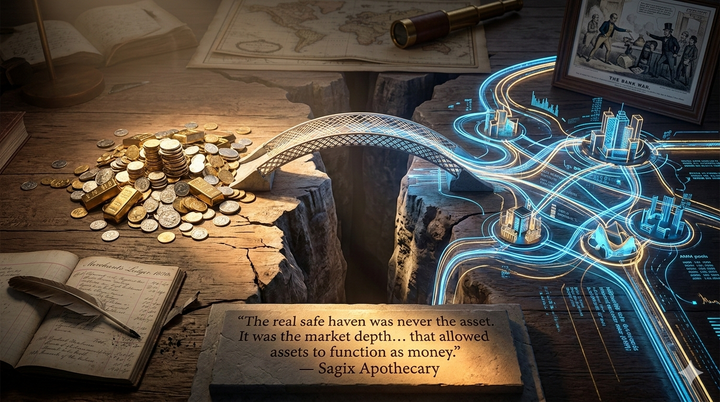
The Druid Deep Dive, Episode 9, Part 3: The invisible pipes: how clearing systems made money move
Explore the hidden plumbing of finance: from London's 1773 Clearing House netting claims, to New York's 1853 proto-central bank issuing crisis certificates, to CLS Bank's 2002 solution for Herstatt risk. Lessons for DeFi's missing settlement layer.
Historical period: 1773–2002
This is the third part of our 4 episode series about liquidity and the backend internals of markets throughout history. Part 2 is here:
 Sagix
Sagix
The layer nobody sees
Parts 1 and 2 established that the safe haven is the pool's depth and its backstop. Now we arrive at the layer underneath both: the clearing and settlement infrastructure that doesn't create money, doesn't store money, but makes money move — and whose failure can freeze an entire financial system overnight.
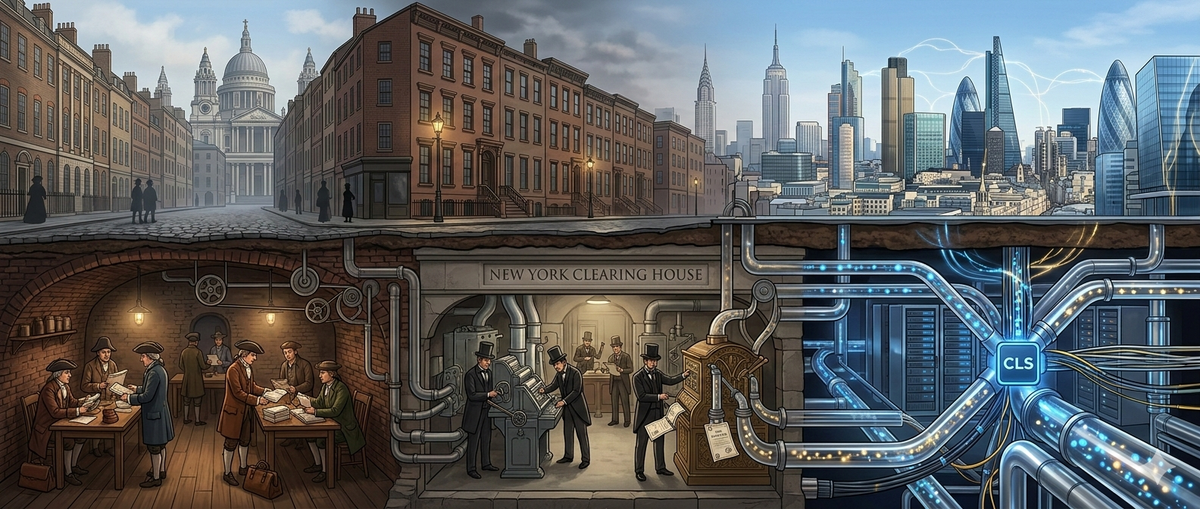
Before 1853, New York banks settled their accounts by employing porters to walk from bank to bank exchanging checks for bags of gold coin [1]. The official reckoning happened only on Fridays, producing record-keeping errors and encouraging abuse [1]. A bank bookkeeper named George D. Lyman proposed sending checks to a central office instead, and on October 11, 1853, fifty-two banks participated in the first exchange at 14 Wall Street, clearing $22.6 million in a single day [1]. No new money was created. No new assets were issued. The same dollars simply moved faster, cheaper, and with less counterparty risk. The New York Clearing House had invented the plumbing of modern finance.

Today, The Clearing House processes nearly $2 trillion in transactions daily and has maintained operations without interruption through every financial crisis and disaster since 1853 [2]. CLS Bank settles over $6.5 trillion in foreign exchange payment instructions every day across eighteen currencies [3]. These institutions are invisible to most market participants. They don't appear on trading screens or in portfolio dashboards. But without them, every asset in the financial system becomes what gold was to an Illinois farmer in 1838: theoretically valuable, practically immovable.
Three clearing systems that shaped financial history
The London Clearing House (1773): where it began
London's bankers solved the settlement problem eighty years before New York. The London Clearing House, established in 1773, emerged when bank clerks who had been meeting informally at coffeehouses to exchange drafts formalized the process into a dedicated institution [4]. The insight was elegantly simple: rather than each bank settling bilaterally with every other bank — requiring dozens of separate transfers daily — a central clearinghouse could net all claims against each other, and banks would only need to settle the difference. If Bank A owed Bank B £100 and Bank B owed Bank A £80, only £20 needed to move.
This multilateral netting principle is the foundation of every clearing system that followed. It doesn't create value. It reduces the friction and risk involved in moving value that already exists. The London model proved so effective that when the New York Clearing House was organized in 1853, its founders explicitly modeled it on the London precedent [4].
The New York Clearing House (1853): America's proto-central bank
The New York Clearing House's most remarkable contribution was not routine check clearing — it was crisis management. Between 1853 and 1913, the United States experienced ten financial panics [1]. Without a central bank, the Clearing House improvised one.
During the Panic of 1857, the Clearing House introduced loan certificates — instruments backed by member banks' collateral that could be used to settle interbank obligations in place of gold or cash [5]. These certificates were not legal tender. They were not issued by the government. They were a private-sector invention that temporarily expanded the settlement medium during liquidity crises, allowing banks to continue clearing transactions when specie was hoarded. During severe panics, nearly all interbank debts at the Clearing House were settled with loan certificates rather than reserves [6]. The certificates functioned as what a contemporary observer called a form of "semi currency" that kept "business machinery in motion" [1].
During the Panic of 1907, the Clearing House stepped in to lend money directly to banks, the stock exchange, and the City of New York itself until the crisis subsided [2]. From 1931 to 1934, when eight thousand American banks failed, only one Clearing House member bank was lost [2]. The institution's survival through every crisis — including both world wars, the Great Depression, and 2008 — demonstrates a principle that DeFi has yet to fully internalize: clearing infrastructure's value is not measured by the returns it generates but by the catastrophes it prevents.
When Congress passed the Federal Reserve Act in 1913, the federal reserve system it created was explicitly modeled on the private clearinghouse network that had sprung up across the country [1]. The Clearing House had demonstrated that settlement infrastructure, properly designed, could function as a systemic stabilizer — absorbing shocks that would otherwise cascade through the banking system.
CLS Bank (2002): solving Herstatt risk
The most sophisticated clearing innovation emerged from a specific disaster. On June 26, 1974, German regulators shut down Bankhaus Herstatt in the middle of the business day [7]. Herstatt's American counterparties had already paid out Deutsche Marks on their side of foreign exchange trades but had not yet received the corresponding dollars. The time-zone gap between Frankfurt and New York meant their payments were irrevocable but their receipts were not. Over the three days following Herstatt's failure, gross funds transferred through the interbank system declined by approximately 60% [7] — not because money had been destroyed, but because banks stopped trusting the pipes.

The problem — which became known as "Herstatt risk" — was that each leg of a foreign exchange trade settled independently, often at different times in different countries. A bank could pay out the currency it sold but never receive the currency it bought. It took the global banking community twenty-eight years to build the solution: CLS Bank, which launched in September 2002 with a payment-versus-payment (PvP) mechanism that settles both legs of an FX trade simultaneously [7]. If one leg fails, neither settles. The credit risk inherent in time-zone gaps and sequential settlement was eliminated by design.
CLS now settles over $6.5 trillion daily, and its multilateral netting approach reduces funding requirements by over 96% [3]. More than 70 of the world's largest financial institutions are direct members, with over 35,000 additional participants [8]. The system survived the 2008 crisis, the 2020 pandemic shock, and a record single-day settlement of $19.1 trillion — all without interruption [9]. CLS did not create a single dollar. It made trillions of existing dollars move safely.
Modern parallel: DeFi's Herstatt problem
The settlement gap in cross-chain DeFi
Part 1 introduced the pet bank fragmentation problem — how Jackson's scattering of federal deposits across dozens of state banks fragmented liquidity into isolated silos that couldn't efficiently clear with each other. Here we examine the settlement mechanics that make this fragmentation dangerous.
Herstatt risk has a direct DeFi analog. When a user bridges assets from Ethereum to Arbitrum, there is a window during which the asset has been locked on one chain but not yet released on the other. If the bridge operator fails, is exploited, or halts during that window, the user has paid out one leg of the trade but has not received the other — exactly the dynamic that destroyed Herstatt's counterparties in 1974. The bridge exploits — Ronin ($625 million), Wormhole ($320 million), and Nomad ($190 million) — are settlement failures, not liquidity failures [10]. The pools existed on both sides; the pipes between them broke.
CLS solved Herstatt risk through payment-versus-payment: both legs settle simultaneously or neither does. In DeFi, the equivalent is atomic settlement — smart contract logic that ensures a swap either completes fully or reverts entirely. Within a single blockchain, atomic swaps are standard. Across blockchains, they remain the exception. The gap between single-chain atomicity and cross-chain settlement fragmentation is DeFi's Herstatt problem.
The loan certificate parallel
The New York Clearing House's loan certificates — private instruments that expanded settlement capacity during panics — find a striking parallel in DeFi's use of wrapped tokens and synthetic assets as settlement media. When wBTC (wrapped Bitcoin) circulates on Ethereum, it functions much like a clearinghouse certificate: it represents value held in custody elsewhere and enables settlement within a system that cannot natively process the underlying asset.
The risk profile is remarkably similar. A clearinghouse certificate was only as good as the member bank's collateral backing it; in a crisis, the question of whether the backing was genuinely there became suddenly, urgently relevant. wBTC depends on BitGo's custody. wstETH depends on Lido's staking infrastructure. Bridged USDC on Arbitrum depends on the bridge contract holding native USDC on Ethereum. Each wrapped token is a settlement certificate — a claim on value held elsewhere, circulating in a system that cannot directly verify the underlying. The certificate works until the moment someone demands the original, and the custodian cannot deliver.
The Clearing House mitigated this risk through membership requirements, regular audits, mutual guarantee structures, and the collective willingness of solvent members to backstop distressed ones. DeFi's wrapped tokens operate with none of these safeguards. There are no membership requirements for bridge operators, no standardized audit cadence, no mutual guarantee fund, and no mechanism for solvent protocols to collectively backstop a failing bridge. The certificates circulate — but the institutional infrastructure that made historical certificates trustworthy is largely absent.
Portfolio lessons: the pipes matter most when they break
The settlement layer completes the third dimension of liquidity risk
A position must survive three tests to be considered genuinely liquid. First, it needs pool depth — sufficient market depth to absorb selling pressure without catastrophic slippage (Part 1). Second, it needs a backstop — some mechanism that provides liquidity when confidence falters (Part 2). Third — and this is where most DeFi participants stop evaluating too soon — it needs working settlement infrastructure. Can you actually move the asset to the venue where depth exists? Are the bridges, aggregators, and cross-chain settlement mechanisms operational, audited, and battle-tested?
The New York Clearing House operated through ten panics without interruption. CLS processed a record $19.1 trillion in a single day without failure. Can your bridge say the same? The Herstatt Bank's counterparties didn't think about settlement infrastructure on June 25, 1974. On June 26, it was the only thing that mattered.
The boring infrastructure premium
There is a final, uncomfortable lesson from two and a half centuries of clearing history. The institutions that made money move — the London Clearing House, the New York Clearing House, CHIPS, CLS — were never the most exciting players in finance. They did not generate outsized returns. They did not attract speculative capital. They were unglamorous, bureaucratic, and obsessed with operational resilience over innovation. And they survived everything.
In DeFi, the protocols most likely to endure decades are not necessarily those offering the highest yields or the most novel tokenomics. They are the ones building settlement infrastructure — the aggregators, the bridges with atomic guarantees, the oracle networks, the interoperability protocols — that make value move reliably. These are the pipes. The pipes don't create money. But without them, money cannot function as money. And in a crisis, the pipes are worth more than everything flowing through them.
Part 4 introduces the fourth and final layer — the hub — and synthesizes the complete framework.
Sources and references
[1] "The Clearing House." Wikipedia, citing The Clearing House Association records, 1853–2006, Columbia University Libraries. https://en.wikipedia.org/wiki/The_Clearing_House
[2] The Clearing House. "Our History." Official website. https://www.theclearinghouse.org/about/history
[3] CLS Group. "The Optimal Model for Mitigating FX Settlement Risk." 2023. https://www.cls-group.com/news/the-optimal-model-for-mitigating-fx-settlement-risk/
[4] New York Clearing House Association. Investor's Wiki. Modeled on London Clearing House (1773). https://investors.wiki/new-york-clearing-house-association
[5] "Clearinghouse Loan Certificates as Interbank Loans in the United States, 1860–1913." Financial History Review, Cambridge University Press, December 2016. https://www.cambridge.org/core/journals/financial-history-review/article/clearinghouse-loan-certificates-as-interbank-loans-in-the-united-states-18601913/761D544D65E48CC0CB9A9C395DD362DA
[6] Sprague, O.M.W. History of Crises Under the National Banking System. U.S. National Monetary Commission, 1910. Referenced in [5].
[7] "CLS Group." Wikipedia, citing BIS Committee on Payment and Settlement Systems publications. https://en.wikipedia.org/wiki/CLS_Group
[8] "The Benefits of Continuous Linked Settlement (CLS) in Today's Foreign Exchange Market." BNP Paribas Securities Services, 2022. https://securities.cib.bnpparibas/foreign-exchange-market-benefits-of-cls/
[9] "CLS Group Settles Record $19.1 Trillion in FX Payment Instructions in a Day." Finance Magnates, 2024. https://www.financemagnates.com/institutional-forex/cls-group-settles-record-191-trillion-in-fx-payment-instructions-in-a-day/
[10] "Settlement Risk in Foreign Exchange Markets and CLS Bank." BIS Quarterly Review, December 2002. https://www.bis.org/publ/qtrpdf/r_qt0212f.pdf
[11] Danino-Lewis, Lisa. "Best Settlement Initiative: CLS." FX Markets e-FX Awards, September 2023. https://www.fx-markets.com/awards/7948948/best-settlement-initiative-cls
[12] "The Rise of the Clearinghouse Certificate." Collecting Paper Money / SPMC. https://collectingpapermoney.spmc.org/wiki/The_Rise_of_the_Clearinghouse_Certificate
[13] "Clearinghouse Loan Certificates." Yale Program on Financial Stability — New Bagehot Project, Panic of 1907 case study. https://elischolar.library.yale.edu/cgi/viewcontent.cgi?article=1350&context=journal-of-financial-crises
[14] Miller, Paul and Carol Ann Northcott. "CLS Bank: Managing Foreign Exchange Settlement Risk." Bank of Canada Review, Autumn 2002. https://ideas.repec.org/a/bca/bcarev/v2002y2002iautumn02p13-25.html
[15] Modern Treasury. "The Clearing House (TCH)." Platform reference. https://www.moderntreasury.com/learn/tch
[16] Gorton, Gary. "Clearinghouses and the Origin of Central Banking in the United States." Journal of Economic History, vol. 45, no. 2 (1985): 277–283.
[17] Cannon, James Graham. Clearing Houses: Their History, Methods and Administration. D. Appleton and Company, 1900. National Monetary Commission reference.
Legal disclaimers and disclosures
Educational purpose only: This content is provided exclusively for educational and historical research purposes. It should not be construed as investment advice, financial planning guidance, policy recommendations, or official economic analysis. Any contemporary parallels or policy discussions are presented as academic analysis, not recommendations for action. Historical patterns provide context for learning but do not predict future financial system outcomes or investment performance.
AI-assisted research disclosure: This historical analysis was researched and written with substantial assistance from artificial intelligence technology (Claude, Anthropic). While extensive efforts were made to verify all statistical claims, citations, and institutional analysis against authoritative sources, readers should independently verify any information before relying on it for academic, professional, investment, or policy purposes.
Accuracy and liability limitations: While extensive effort has been made to ensure historical accuracy through authoritative sources, the authors make no warranties about completeness, accuracy, or currency of information. Historical interpretation involves scholarly judgment and academic debate. Economic data may contain revisions, measurement inconsistencies, or reporting variations across different time periods and institutional sources.
Liability protections: The authors, publishers, and Sagix Apothecary assume no responsibility for errors, omissions, or consequences arising from the use of this information. This includes any errors that may result from AI assistance in research, writing, or data analysis. Users assume full responsibility for any decisions or actions taken based on this content.
Investment risk warning: Historical financial analysis does not constitute investment advice or recommendations. Past performance, whether historical or hypothetical, does not guarantee future results. All investments carry risk of loss, and readers should conduct their own research and consult qualified financial advisors before making investment decisions.
No professional relationship: This content does not create any professional, advisory, fiduciary, or client relationship between the reader and Sagix Apothecary, its authors, or affiliated entities. Readers seeking financial, investment, legal, regulatory, or policy guidance should consult qualified professionals licensed in their jurisdiction.
Methodological note: This analysis synthesizes findings from multiple Federal Reserve Bank research departments, Bank for International Settlements publications, peer-reviewed academic journals, and authoritative institutional records. The numbered citation system allows readers to verify specific claims against original sources rather than relying on secondary interpretations. All quantitative data and statistical analyses are drawn from the referenced academic literature rather than independent calculation.
Contemporary financial systems: References to modern financial systems, cryptocurrency protocols, or DeFi mechanisms are made for educational comparison purposes only. These comparisons do not constitute endorsements, recommendations, or predictions about the performance or suitability of any current financial products or services.
Publication information: Last Updated: March 2026 | Series: The Druid Deep Dive | Publisher: The Genesis Address LLC